Mengistie Berihun Agegn, Abiy Saron Abeje, Anteneh Tazeb Alemu, Wubneh Solomon Berhe, Andualem Fantahun, Melese Mihret, Fentie Elsa Awoke, Setegn Abebaw, Demeke Muluken, Amare Gebeyehu Nigussie, Worku Gashaw, Tegegne Gizachew Aynalem, Godana Tilahun Nega, Biset Wondimnew Mersha, Tsega Nuhamin Tesfa, Aragaw Getie Mihret
Department of General Midwifery, School of Midwifery, College of Medicine and Health Sciences, University of Gondar, Gondar, Ethiopia.
Department of Clinical Midwifery, School of Midwifery, College of Medicine and Health Sciences, University of Gondar, Gondar, Ethiopia.
Syst Rev. 2025 Jun 10;14(1):126. doi: 10.1186/s13643-025-02837-9.
Post-abortion family planning (PAFP) refers to the use of modern contraceptive methods, preferably immediately following an abortion and within 48 h of the abortion, or before fertility returns. It is highly recommended to delay pregnancy for at least 6 months following an induced or spontaneous abortion to reduce the occurrence of adverse maternal and neonatal outcomes. In sub-Saharan Africa (SSA), there is a high burden of unsafe abortions and an unintended pregnancy rate. Additionally, there are inconsistent study findings that have been done to investigate the prevalence and determinant factors of post-abortion family planning use in the region.
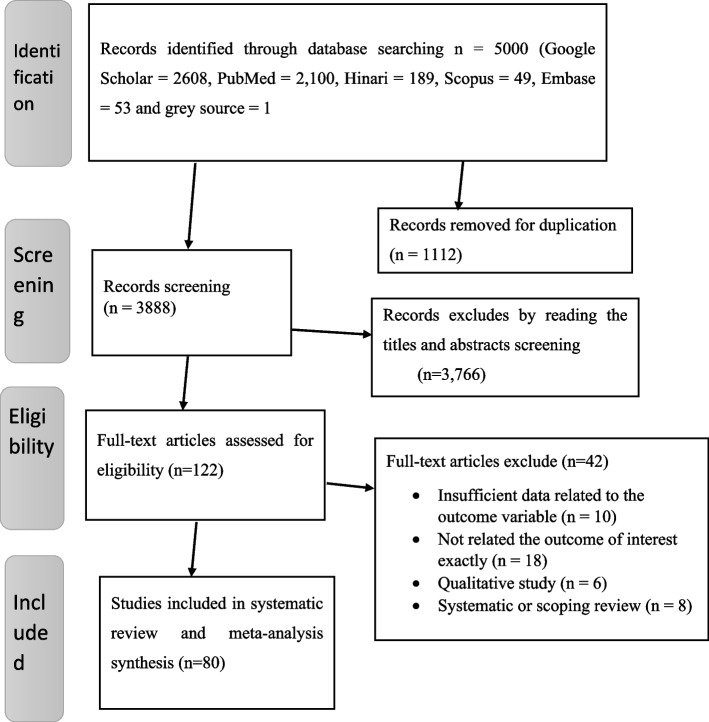
This systematic review followed standard methods and reported as per the Preferred Reporting Items for Systematic Reviews and Meta-Analyses (PRISMA) guidelines. The protocol for this study was registered in the International Prospective Register of Systematic Reviews (PROSPERO) with reference number CRD42024518297. The eligible publications were searched by PubMed, Research4Life, Scopus, EMBASE, and Google Scholar. The data were extracted using Microsoft Excel 2019 and analyzed using Stata software version 17. The methodological quality of the included studies was assessed using the Joanna Briggs Institute's (JBI) Critical Appraisal Checklist. Publication bias was assessed by using the funnel plot and Egger's test. A random-effects model was used to estimate the pooled prevalence of post-abortion family planning. The I test was performed to assess the statistical heterogeneity among the included studies.
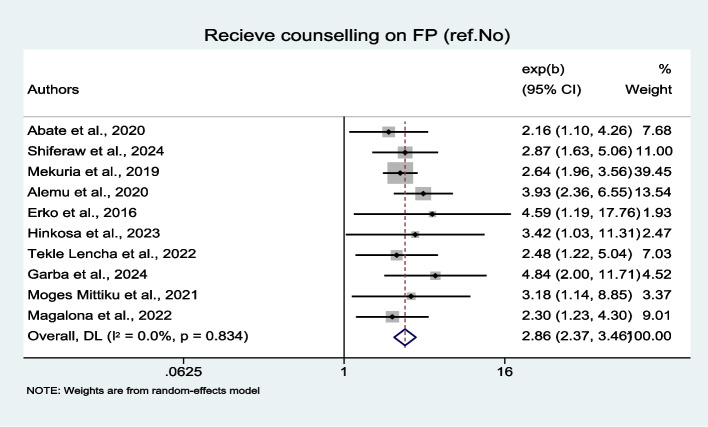
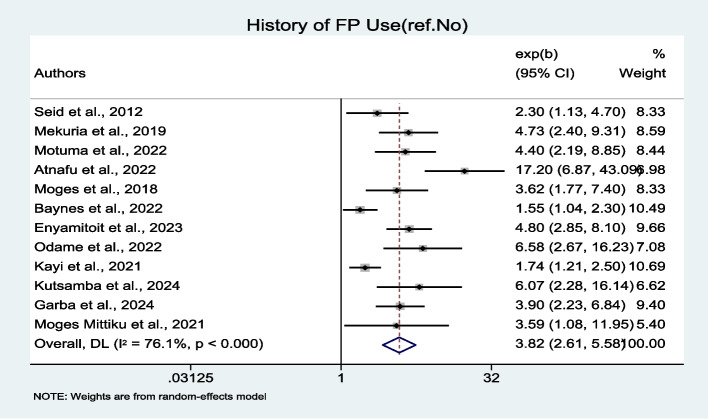
This systematic review and meta-analysis included 80 eligible articles from 16 sub-Saharan African countries, with a total of 248,299 study participants. The pooled prevalence of post-abortion family planning use in sub-Saharan Africa was 60.67% (95% CI 55.61-65.73). In addition, the commonly adopted contraception methods after abortion were injectables, 34.98% (95% CI 27.59, 42.37), followed by 20.71% (95% CI 17.20, 24.22) of oral contraception pills, and 20.38% (95% CI 16.82, 23.94) utilized implants. Women aged 15-24 years (AOR = 3.40, 95% CI 2.12, 5.44), being married (AOR = 2.70, 95% CI 1.68, 4.34), attaining secondary school (AOR = 2.75, 95% CI 1.62, 4.66) and college or above (AOR = 2.92, 95% CI 1.85, 4.62), unplanned pregnancy (AOR = 5.03, 95% CI 2.93, 8.61), having prior history of abortion (AOR = 1.88, 95% CI 1.35, 2.62), having good knowledge about family planning (AOR = 2.86, 95% CI 2.37, 3.46), prior family planning use (AOR = 3.82, 95% CI 2.62, 5.58), positive attitude towards family planning methods (AOR = 2.78, 95% CI 1.81, 4.28), partner support (AOR = 2.32, 95% CI 1.64, 3.30), and received post-abortion family planning counseling (AOR = 2.86, 95% CI 2.37, 3.46) were predictors that significantly associated with contraceptive utilization following abortion.
This meta-analysis indicates that the pooled prevalence of post-abortion contraception use in sub-Saharan Africa remains low. Therefore, appropriate planning and implementation of effective strategies are crucial to scaling up post-abortion family planning use, including improving educational attainment, advocating for post-abortion contraceptive methods, and providing effective post-abortion family planning counseling.
PROSPERO CRD42024518297.
流产后计划生育(PAFP)是指使用现代避孕方法,最好在流产后立即且在流产后48小时内,或在恢复生育能力之前使用。强烈建议在人工流产或自然流产后推迟怀孕至少6个月,以减少不良孕产妇和新生儿结局的发生。在撒哈拉以南非洲(SSA),不安全流产负担和意外怀孕率都很高。此外,该地区关于流产后计划生育使用的患病率和决定因素的研究结果并不一致。
本系统评价遵循标准方法,并按照系统评价和Meta分析的首选报告项目(PRISMA)指南进行报告。本研究方案已在国际前瞻性系统评价注册库(PROSPERO)中注册,注册号为CRD42024518297。通过PubMed、Research4Life、Scopus、EMBASE和谷歌学术搜索符合条件的出版物。使用Microsoft Excel 2019提取数据,并使用Stata软件版本17进行分析。使用乔安娜·布里格斯研究所(JBI)的批判性评价清单评估纳入研究的方法学质量。通过漏斗图和埃格检验评估发表偏倚。使用随机效应模型估计流产后计划生育的合并患病率。进行I检验以评估纳入研究之间的统计异质性。
本系统评价和Meta分析纳入了来自撒哈拉以南非洲16个国家的80篇符合条件的文章,共有248,299名研究参与者。撒哈拉以南非洲流产后计划生育使用的合并患病率为60.67%(95%CI 55.61-65.73)。此外,流产后常用的避孕方法是注射剂,占34.98%(95%CI 27.59,42.37),其次是口服避孕药,占20.71%(95%CI 17.20,24.22),使用植入物的占20.38%(95%CI 16.82,23.94)。15-24岁的女性(调整后比值比[AOR]=3.40,95%CI 2.12,5.44)、已婚女性(AOR=2.70,95%CI 1.68,4.34)、完成中学教育的女性(AOR=2.75,95%CI 1.62,4.66)和大专及以上学历的女性(AOR=2.92,95%CI 1.85,4.62)、意外怀孕(AOR=5.03,95%CI 2.93,8.61)、有流产史(AOR=1.88,95%CI 1.35,2.62)、对计划生育有良好了解(AOR=2.86,95%CI 2.37,3.46)、以前使用过计划生育(AOR=3.82,95%CI 2.62,5.58)、对计划生育方法持积极态度(AOR=2.78,95%CI 1.81,4.28)、伴侣支持(AOR=2.32,95%CI 1.64,3.30)以及接受过流产后计划生育咨询(AOR=2.86,95%CI 2.37,3.46)是与流产后避孕使用显著相关的预测因素。
本Meta分析表明,撒哈拉以南非洲流产后避孕使用的合并患病率仍然较低。因此,适当规划和实施有效策略对于扩大流产后计划生育的使用至关重要,包括提高教育水平、倡导流产后避孕方法以及提供有效的流产后计划生育咨询。
PROSPERO CRD42024518297