Guo Xiaoping, Li Wei, Sun Jing, Ma Yanzhuo
Department of Cardiology, Bethune International Peace Hospital, Shijiazhuang, Hebei, China.
Front Cardiovasc Med. 2025 May 27;12:1561505. doi: 10.3389/fcvm.2025.1561505. eCollection 2025.
Kinesiophobia is prevalent among patients with coronary heart disease (CHD). This study aimed to explore whether psychologically-informed cardiac rehabilitation (CR) could positively influence the reduction of kinesiophobia in CHD patients.
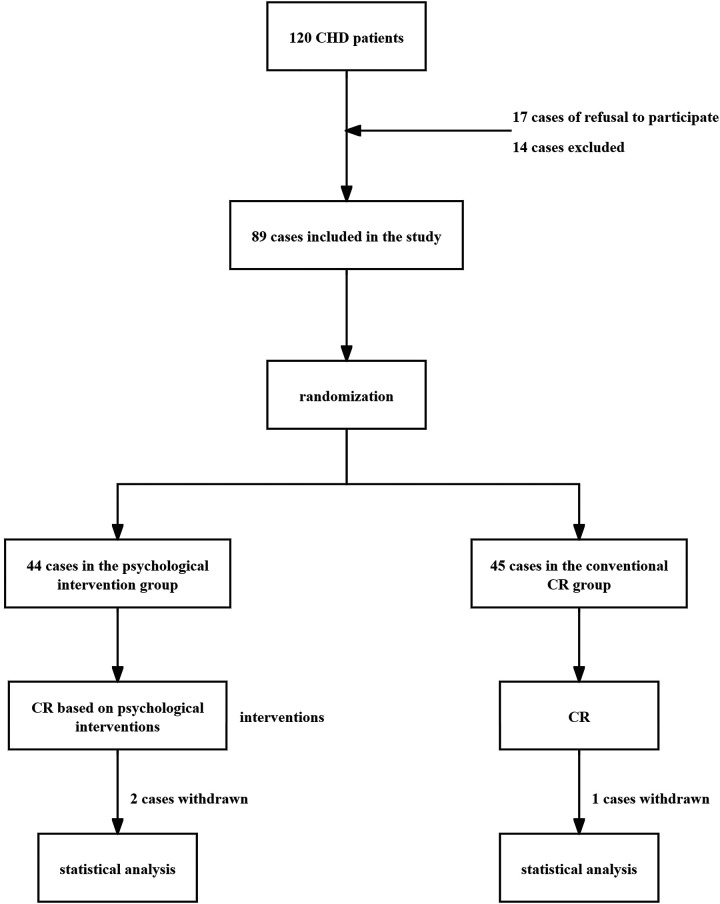
A total of 86 CHD patients, who sought treatment at Bethune International Peace Hospital between June 2022 and June 2023, were selected and divided into two groups: a psychological intervention group comprising 42 patients and a conventional CR group of 44 patients. The conventional CR group received standard CR intervention, whereas the psychological intervention group underwent CR intervention augmented with psychological support. The effectiveness of these interventions was evaluated using the Self-Rating Depression Scale (SDS), the Self-Rating Anxiety Scale (SAS), the Multidimensional Exercise Self-Efficacy Scale (MSES), the TSK-Heart (for assessing kinesiophobia in cardiac patients), and the Short Form Health Survey (SF-36) scores.
Following the intervention, the SDS and SAS scores of the psychological intervention group were higher than those of the conventional CR group. The MSES dimension scores and the total score of the psychological intervention group were elevated in comparison to the CR group. Conversely, the TSK-Heart dimension scores and the total score of the psychological intervention group were diminished relative to the CR group. Additionally, the SF-36 dimension scores and total score of the psychological intervention group surpassed those of the CR group post-intervention.
The integration of psychologically-supported CR into the rehabilitation regimen for CHD patients effectively mitigates negative emotions, enhances self-efficacy, and markedly reduces kinesiophobia, thus significantly improving overall quality of life.
运动恐惧在冠心病(CHD)患者中普遍存在。本研究旨在探讨心理支持的心脏康复(CR)是否能对冠心病患者运动恐惧的减轻产生积极影响。
选取2022年6月至2023年6月在白求恩国际和平医院寻求治疗的86例冠心病患者,分为两组:心理干预组42例,传统CR组44例。传统CR组接受标准CR干预,而心理干预组在CR干预的基础上增加心理支持。采用自评抑郁量表(SDS)、自评焦虑量表(SAS)、多维运动自我效能量表(MSES)、TSK-Heart(用于评估心脏病患者的运动恐惧)和简短健康调查问卷(SF-36)评分来评估这些干预措施的效果。
干预后,心理干预组的SDS和SAS评分高于传统CR组。与CR组相比,心理干预组的MSES维度评分和总分有所提高。相反,心理干预组的TSK-Heart维度评分和总分相对于CR组有所降低。此外,干预后心理干预组的SF-36维度评分和总分超过了CR组。
将心理支持的CR纳入冠心病患者的康复方案可有效减轻负面情绪,增强自我效能,并显著降低运动恐惧,从而显著提高总体生活质量。