Liu Muxing, Guo Ziqian, Hu Jiexiong, Chen Yuke, Chen Fang, Chen Weizhong, Wang Wenya, Ye Boyang, Yang Zhixiang, Li Gang, Liu Xinyu, Zhang Haifeng, Wang Ping, Zhang Zhengguang
Sanya Institute of Nanjing Agricultural University, Department of Plant Pathology, College of Plant Protection, Nanjing Agricultural University, and Key Laboratory of Integrated Management of Crop Diseases and Pests, Ministry of Education, Nanjing 210095, China.
Department of Microbiology, Immunology, and Parasitology, Louisiana State University Health Sciences Center, New Orleans, LA 70112, USA.
Plant Cell. 2025 Jul 1;37(7). doi: 10.1093/plcell/koaf146.
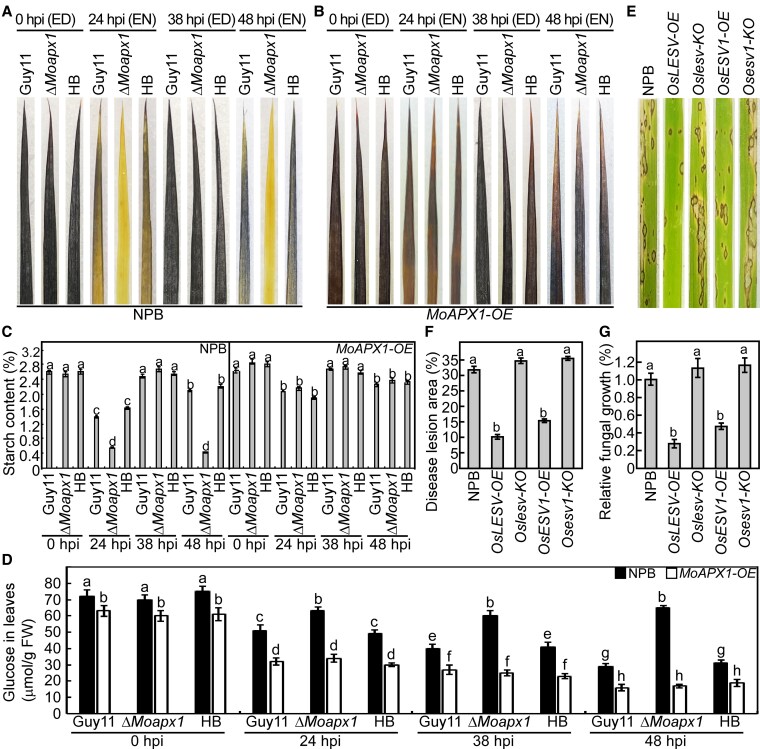
Fungi secrete effector proteins, including extracellular redox enzymes, to inhibit host immunity. Redox enzymes have been hypothesized to inhibit host reactive oxygen species (ROS); however, how they suppress host immunity remains unknown. We characterized an extracellular ascorbate peroxidase (MoApx1) that is secreted into rice chloroplasts by the rice blast fungus Magnaporthe oryzae. MoApx1 displays multifunctional capabilities that significantly contribute to fungal virulence. Firstly, MoApx1 neutralizes host-derived H2O2 within the chloroplast through its peroxidase activity, thereby inhibiting chloroplast ROS (cROS)-mediated defense responses. Secondly, MoApx1 targets the photosystem I subunit OsPsaD, disrupting photosynthetic electron transport to further suppress cROS production. Most importantly, MoApx1 has evolved a fungal-specific starch-binding domain that binds host starch, inhibiting its degradation and disrupting the energy supply required for host resistance. Our findings underscore the importance of a novel multifaceted strategy, potentially widely employed by other fungal pathogens, in suppressing host immunity during host-microbe interactions.
真菌分泌效应蛋白,包括细胞外氧化还原酶,以抑制宿主免疫。氧化还原酶被推测可抑制宿主活性氧(ROS);然而,它们如何抑制宿主免疫仍不清楚。我们鉴定了一种细胞外抗坏血酸过氧化物酶(MoApx1),它由稻瘟病菌Magnaporthe oryzae分泌到水稻叶绿体中。MoApx1具有多种功能,对真菌毒力有显著贡献。首先,MoApx1通过其过氧化物酶活性中和叶绿体中宿主来源的H2O2,从而抑制叶绿体ROS(cROS)介导的防御反应。其次,MoApx1靶向光系统I亚基OsPsaD,破坏光合电子传递以进一步抑制cROS产生。最重要的是,MoApx1进化出了一个真菌特异性淀粉结合结构域,该结构域结合宿主淀粉,抑制其降解并破坏宿主抗性所需的能量供应。我们的研究结果强调了一种新的多方面策略的重要性,这种策略可能被其他真菌病原体广泛采用,以在宿主-微生物相互作用过程中抑制宿主免疫。