Toczydlowski Rachel H, Brennan Reid S, Crandall Eric D, Kelley Joanna L, Pringle James M, Riginos Cynthia, Wares John P, Bradburd Gideon S
Northern Research Station, United States Forest Service, Rhinelander, WI, 54501, U.S.
Marine Evolutionary Ecology, GEOMAR Helmholtz Centre for Ocean Research Kiel, Kiel, 24105, Germany.
bioRxiv. 2025 Jun 6:2025.06.03.657718. doi: 10.1101/2025.06.03.657718.
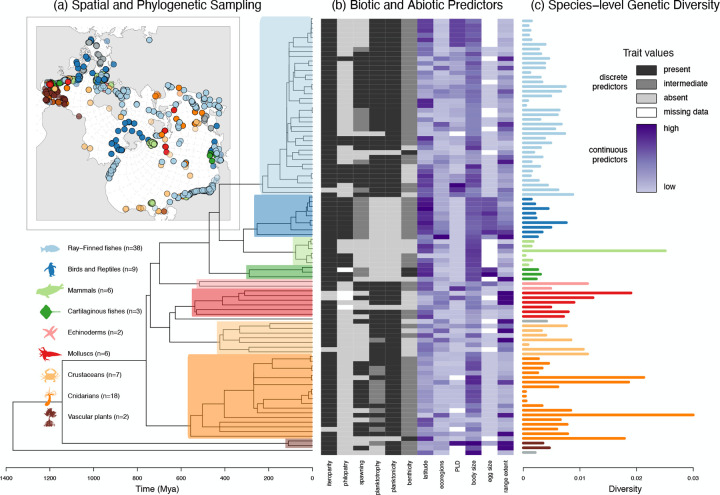
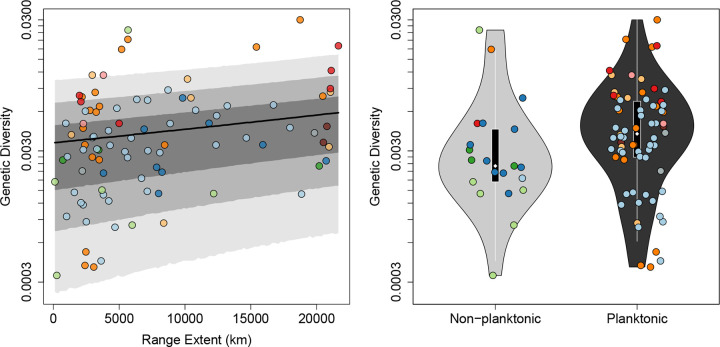
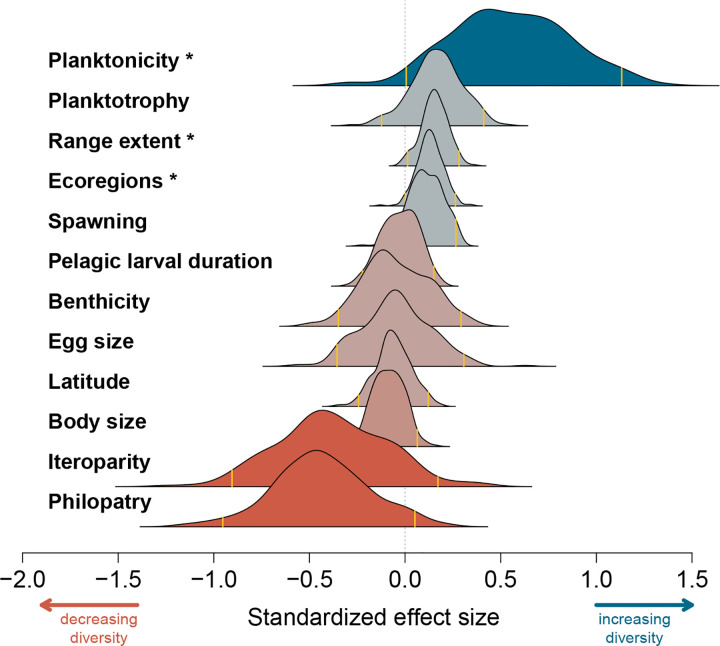
Why do some species have more genetic diversity than others? This question is one of the greatest remaining mysteries in evolutionary biology, and is particularly urgent in marine species, which are experiencing catastrophic anthropogenic impacts. We address this critical gap by estimating genetic diversity for 93 marine species sampled over 9,000 localities. For each species, we aggregate biotic traits and abiotic geographic data for their ranges. We show that diversity increases with range extent and planktonic dispersal. We hypothesize that these traits increase a species' ability to avoid or recover from bottlenecks, thereby maintaining diversity. Our findings provide insights into the factors interacting to shape genomic variation in the ocean, and offer a predictive framework for understanding marine biodiversity in the face of global change.
为什么有些物种比其他物种具有更多的遗传多样性?这个问题是进化生物学中现存最大的谜团之一,对于正遭受灾难性人为影响的海洋物种而言尤为紧迫。我们通过估算在9000多个地点采样的93种海洋物种的遗传多样性,来填补这一关键空白。对于每个物种,我们汇总其分布范围内的生物特征和非生物地理数据。我们发现,多样性随着分布范围和浮游扩散而增加。我们推测,这些特征增强了物种避免瓶颈效应或从瓶颈效应中恢复的能力,从而维持了多样性。我们的研究结果为影响海洋基因组变异的相互作用因素提供了见解,并为面对全球变化理解海洋生物多样性提供了一个预测框架。