Ben Sassi Mehdi, Azais Henri, Marcaillou Charles, Guibert Sylvain, Martin Emmanuel, Alexandre Jérôme, Benoit Louise, de Reynies Aurélien, Laude Emilie, Duong Cam, Medioni Jacques, Borghese Bruno, Bats Anne-Sophie, Taly Valerie, Laurent-Puig Pierre
Centre de Recherche des Cordeliers, INSERM UMRS1138, CNRS SNC 5096, Sorbonne Université, Université Paris Cité, Paris, France.
IntegraGen SA, Evry, France.
J Exp Clin Cancer Res. 2025 Jun 12;44(1):174. doi: 10.1186/s13046-025-03433-4.
Epithelial ovarian cancer (EOC) is a leading cause of cancer mortality in women, often diagnosed at advanced stages. While first-line treatments improve survival, relapses remain common, with 5-year survival rates below 40%. Circulating tumor DNA (ctDNA) is a promising biomarker for non-invasive EOC detection and monitoring. It may help assess treatment response, notably microscopic residual disease. Our objective was to compare two ctDNA characterization strategies in EOC for assessing tumor burden during first-line treatment: a tumor-informed approach based on somatic mutations and a tumor-type informed approach utilizing DNA methylation patterns.
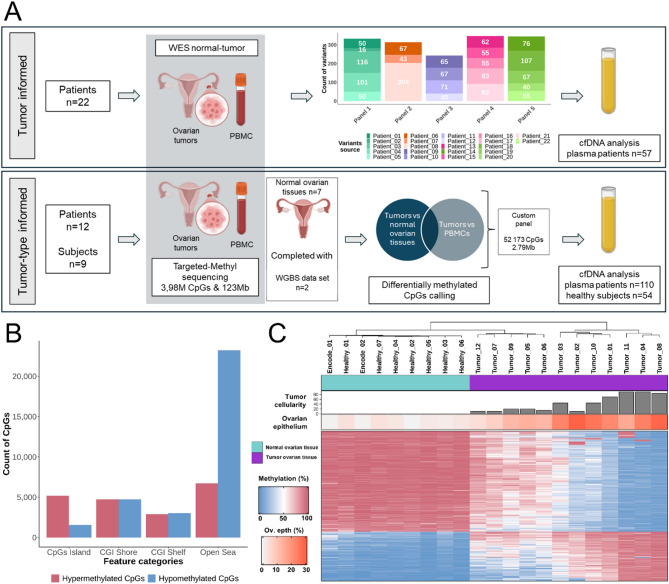
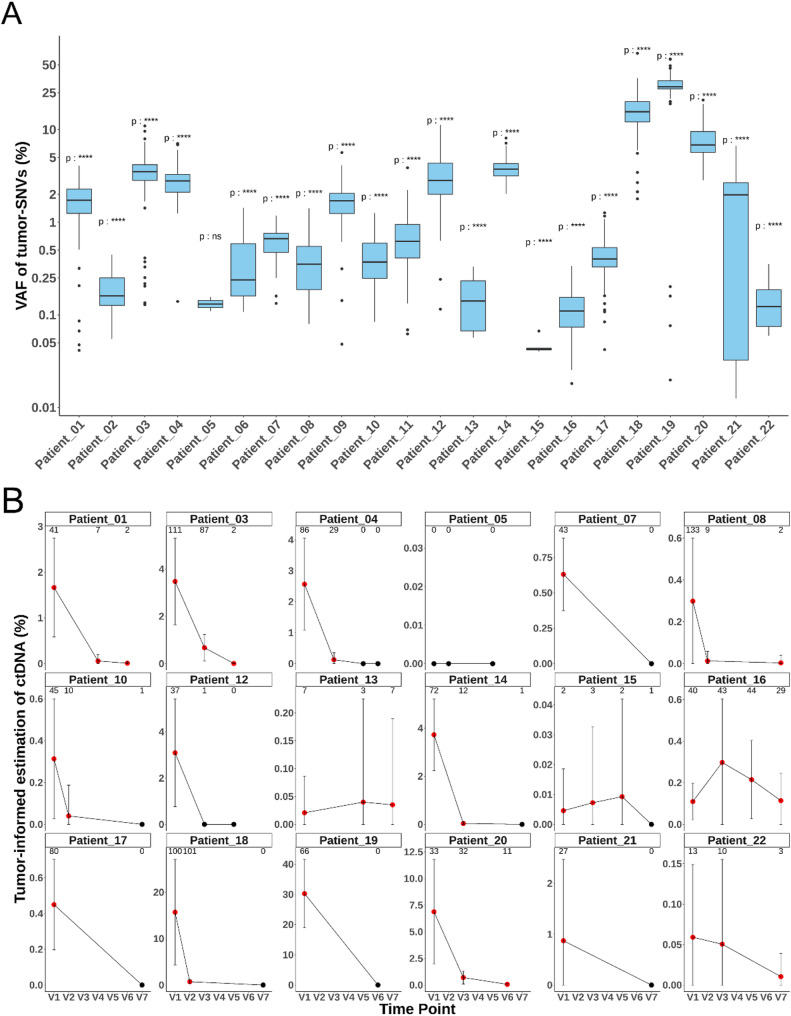
In the tumor-informed approach, whole exome sequencing (WES) was performed on EOC tumor DNA and matched PBMCs from 22 patients to identify tumor-specific mutations. Personalized panels were then designed to track these mutations in plasma cfDNA. In the tumor-type informed approach, differentially methylated loci (DMLs) were identified by comparing EOC samples, healthy ovarian tissues, and PBMCs. A unique custom methylation panel was designed, and a support vector machine classifier was trained to distinguish between methylation profiles in plasma cfDNA from healthy donors and from EOC patients. Plasma samples from 47 advanced-stage EOC patients receiving chemotherapy and 54 healthy subjects were analyzed.
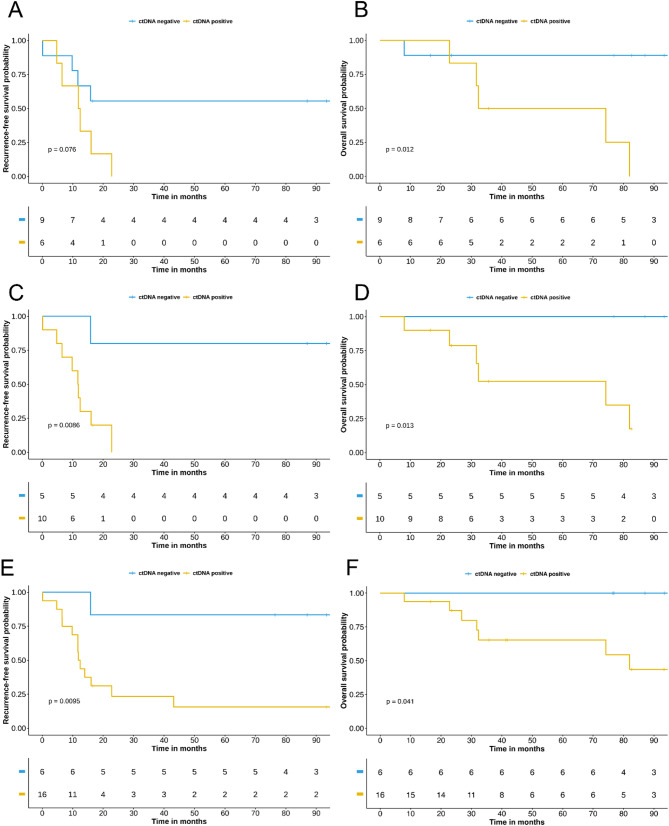
For the tumor-informed approach, WES identified an average of 72 somatic mutations per patient. For the tumor-type informed approach, 52,173 DMLs were identified as tumor-specific markers. In 47 plasma samples tested by both approaches, ctDNA levels were significantly correlated (R = 0.56, p = 4.3 × 10), with 70.2% concordance in detection. At baseline, ctDNA was detected in 21/22 patients with the tumor-informed approach, and in 11/12 non-training baseline samples with the tumor-type-informed classifier. At end-of-treatment, the latter detected ctDNA in 16/22 samples, outperforming the former. Detection using this more sensitive approach was significantly associated with relapse (log-rank p = 0.009; hazard ratio = 9.44; 95% CI 1.22-73.26) and poorer overall survival (log-rank p = 0.041).
The tumor-type informed classifier demonstrated sensitivity and specificity for ctDNA detection, outperforming the tumor-informed approach in monitoring EOC progression. Requiring fewer sequencing data, it offers a practical, efficient solution for clinical management of EOC.
上皮性卵巢癌(EOC)是女性癌症死亡的主要原因,通常在晚期才被诊断出来。虽然一线治疗可提高生存率,但复发仍很常见,5年生存率低于40%。循环肿瘤DNA(ctDNA)是一种有前景的生物标志物,可用于EOC的非侵入性检测和监测。它可能有助于评估治疗反应,特别是微小残留病。我们的目标是比较EOC中两种ctDNA特征分析策略,以评估一线治疗期间的肿瘤负荷:一种基于体细胞突变的肿瘤知情方法和一种利用DNA甲基化模式的肿瘤类型知情方法。
在肿瘤知情方法中,对22例患者的EOC肿瘤DNA和匹配的外周血单核细胞(PBMC)进行全外显子测序(WES),以识别肿瘤特异性突变。然后设计个性化检测板,以追踪血浆游离DNA(cfDNA)中的这些突变。在肿瘤类型知情方法中,通过比较EOC样本、健康卵巢组织和PBMC,识别差异甲基化位点(DML)。设计了一个独特的定制甲基化检测板,并训练了一个支持向量机分类器,以区分健康供体和EOC患者血浆cfDNA中的甲基化谱。分析了47例接受化疗的晚期EOC患者和54例健康受试者的血浆样本。
对于肿瘤知情方法,WES平均每位患者识别出72个体细胞突变。对于肿瘤类型知情方法,52173个DML被识别为肿瘤特异性标志物。在两种方法检测的47份血浆样本中,ctDNA水平显著相关(R = 0.56,p = 4.3×10),检测一致性为70.2%。在基线时,肿瘤知情方法在21/22例患者中检测到ctDNA,肿瘤类型知情分类器在11/12例非训练基线样本中检测到ctDNA。在治疗结束时,后者在16/22份样本中检测到ctDNA,优于前者。使用这种更敏感方法的检测与复发显著相关(对数秩检验p = 0.009;风险比 = 9.44;95%可信区间1.22 - 73.26)和较差的总生存期(对数秩检验p = 0.041)。
肿瘤类型知情分类器在ctDNA检测中表现出敏感性和特异性,在监测EOC进展方面优于肿瘤知情方法。由于所需的测序数据较少,它为EOC的临床管理提供了一种实用、高效的解决方案。