Javed Saba, Lam Loc, Nwankwo Angela, Komachkov Zaur
Department of Pain Management, University of Texas MD Anderson Cancer Center, Houston, TX 77030, USA.
H. Ben Taub Department of Physical Medicine and Rehabilitation, Baylor College of Medicine, Houston, TX 77030, USA.
J Clin Med. 2025 Jun 4;14(11):3964. doi: 10.3390/jcm14113964.
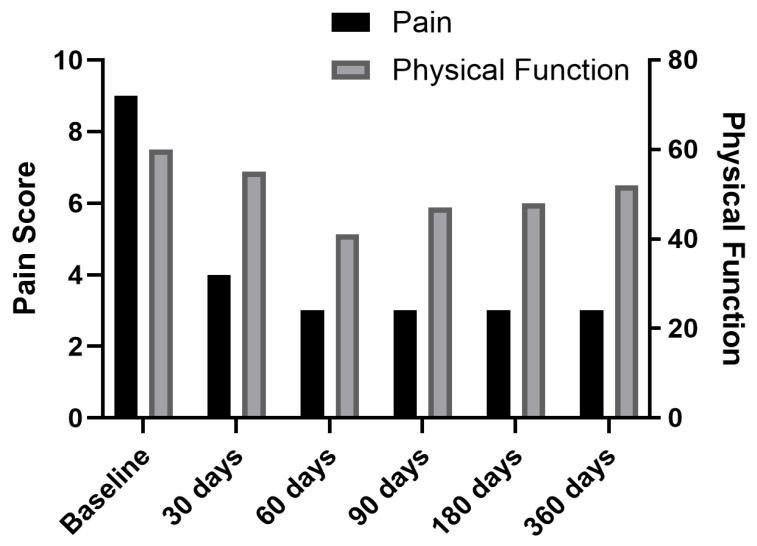
This study evaluated peripheral nerve stimulation (PNS) as a treatment for vertebra plana fractures, focusing on its impact on pain intensity, physical function, anxiety, depression, fatigue, social role participation, and pain interference. The goal was to assess whether PNS could serve as a minimally invasive alternative for managing pain in patients with severe vertebral fractures. Four patients with lumbar vertebra plana fractures received PNS implants for 60 days. Pain scores and PROMIS-29 domains (physical function, anxiety, depression, fatigue, social participation, and pain interference) were assessed at 30, 60, 90, 180, and 365 days post-implantation. Data analysis included mean and standard deviation calculations. PNS led to marked improvements in pain-related outcomes. The average pain intensity scores dropped from 8.5 at baseline to 4.25 at one year, and pain interference scores declined from 61.75 to 54.75. Physical function initially decreased but improved from 38.5 at three months to 46.75 at one year. Changes in depression, anxiety, fatigue, and social participation were minimal, reflecting their multifactorial nature and limited response to pain relief alone. This case series suggests that PNS may significantly reduce pain and pain interference while enhancing physical function in patients with vertebra plana fractures. Its sustained benefits highlight PNS as a promising minimally invasive treatment, especially for those ineligible for traditional procedures. However, the limited improvement in psychological and social domains underscores the need for comprehensive care strategies. Further research is warranted to explore the broader role of PNS in managing vertebral fracture pain.
本研究评估了外周神经刺激(PNS)作为椎体扁平骨折治疗方法的效果,重点关注其对疼痛强度、身体功能、焦虑、抑郁、疲劳、社会角色参与和疼痛干扰的影响。目的是评估PNS是否可作为治疗严重椎体骨折患者疼痛的微创替代方法。4例腰椎椎体扁平骨折患者接受了60天的PNS植入。在植入后30、60、90、180和365天评估疼痛评分和PROMIS-29领域(身体功能、焦虑、抑郁、疲劳、社会参与和疼痛干扰)。数据分析包括均值和标准差计算。PNS使与疼痛相关的结果有显著改善。平均疼痛强度评分从基线时的8.5降至一年时的4.25,疼痛干扰评分从61.75降至54.75。身体功能最初下降,但从三个月时的38.5改善至一年时的46.75。抑郁、焦虑、疲劳和社会参与方面的变化最小,这反映了它们的多因素性质以及仅靠缓解疼痛的有限反应。该病例系列表明,PNS可能显著减轻椎体扁平骨折患者的疼痛和疼痛干扰,同时增强身体功能。其持续的益处凸显PNS作为一种有前景的微创治疗方法,特别是对于那些不适合传统手术的患者。然而,心理和社会领域改善有限凸显了全面护理策略的必要性。有必要进一步研究以探索PNS在管理椎体骨折疼痛方面的更广泛作用。