Yang Fan, Mao Ying, Huang Hanyu, Luo Wen, Liu Li, Chen Wenzhi
State Key Laboratory of Ultrasound in Medicine and Engineering, College of Biomedical Engineering, Chongqing Medical University, Chongqing, China.
Department of Oncology, Suining Central Hospital, Suining, China.
Front Immunol. 2025 May 29;16:1579293. doi: 10.3389/fimmu.2025.1579293. eCollection 2025.
The efficacy of regorafenib or fruquintinib in combination with PD-1/PD-L1 inhibitors for metastatic colorectal cancer (mCRC) treatment has not been elucidated. This study aims to systematically evaluate the efficacy and safety of this combination therapy.
PubMed, Embase, Cochrane Library, and Web of Science were systematically retrieved until July 24, 2024. A meta-analysis was carried out for the overall objective response rate (ORR), disease control rate (DCR), progression-free survival (PFS), overall survival (OS), and the incidence of grade 3 or higher treatment-related adverse events (AEs). Non-overlapping 95% confidence intervals (CIs) were considered statistically significant.
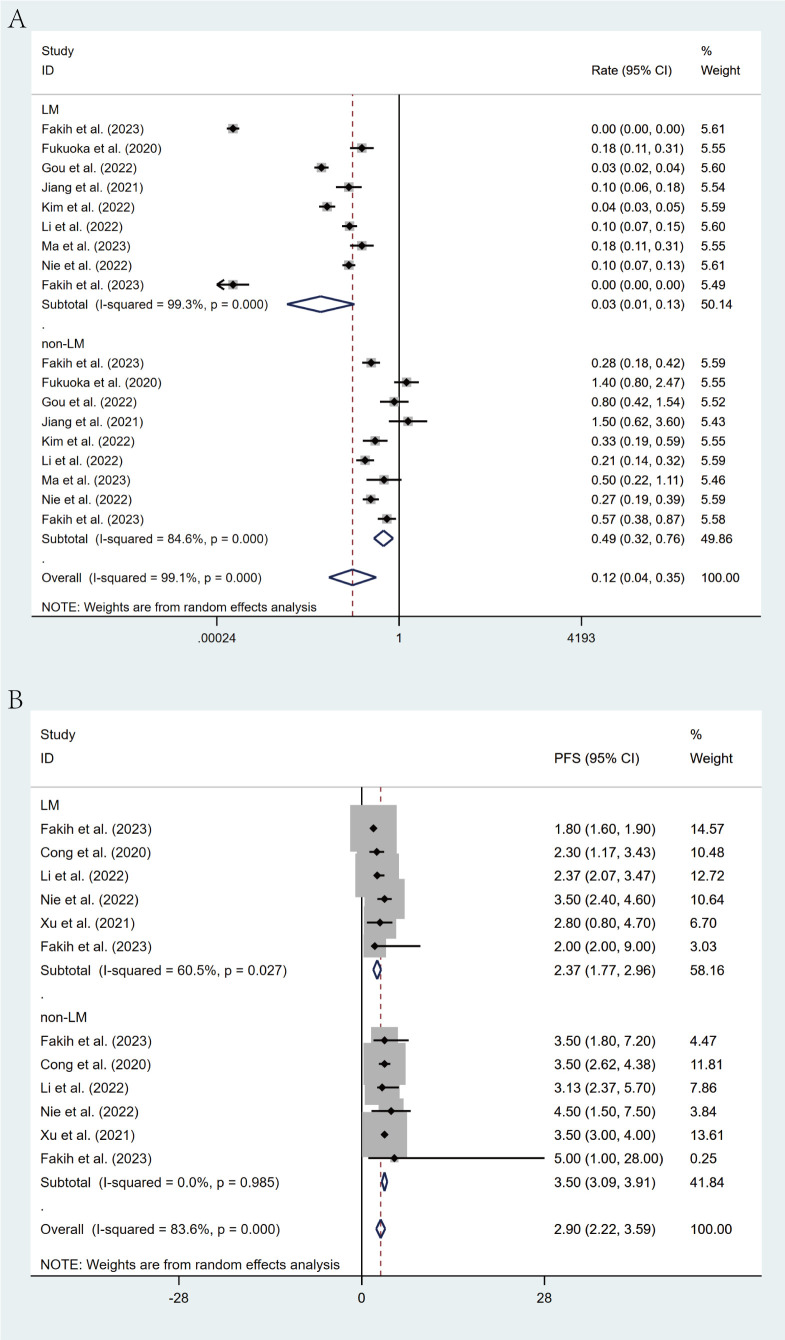
26 studies encompassing 1,409 patients were analyzed. Pooled analysis revealed an ORR of 6% (95% CI: 3%-12%), a DCR of 62% (95% CI: 55%-68%), a median PFS of 3.84 months (95% CI: 3.19-4.49 months), a median OS of 13.08 months (95% CI: 10.17-16.00 months), and an incidence rate of grade 3-4 AEs of 21% (95% CI: 15%-28%). In subgroup analyses, the fruquintinib-based regimen demonstrated significantly superior efficacy compared to regorafenib-based therapy, with higher ORR (16% [95% CI: 13%-21%] vs 3% [95% CI: 1%-9%]), DCR (79% [95% CI: 72%-85%] vs 54% [95% CI: 47%-61%]), and median PFS (5.40 months [95% CI: 4.60-6.19] vs 3.00 months [95% CI: 2.47-3.52]). Median OS was numerically but not significantly longer with fruquintinib (14.35 months [95% CI: 10.68-18.02] vs 12.70 months [95% CI: 8.79-16.61]). Liver metastasis status strongly influenced outcomes, with significantly lower ORR (3% [95% CI: 1%-13%] vs 49% [95% CI: 32%-76%]) and shorter median PFS (2.37 months [95% CI: 1.77-2.96] vs 3.50 months [95% CI: 3.09-3.91]) in patients with liver involvement.
The combination of regorafenib or fruquintinib with PD-1/PD-L1 shows moderate efficacy and acceptable safety in the treatment of mCRC. The fruquintinib-based regimen may be superior to the regorafenib-based regimen, and patients without liver metastasis may derive greater benefits. These findings offer new insights for treating mCRC, although they should be validated through large randomized controlled trials.
https://www.crd.york.ac.uk/PROSPERO, identifier CRD42024582268.
瑞戈非尼或呋喹替尼联合PD-1/PD-L1抑制剂治疗转移性结直肠癌(mCRC)的疗效尚未阐明。本研究旨在系统评价这种联合治疗的疗效和安全性。
系统检索PubMed、Embase、Cochrane图书馆和Web of Science直至2024年7月24日。对总客观缓解率(ORR)、疾病控制率(DCR)、无进展生存期(PFS)、总生存期(OS)以及3级或更高等级治疗相关不良事件(AE)的发生率进行荟萃分析。非重叠的95%置信区间(CI)被认为具有统计学意义。
分析了26项研究,共1409例患者。汇总分析显示,ORR为6%(95%CI:3%-12%),DCR为62%(95%CI:55%-68%),中位PFS为3.84个月(95%CI:3.19-4.49个月),中位OS为13.08个月(95%CI:10.17-16.00个月),3-4级AE的发生率为21%(95%CI:15%-28%)。在亚组分析中,基于呋喹替尼的方案与基于瑞戈非尼的方案相比显示出显著更高的疗效,ORR更高(16%[95%CI:13%-21%]对3%[95%CI:1%-9%]),DCR更高(79%[95%CI:72%-85%]对54%[95%CI:47%-61%]),中位PFS更长(5.40个月[95%CI:4.60-6.19]对3.00个月[95%CI:2.47-3.52])。基于呋喹替尼的方案的中位OS在数值上更长,但无显著差异(14.35个月[95%CI:10.68-18.02]对12.70个月[95%CI:8.79-16.61])。肝转移状态对结果有强烈影响,有肝转移的患者ORR显著更低(3%[95%CI:1%-13%]对49%[95%CI:32%-76%]),中位PFS更短(2.37个月[95%CI:1.77-2.96]对3.50个月[95%CI:3.09-3.91])。
瑞戈非尼或呋喹替尼联合PD-1/PD-L1在mCRC治疗中显示出中等疗效和可接受的安全性。基于呋喹替尼的方案可能优于基于瑞戈非尼的方案,且无肝转移的患者可能获益更大。这些发现为mCRC的治疗提供了新的见解,尽管它们应通过大型随机对照试验进行验证。