Liu Ying, Ye Wei, Mattke Soeren
The USC Brain Health Observatory, University of Southern California, Los Angeles, California, United States.
Gerontologist. 2025 Aug 4;65(8). doi: 10.1093/geront/gnaf150.
Older adults caring for people with dementia experience substantial burden and bear higher risk of cognitive decline themselves. Little is known on their uptake of cognitive screening.
Between December 19, 2023, and February 28, 2024, US residents aged 65+ from a nationally representative, probability-based internet panel were surveyed on their experience with cognitive screening in the past 12 months. Self-reported caregiving status, including the health conditions of the care recipients, was collected between 2011 and 2023. Multivariable logistic regression examined the association between the probability of taking a cognitive test and the caregiver status (dementia caregiver, non-dementia caregiver, or non--caregiver), after accounting for the demographics, whether having subjective memory concerns, and whether having a usual source of care.
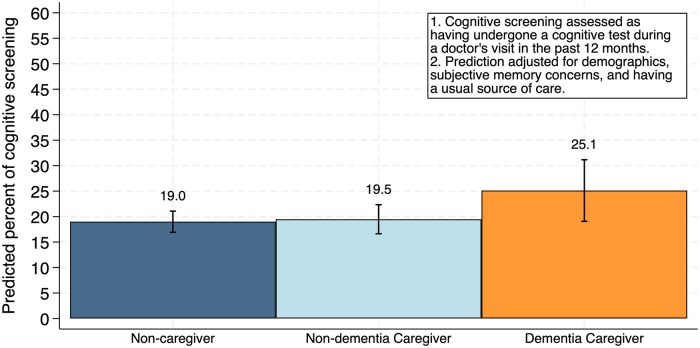
Among the 2,272 participants (74% of eligibles), 19.7% reported having undergone a cognitive test during a doctor's visit: 25.2% of dementia caregivers, 19.2% of non-dementia caregivers, and 19.1% of non-caregivers. After regression adjustment, dementia caregivers had a 6 percentage points higher rate of screening (adjusted odds ratio [AOR] = 1.44, 95% CI = 1.01, 2.07), whereas no difference was found between non-dementia caregivers and non-caregivers (AOR = 1.03, 95% CI = 0.82, 1.30).
This study provides evidence that older dementia caregivers are significantly but only marginally more likely to undergo cognitive screening than their non-dementia caregiver and non-caregiver counterparts, despite their increased risk of cognitive impairment. These findings call for attention to this potential gap in care, and interventions to address the barriers faced by older dementia caregivers.
照顾痴呆症患者的老年人承受着巨大的负担,自身认知能力下降的风险也更高。关于他们接受认知筛查的情况,人们了解甚少。
在2023年12月19日至2024年2月28日期间,对来自全国代表性、基于概率的互联网小组的65岁及以上美国居民进行了调查,了解他们在过去12个月内的认知筛查经历。在2011年至2023年期间收集了自我报告的护理状况,包括受护理者的健康状况。在考虑了人口统计学因素、是否有主观记忆问题以及是否有固定的护理来源后,多变量逻辑回归分析研究了进行认知测试的概率与护理者状况(痴呆症护理者、非痴呆症护理者或非护理者)之间的关联。
在2272名参与者(占符合条件者的74%)中,19.7%报告在看医生时接受过认知测试:痴呆症护理者中有25.2%,非痴呆症护理者中有19.2%,非护理者中有19.1%。经过回归调整后,痴呆症护理者的筛查率高出6个百分点(调整后的优势比[AOR]=1.44,95%置信区间[CI]=1.01,2.07),而非痴呆症护理者和非护理者之间没有差异(AOR=1.03,95%CI=0.82,1.30)。
本研究提供的证据表明,尽管老年痴呆症护理者认知障碍风险增加,但与非痴呆症护理者和非护理者相比,他们接受认知筛查的可能性仅略高。这些发现呼吁关注这一潜在的护理差距,并采取干预措施解决老年痴呆症护理者面临的障碍。