Salmerón-Campillo Rosa M, Diaz-Guirado Jose A, Martinez-Ros Gines, Jaskulski Mateusz, López-Gil Norberto
Grupo de Ciencias de La Visión (CiViUM), Facultad de Óptica y Optometría, Universidad de Murcia, Murcia, Spain; Visionapp Solutions S.L., Murcia, Spain.
Visionapp Solutions S.L., Murcia, Spain.
J Optom. 2025 Jun 13;18(3):100561. doi: 10.1016/j.optom.2025.100561.
To evaluate the viability and accuracy of a mobile application (app) for subjective measurement of presbyopic addition, comparing its performance with standard clinical methods.
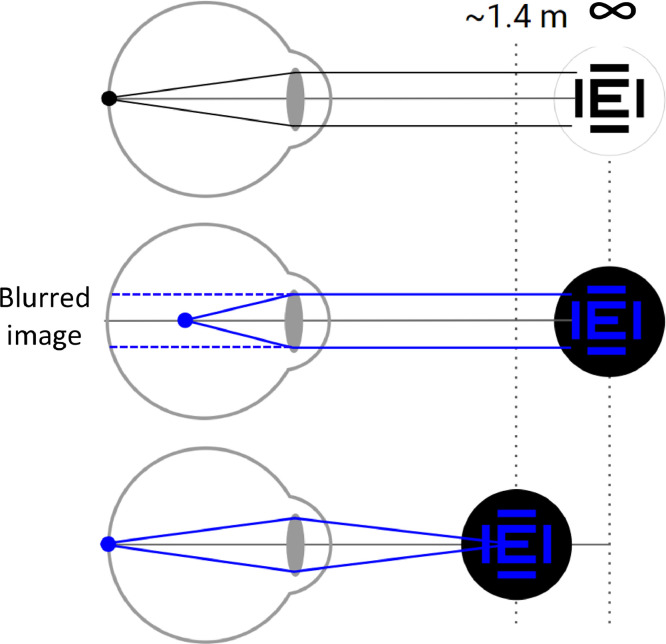
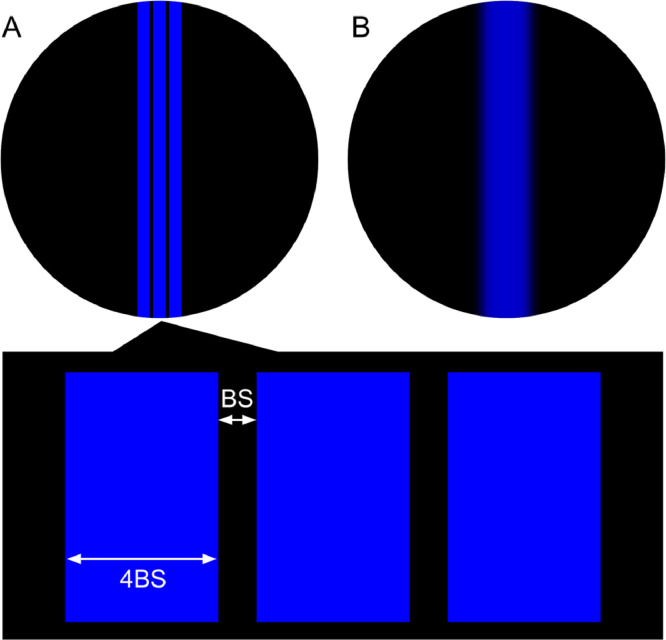
Twenty presbyopic subjects (aged 52 to 64) participated in the study. Clinical measurements of sphero-cylindrical refraction and its correction was achieved using trial lenses. Addition was also clinically measured using a standard and a tentative method. A set of 12 trial lenses ranging from 0 to 2.75 D were randomly put on top of the far distance correction, generating the correction addition correction or different levels of under/over correction of the addition. Participants then used a smartphone-based app to subjectively determine binocularly their near point (NP) using a push-up method while looking at a blue stimulus that rescaled as a function of the face-device distance measured using the front camera of the device. For each induced level of under/over correction of the addition, participants completed three measurements of their near point.
Linear regression analysis showed a strong correlation (R² = 0.82) between app-measured and clinical addition values. Bland-Altman analysis revealed a mean over estimation of -0.22± 0.38 D with a limit of agreement of ±0.74 D of the near correction. Cumulative error analysis indicated that 61.7 % of app measurements were within 0.25 D of clinical values, and 82.5 % within 0.50 D CONCLUSIONS: A smartphone-based subjective measurement of presbyopic addition can potentially be used to assess the addition needed to detect the under or over corrected addition in full presbyopic subjects.
评估一款用于主观测量老视附加光度的移动应用程序(app)的可行性和准确性,并将其性能与标准临床方法进行比较。
20名老视受试者(年龄52至64岁)参与了该研究。使用试镜进行球柱面屈光及其矫正的临床测量。还使用标准方法和一种试验方法临床测量附加光度。一组12个度数范围从0到2.75 D的试镜被随机放置在远距矫正镜片之上,产生附加光度的矫正或不同程度的附加光度欠矫/过矫。参与者随后使用一款基于智能手机的应用程序,通过上推法主观双眼确定其近点(NP),同时观看一个蓝色刺激物,该刺激物会根据使用设备前置摄像头测量的面部与设备距离进行重新缩放。对于每个诱导的附加光度欠矫/过矫水平,参与者完成三次近点测量。
线性回归分析显示,应用程序测量的附加光度值与临床测量值之间存在强相关性(R² = 0.82)。Bland-Altman分析显示,近矫正的平均高估为-0.22±0.38 D,一致性界限为±0.74 D。累积误差分析表明,61.7%的应用程序测量值在临床值的0.25 D范围内,82.5%在0.50 D范围内。结论:基于智能手机的老视附加光度主观测量有可能用于评估全老视受试者中检测附加光度欠矫或过矫所需的附加光度。