Day Zoe I, Roberts-Thomson Samuel, Nouri Yasmin J, Dalton Nathan S, Wang Stacie S, Davenport Alexander, Ludlow Louise E, Hulett Mark D, Cross Ryan S, Jenkins Misty R
The Walter and Eliza Hall Institute of Medical Research, Parkville, VIC, Australia.
Department of Biochemistry and Chemistry, School of Agriculture, Biomedicine and Environment, La Trobe Institute for Molecular Science, La Trobe University, Bundoora, VIC, Australia.
NPJ Precis Oncol. 2025 Jun 14;9(1):184. doi: 10.1038/s41698-025-00956-z.
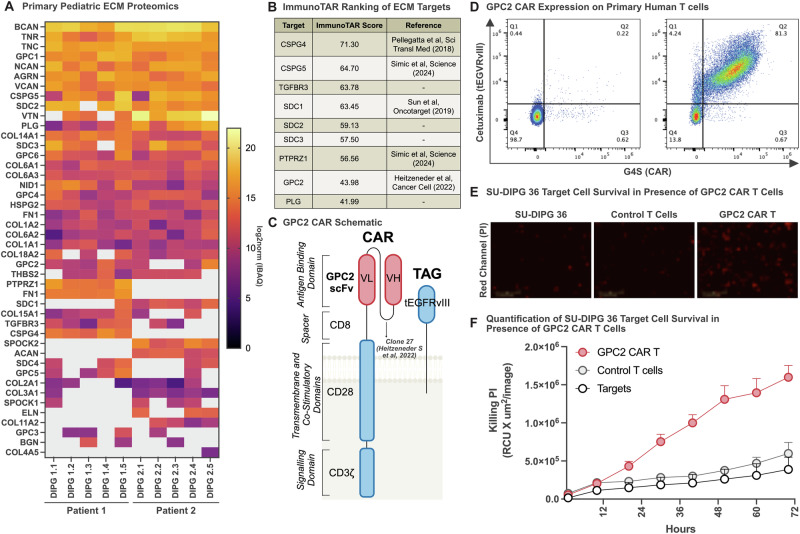
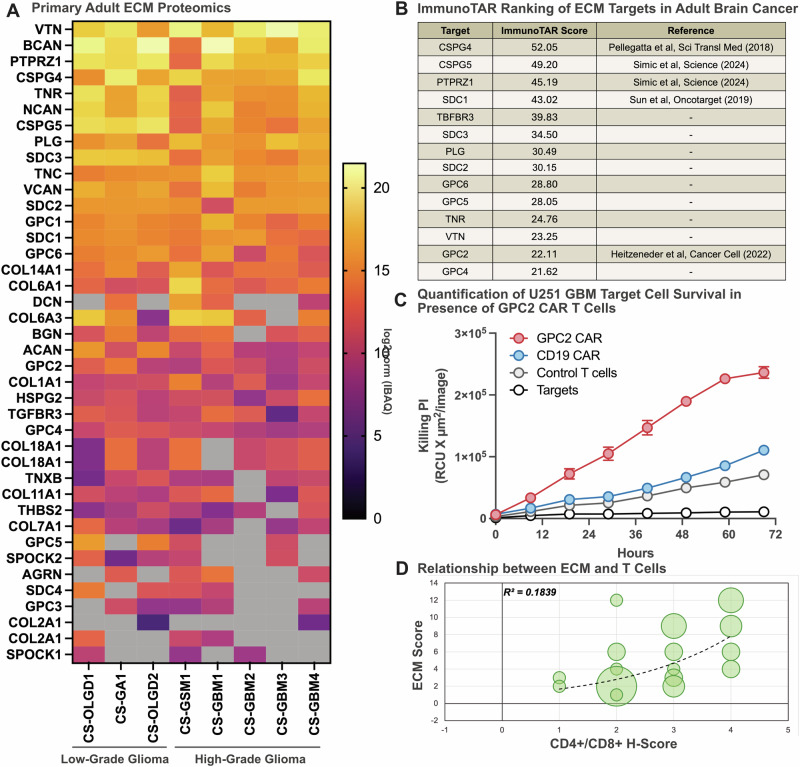
High-grade gliomas (HGGs), including glioblastoma (GBM) and pediatric diffuse midline gliomas (DMGs), remain highly fatal despite therapeutic advances. The tumor microenvironment (TME), particularly the extracellular matrix (ECM), plays a crucial role in tumor progression, immune exclusion, and drug resistance. We performed a comprehensive proteomic, transcriptomic, and pathological characterization of the ECM in primary adult and pediatric HGGs. Using cell surface proteomics, TCGA transcriptomics, and immunohistochemistry, we identified key ECM components influencing immune infiltration. We integrated these findings into ImmunoTar, a computational model prioritizing immunotherapeutic targets. Our study presents the first in-depth cell surface proteomic landscape of HGG ECM, identifying CSPG4/5, PTPRZ1, SDC1, TGFBR3, PLG, and GPC2 as key targets. We validate ECM-targeted CAR T cell therapy, including Glypican-2 (GPC2), which shows strong efficacy against pediatric DIPG. These findings highlight ECM-focused immunotherapy as a promising strategy to overcome HGGs' immunosuppressive TME, particularly in pediatric patients.
高级别胶质瘤(HGGs),包括胶质母细胞瘤(GBM)和儿童弥漫性中线胶质瘤(DMGs),尽管治疗取得了进展,但仍然具有很高的致死率。肿瘤微环境(TME),尤其是细胞外基质(ECM),在肿瘤进展、免疫排斥和耐药性中起着关键作用。我们对原发性成人和儿童HGGs的ECM进行了全面的蛋白质组学、转录组学和病理学特征分析。利用细胞表面蛋白质组学、TCGA转录组学和免疫组织化学,我们确定了影响免疫浸润的关键ECM成分。我们将这些发现整合到ImmunoTar中,这是一个对免疫治疗靶点进行优先级排序的计算模型。我们的研究展示了首个HGG ECM的深度细胞表面蛋白质组学图谱,确定CSPG4/5、PTPRZ1、SDC1、TGFBR3、PLG和GPC2为关键靶点。我们验证了针对ECM的CAR T细胞疗法,包括Glypican-2(GPC2),其对儿童弥漫性脑桥胶质瘤(DIPG)显示出强大的疗效。这些发现突出了以ECM为重点的免疫疗法作为一种有前景的策略,以克服HGGs的免疫抑制性TME,特别是在儿科患者中。