Bai Mei, Wu Xiansheng, Wang Jinghui, Zhang Miaoying, Qiao Zhongwei, Zhang Lin, Liu Jungang
Department of Radiology, Children's Hospital of Fudan University, Shanghai, China.
Department of Radiology, Xiamen Children's Hospital (Children's Hospital of Fudan University Xiamen Branch), No 92-98, Yibing Road, Huli District, Xiamen, Fujian, China.
Orphanet J Rare Dis. 2025 Jun 15;20(1):307. doi: 10.1186/s13023-025-03841-x.
To valuate the role of nonmalignant nephrological findings and renal MRI radiomics in differentiating molecular subtypes of Beckwith-Wiedemann syndrome (BWS).
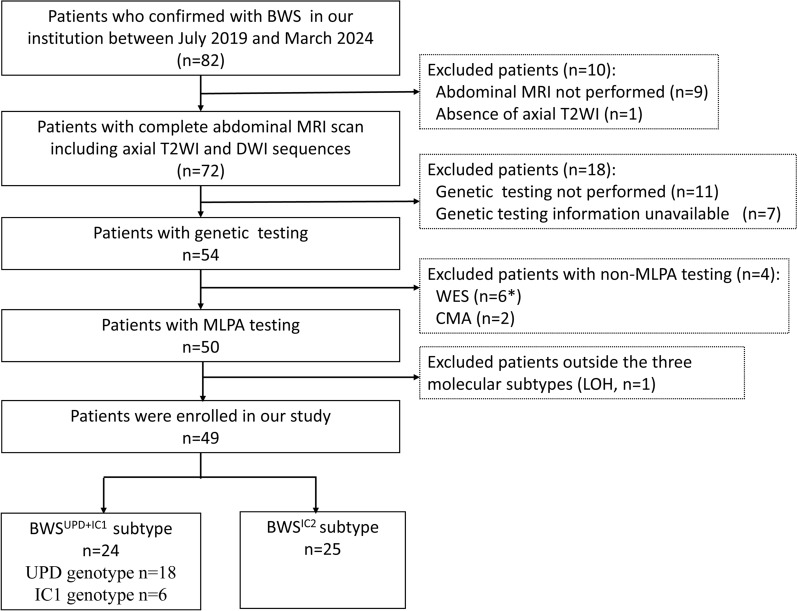
Clinical data and abdominal MRI scans of 49 patients who underwent partial glossectomy between July 2019 and March 2024 were retrospectively analysed. Patients were categorized into two subtypes: BWS (24 cases, with a predisposition to renal involvement) and BWS (25 cases, with a lower risk of renal involvement), based on genetic testing. Pearson correlation analysis was conducted to evaluate the relationship between patients' age and renal volume. Radiomic features derived from the T2WI sequence and the ADC map were selected to construct single-sequence and combined models. Delong test was used to compare the performance of the models.
Clinically, the BWS subtype exhibited a lower incidence of ear creases/pits (P = 0.048) and omphalocele/umbilical hernia (P = 0.032) compared to the BWS subtype. Abdominal MRI findings indicated the BWS subtype had larger total renal volume (P = 0.017) and a weaker correlation between total renal volume and patients' age (r = 0.38). Notably, 91.84% (45/49) of BWS patients exhibited a total renal volume exceeding the normal population's upper limit, with the IC1 subtype demonstrating the largest mean volume. The BWS subtype showed higher incidences of nonmalignant renal (P = 0.013) and non-renal abdominal abnormalities. The T2WI, ADC, and combined models achieved the highest area under the receiver operating characteristic (ROC) curves (AUCs) of 0.837, 0.882 and 0.954 (P > 0.05), respectively.
Nonmalignant renal abnormalities and MRI radiomics models have potential as alternative imaging tools for the identification of renal predisposition genotypes and the surveillance of renal size change in BWS patients.
评估非恶性肾脏检查结果及肾脏MRI影像组学在鉴别贝克威思-维德曼综合征(BWS)分子亚型中的作用。
回顾性分析2019年7月至2024年3月期间接受部分舌切除术的49例患者的临床资料及腹部MRI扫描结果。根据基因检测,将患者分为两个亚型:BWS(24例,有肾脏受累倾向)和BWS(25例,肾脏受累风险较低)。采用Pearson相关分析评估患者年龄与肾脏体积之间的关系。选取T2WI序列和ADC图的影像组学特征构建单序列和联合模型。使用德龙检验比较模型的性能。
临床上,与BWS亚型相比,BWS亚型耳褶/耳凹(P = 0.048)和脐膨出/脐疝(P = 0.032)的发生率较低。腹部MRI结果显示,BWS亚型的总肾体积较大(P = 0.017),且总肾体积与患者年龄之间的相关性较弱(r = 0.38)。值得注意的是,91.84%(45/49)的BWS患者总肾体积超过正常人群上限,其中IC1亚型的平均体积最大。BWS亚型非恶性肾脏(P = 0.013)和非肾脏腹部异常的发生率较高。T2WI、ADC及联合模型的受试者操作特征(ROC)曲线下面积(AUC)分别达到最高值0.837、0.882和0.954(P > 0.05)。
非恶性肾脏异常及MRI影像组学模型有潜力作为替代成像工具,用于识别BWS患者的肾脏易感基因型及监测肾脏大小变化。