He Wenmeng, Wang Shiqin, Wang Beibei, Wang Mingming, Liao Pan
Department of Life Science, Faculty of Science and Technology, Beijing Normal-Hong Kong Baptist University, Zhuhai, Guangdong, China.
Department of Biology, Hong Kong Baptist University, Kowloon Tong, Hong Kong, SAR, China.
Food Chem (Oxf). 2025 May 27;10:100263. doi: 10.1016/j.fochms.2025.100263. eCollection 2025 Jun.
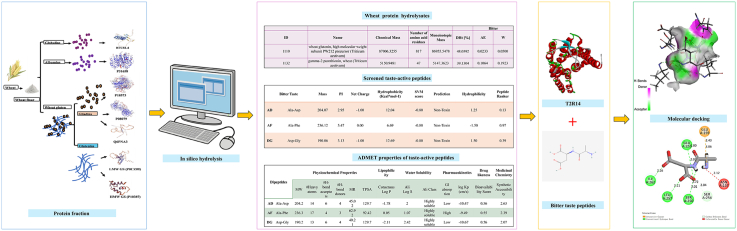
Wheat protein hydrolysates (WPHs) hold promise for functional food applications, but papain (EC 3.4.22.2)-mediated hydrolysis often results in undesirable bitterness and low yields of small peptides. To address this, we employed strategies to systematically characterize bitter peptides in papain-derived WPHs and elucidate their molecular interactions with the human bitter taste receptor TAS2R14. Enzymatic hydrolysis of wheat proteins was simulated using the BIOPEP-UWM database, identifying 36 potential bitter peptides. Molecular docking studies revealed four critical binding residues (Asn157, Ile262, Trp89, and Phe247) on TAS2R14 that mediate bitterness perception. Notably, peptides rich in proline (Pro), phenylalanine (Phe), and tryptophan (Trp) exhibited heightened bitterness, while glycine (Gly)- and glutamic acid (Glu)-containing peptides were associated with reduced bitterness. These findings provide a mechanistic basis for mitigating bitterness in WPHs through selective enrichment or exclusion of peptides with specific amino acid profiles. By enabling targeted design of hydrolysis processes, this work advances the application of WPHs as palatable, bioactive ingredients in the food industry.
小麦蛋白水解物(WPHs)在功能性食品应用方面具有潜力,但木瓜蛋白酶(EC 3.4.22.2)介导的水解通常会导致不良的苦味以及小肽产量较低。为了解决这个问题,我们采用策略系统地表征木瓜蛋白酶衍生的WPHs中的苦味肽,并阐明它们与人类苦味受体TAS2R14的分子相互作用。使用BIOPEP-UWM数据库模拟小麦蛋白的酶促水解,鉴定出36种潜在的苦味肽。分子对接研究揭示了TAS2R14上四个关键的结合残基(Asn157、Ile262、Trp89和Phe247),它们介导苦味感知。值得注意的是,富含脯氨酸(Pro)、苯丙氨酸(Phe)和色氨酸(Trp)的肽表现出更高的苦味,而含有甘氨酸(Gly)和谷氨酸(Glu)的肽与较低的苦味相关。这些发现为通过选择性富集或排除具有特定氨基酸谱的肽来减轻WPHs中的苦味提供了机制基础。通过实现水解过程的靶向设计,这项工作推动了WPHs作为食品工业中可口的生物活性成分的应用。