Shi Shuming, Li Li, Zhou Hao, Xu Fuhao, Liu Ning, Zhang Dexian, Yuan Shuanghu
School of Clinical Medicine, Shandong Second Medical University, Weifang, China.
Department of Radiation Oncology, Cancer Hospital Affiliated to Shandong First Medical University, Shandong First Medical University, and Shandong Academy of Medical Sciences, Jinan, China.
J Thorac Dis. 2025 May 30;17(5):2937-2946. doi: 10.21037/jtd-2024-2107. Epub 2025 May 23.
Recent advancements in immunotherapy have demonstrated promising results across various solid tumors, prompting the exploration of neoadjuvant immunotherapy combined with chemotherapy (NICT) as a potential alternative. This study sought to evaluate the safety and effectiveness of NICT in comparison with neoadjuvant chemoradiotherapy (NCRT) for patients with resectable locally advanced esophageal squamous cell carcinoma (ESCC) undergoing radical esophagectomy.
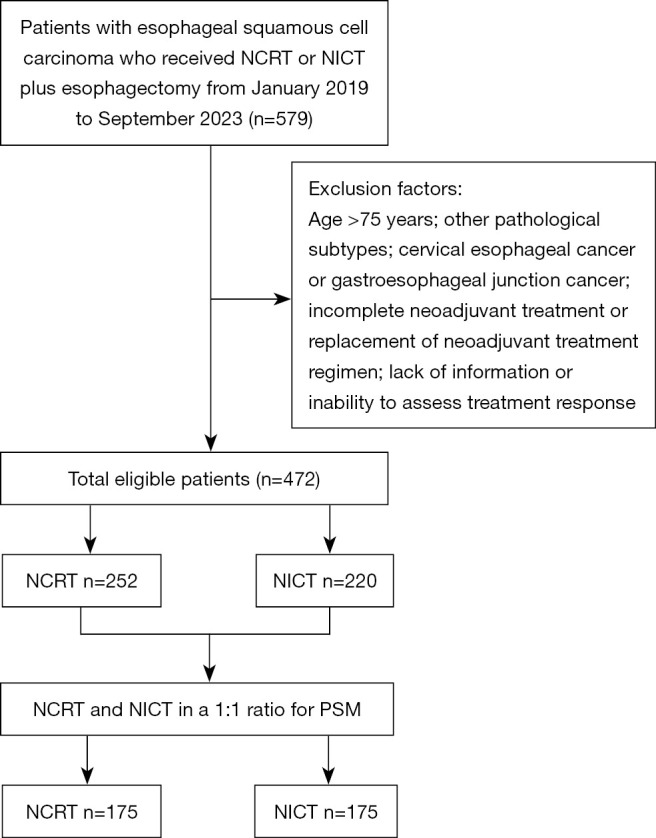
From January 2019 to September 2023, a total of 472 patients with locally advanced ESCC who met the eligibility criteria were recruited from three different medical centers. All patients treated with neoadjuvant therapy prior to radical esophagectomy. Among them, 252 patients treated with the NCRT regimen, and 220 patients treated with the NICT regimen. To reduce the influence of potential confounding factors between the two cohorts, propensity score matching (PSM) was applied.
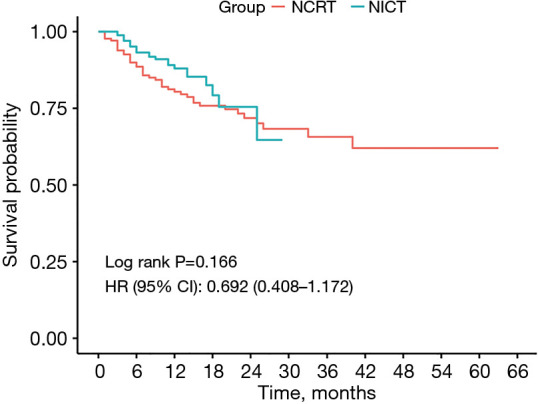
Following PSM, an analysis was conducted on 350 patients who received either NCRT or NICT, with 175 individuals in each cohort. The NCRT cohort exhibited a significantly greater rate of pathological complete response (pCR) than the NICT cohort (44.57% 16.00%, P<0.001). The occurrence of postoperative complications was lower in the NICT cohort, with rates of 31.43% compared with 45.14% in the NCRT group (P=0.008). After 12 months of follow-up, no significant difference was observed in the disease-free survival (DFS) rate between the NCRT group and the NICT group (82.2% 88.0%, P=0.25).
The NCRT cohort exhibited greater rates of pCR and lymph node pCR rates than the NICT cohort. Conversely, the NICT group presented with fewer postoperative complications the NCRT group.
免疫疗法的最新进展在各种实体瘤中都显示出了有前景的结果,促使人们探索新辅助免疫疗法联合化疗(NICT)作为一种潜在的替代方案。本研究旨在评估可切除的局部晚期食管鳞状细胞癌(ESCC)患者在接受根治性食管切除术前,新辅助免疫疗法联合化疗(NICT)与新辅助放化疗(NCRT)相比的安全性和有效性。
从2019年1月至2023年9月,从三个不同的医疗中心招募了总共472例符合入选标准的局部晚期ESCC患者。所有患者在根治性食管切除术前均接受新辅助治疗。其中,252例患者接受NCRT方案治疗,220例患者接受NICT方案治疗。为减少两组之间潜在混杂因素的影响,采用了倾向评分匹配(PSM)。
经过PSM后,对350例接受NCRT或NICT的患者进行了分析,每组各175例。NCRT组的病理完全缓解(pCR)率显著高于NICT组(44.57%对16.00%,P<0.001)。NICT组术后并发症的发生率较低,为31.43%,而NCRT组为45.14%(P=0.008)。随访12个月后,NCRT组和NICT组的无病生存率(DFS)率无显著差异(82.2%对88.0%,P=0.25)。
NCRT组的pCR率和淋巴结pCR率高于NICT组。相反,NICT组的术后并发症比NCRT组少。