Gerhardt Florian, Müller Christian, Venerito Marino, Chater Jack, Mohr Raphael, Egerer Mara, Lindig Udo, Schindler Aaron, Ebel Sebastian, Fischer Janett, Schwarz Maik, Gehring Sonja, Berg Thomas, van Bömmel Florian
Division of Hepatology, Department of Medicine II, Leipzig University Medical Center, Leipzig, Germany.
Department of Gastroenterology, Hepatology and Infectious Diseases, Otto von Guericke University Hospital, Magdeburg, Germany.
J Cancer Res Clin Oncol. 2025 Jun 18;151(6):191. doi: 10.1007/s00432-025-06239-1.
Biliary tract cancers (BTCs) are a heterogeneous group of malignant cancers with an overall poor prognosis. For more than a decade, the standard palliative first-line therapy was cytotoxic chemotherapy with gemcitabine/cisplatin. The results of the TOPAZ-1 and KEYNOTE-966 trials have now introduced immune checkpoint inhibitors (ICIs) into first-line therapy.
Between July 2022 and March 2024, we retrospectively analyzed patients with advanced BTC who were treated with gemcitabine/cisplatin and durvalumab (GCD) at collaborating German university hospitals, tertiary hospitals, and outpatient oncology practices.
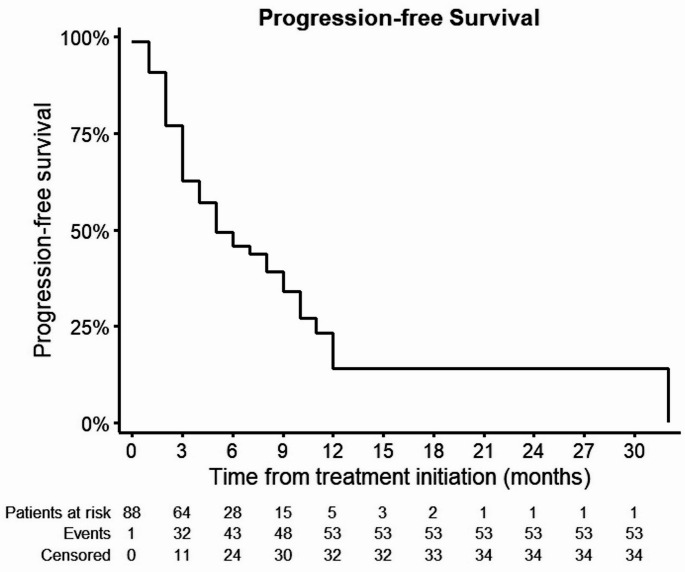
A total of 90 patients were enrolled. The median overall survival (mOS) was 16 months, and the median progression-free survival (mPFS) was 5 months. The overall response rate (ORR) was 11.1%, and the disease control rate (DCR) was 41.1%. A perihilar primary tumor was significantly associated with better mPFS, while age group between 70 and 75 years and performance status of ECOG 2 at treatment initiation were significantly associated with poorer mOS. Adverse events (AEs) occurred in a total of 64% of patients. The most common grade 1 and grade 2 AEs included anemia (23%), thrombocytopenia (16%), neutropenia (10%), nausea (14%), and fatigue (16%). Grade 3 and grade 4 AEs included anemia (10%), thrombocytopenia (5%), and neutropenia (11%). Only one case of immune-mediated hypothyroidism (imAE) was documented.
Our real-world data support previously reported findings and further validate ICI based therapy as the standard of care for patients with advanced BTCs.
胆道癌(BTCs)是一组异质性恶性肿瘤,总体预后较差。十多年来,标准的姑息一线治疗是使用吉西他滨/顺铂进行细胞毒性化疗。TOPAZ - 1和KEYNOTE - 966试验的结果现已将免疫检查点抑制剂(ICIs)引入一线治疗。
在2022年7月至2024年3月期间,我们回顾性分析了在德国合作的大学医院、三级医院和门诊肿瘤诊所接受吉西他滨/顺铂和度伐利尤单抗(GCD)治疗的晚期BTC患者。
共纳入90例患者。中位总生存期(mOS)为16个月,中位无进展生存期(mPFS)为5个月。总缓解率(ORR)为11.1%,疾病控制率(DCR)为41.1%。肝门部原发性肿瘤与较好的mPFS显著相关,而70至75岁年龄组以及治疗开始时ECOG 2的体能状态与较差的mOS显著相关。共有64%的患者发生了不良事件(AE)。最常见的1级和2级AE包括贫血(23%)、血小板减少(16%)、中性粒细胞减少(10%)、恶心(14%)和疲劳(16%)。3级和4级AE包括贫血(10%)、血小板减少(5%)和中性粒细胞减少(11%)。仅记录到1例免疫介导的甲状腺功能减退(imAE)病例。
我们的真实世界数据支持先前报道的结果,并进一步验证了基于ICI的治疗作为晚期BTC患者护理标准的有效性。