Mu Liu, Rong Yan, Xin Yang Jia, Zhang Hong, Xu Zucai
Department of Neurology, Affiliated Hospital of Zunyi Medical University, Zunyi, Guizhou, 563003, People's Republic of China.
Key Laboratory of Brain Function and Brain Disease Prevention and Treatment of Guizhou Province, Zunyi, Guizhou, 563003, People's Republic of China.
J Inflamm Res. 2025 Jun 13;18:7769-7779. doi: 10.2147/JIR.S524814. eCollection 2025.
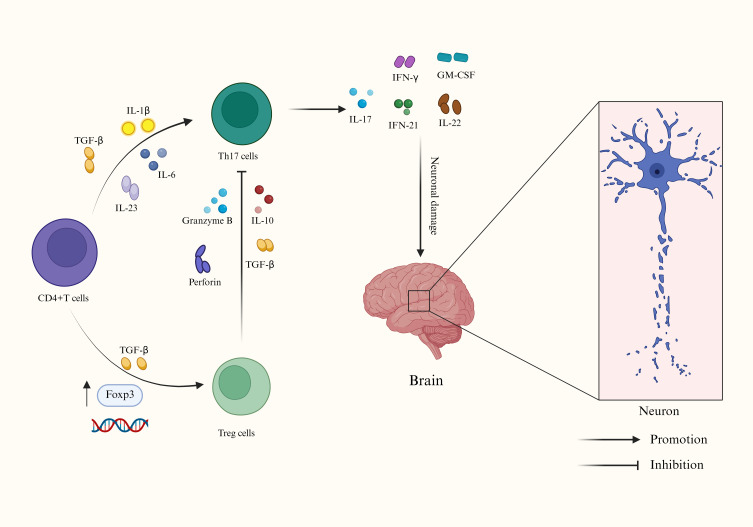
Epilepsy is associated with widespread neurological circumstances due to aberrant neuronal discharges in the brain, which have significant adverse effects on patient's quality of life and increase their risk of death. Immune imbalance, particularly disruption of the Th17/Treg cell balance, has gained increasing attention in the pathophysiology of epilepsy as our understanding of neuroimmune interactions improves. This paper examines the potential therapeutic effects and thoroughly discusses the processes by which the Th17/Treg cell imbalance contributes to the development of epilepsy. The primary emphasis is on the mechanism by which this imbalance impairs blood-brain barrier integrity, neuroinflammation, and other elements. On the therapeutic front, targeting the Th17/Treg axis for immune regulation-through approaches such as ketogenic diets, nanomaterials, and gene editing-shows promising prospects for restoring immune balance. By furthering our knowledge of the connection between Th17/Treg cell imbalance and epilepsy etiology, this work offers a crucial theoretical foundation for creating innovative immunotherapy approaches.
癫痫与广泛的神经学情况相关,这是由于大脑中异常的神经元放电所致,这些放电对患者的生活质量有显著的不利影响,并增加了他们的死亡风险。随着我们对神经免疫相互作用的理解不断提高,免疫失衡,特别是Th17/Treg细胞平衡的破坏,在癫痫的病理生理学中受到越来越多的关注。本文研究了潜在的治疗效果,并深入探讨了Th17/Treg细胞失衡导致癫痫发生的过程。主要重点在于这种失衡损害血脑屏障完整性、神经炎症及其他因素的机制。在治疗方面,通过生酮饮食、纳米材料和基因编辑等方法靶向Th17/Treg轴进行免疫调节,显示出恢复免疫平衡的广阔前景。通过加深我们对Th17/Treg细胞失衡与癫痫病因之间联系的认识,这项工作为创建创新的免疫治疗方法提供了关键的理论基础。