El Hashem Afife, Bou Saba Angela, Bou Madi Anna Maria, Mahfouz Caroline, Derian Clara, El Husseiny Elie, Hanna Jeanne-Marie, El Hayek Maguy, Assaad Shafika
Fundamental Health Sciences Department, School of Medicine and Medical Sciences, Holy Spirit University of Kaslik, Jounieh, Lebanon.
Front Public Health. 2025 Jun 4;13:1605086. doi: 10.3389/fpubh.2025.1605086. eCollection 2025.
Mental health plays a fundamental role in overall wellbeing, with depression being one of the most common mental health disorders worldwide. University students face significant academic, financial, and social pressures, making them particularly vulnerable to depression. Research showed difference in consumption of psychoactive substances such as caffeine and tobacco among genders and academic fields. It suggests also a link between the use of these substances and an increase in depressive symptoms. The consumption of these substances among all university students in Lebanon from multiple majors and the relationship between this intake and mental health remains underexplored.
This cross-sectional study surveyed university students across Lebanon to assess their tobacco and caffeine consumption and its relationship with depression. A self-administered online questionnaire, including the Beck Depression Inventory, was used to measure depression levels and collect data on substance use patterns. A total of 626 convenient responses were analyzed, incorporating both descriptive and inferential statistical analyses.
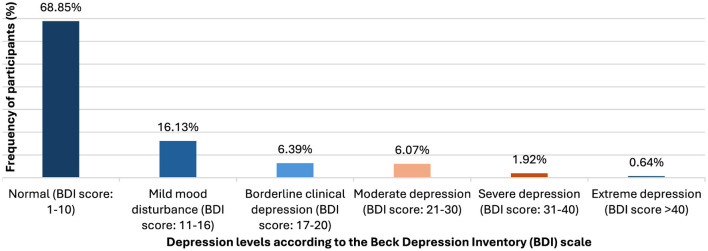
The study found that 31.15% of university students experienced some level of depression. Gender differences were observed in tobacco and caffeine consumption: cigarette smoking was significantly higher among males (25%) than females (7.4%), while no significant gender-based differences were found for electronic cigarette and shisha use. Among caffeinated products, chocolate was the most consumed (92.9% males, 98.1% females), followed by other types of coffee (71.9% males, 80.5% females). Significant gender differences were noted in Arabic coffee, chocolate, tea, and cigarette consumption, but not for energy drinks, e-cigarettes, or waterpipes. Depression levels did not significantly differ between genders for most substances, except for cigarette smoking, where female smokers exhibited significantly higher depression scores than male smokers ( = 0.032). Additionally, depression levels varied across academic majors, with architecture students displaying the highest levels and medical students the lowest. Tobacco consumption is higher among non-medical majors, whereas caffeine is higher among health and non-medical majors.
This study highlights the need for targeted mental health interventions, awareness campaigns, and accessible psychological support services for university students. Future research should explore additional sociocultural factors influencing substance use and mental health.
心理健康在整体幸福感中起着至关重要的作用,抑郁症是全球最常见的心理健康障碍之一。大学生面临着巨大的学业、经济和社会压力,这使他们特别容易患上抑郁症。研究表明,咖啡因和烟草等精神活性物质的消费在性别和学术领域存在差异。这也表明这些物质的使用与抑郁症状的增加之间存在联系。黎巴嫩多专业大学生对这些物质的消费情况以及这种摄入量与心理健康之间的关系仍未得到充分研究。
这项横断面研究对黎巴嫩各地的大学生进行了调查,以评估他们的烟草和咖啡因消费情况及其与抑郁症的关系。使用一份包括贝克抑郁量表的自填式在线问卷来测量抑郁水平并收集关于物质使用模式的数据。总共分析了626份方便获取的回复,纳入了描述性和推断性统计分析。
研究发现,31.15%的大学生经历了某种程度的抑郁。在烟草和咖啡因消费方面观察到性别差异:男性吸烟率(25%)显著高于女性(7.4%),而电子烟和水烟的使用在性别上没有显著差异。在含咖啡因的产品中,巧克力的消费量最大(男性为92.9%,女性为98.1%),其次是其他类型的咖啡(男性为71.9%,女性为80.5%)。在阿拉伯咖啡、巧克力、茶和香烟消费方面存在显著的性别差异,但能量饮料、电子烟或水烟则没有。除吸烟外,大多数物质的抑郁水平在性别上没有显著差异,吸烟女性的抑郁得分显著高于吸烟男性( = 0.032)。此外,抑郁水平因学术专业而异,建筑专业学生的抑郁水平最高,医学专业学生的抑郁水平最低。非医学专业学生的烟草消费量较高,而健康和非医学专业学生的咖啡因消费量较高。
这项研究强调了针对大学生开展有针对性的心理健康干预、宣传活动和提供可及的心理支持服务的必要性。未来的研究应探索影响物质使用和心理健康的其他社会文化因素。