Cernuda-Martínez José Antonio, Cobo-Sánchez José Luis, Alarcón-Duque Eva María, Moreno-Rubio Esther, Suárez-Mier María Belén, Del Río-Pisabarro María Del Camino, Ferraz-Torres Marta
Facultad de Enfermería de Gijón, Universidad de Oviedo, Gijón, Spain.
Hospital Universitario Marqués de Valdecilla, Santander, Spain.
Int J Nurs Stud Adv. 2025 May 28;9:100355. doi: 10.1016/j.ijnsa.2025.100355. eCollection 2025 Dec.
Peripheral intravenous catheters (PIVC) are essential medical devices, yet they frequently lead to complications such as phlebitis, infiltration, and occlusion. Identifying risk factors is key to reducing these complications.
To estimate the incidence of PIVC‑associated phlebitis in Spanish hospitals and identify clinical and epidemiological risk factors.
We performed a prospective cohort study in 80 Spanish hospitals from 1 to 28 February 2023. Adult inpatients (≥18 years) receiving PIVCs in non‑ICU, non‑emergency, non‑pediatric wards were eligible. A total of 13,812 PIVCs in 9387 patients were followed daily by trained nurses until catheter removal, phlebitis onset (Maddox grade ≥ 2), or 15 days. We calculated cumulative incidence and incidence density per 100 catheter‑days. Multivariable Cox proportional hazards models estimated hazard ratios (HRs) for predictors-sex, age group, number of infused medications, hospital size, and dwell time.
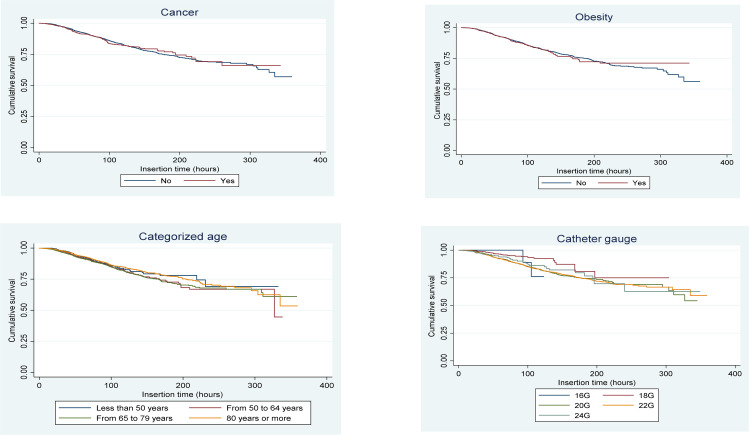
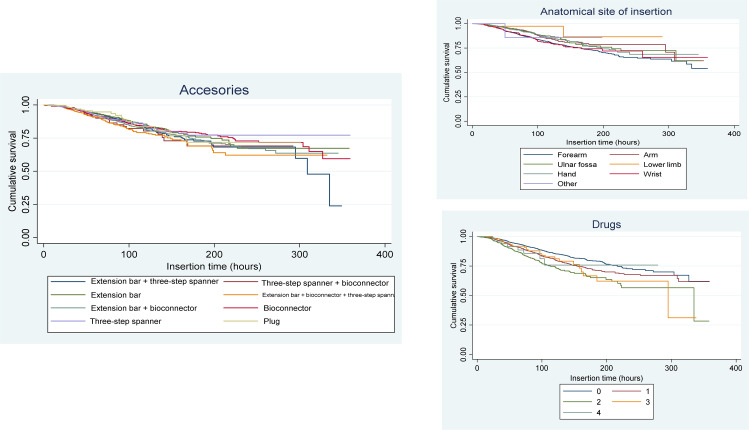
Phlebitis occurred in 1302 PIVCs (cumulative incidence 9.43 %; incidence density 0.14 per 100 person‑hours). Independent risk factors were female sex (HR 1.32, 95 % CI 1.21-1.45), age 65-79 years (HR 1.25, 95 % CI 1.12-1.40), administration of ≥ 2 medications (HR 1.50, 95 % CI 1.35-1.67), and hospital size ≥ 1000 beds (HR 1.30, 95 % CI 1.12-1.52). Phlebitis risk peaked 48-96 h post‑insertion.
Phlebitis incidence remains above recommended levels. Multivariable analysis identified female sex, a higher number of infused medications, older patient age, larger hospital size, and longer PIVC dwell time as the main independent predictors of phlebitis. Not registered.
外周静脉导管(PIVC)是重要的医疗设备,但它们经常导致诸如静脉炎、渗漏和堵塞等并发症。识别风险因素是减少这些并发症的关键。
评估西班牙医院中与PIVC相关的静脉炎发生率,并识别临床和流行病学风险因素。
2023年2月1日至28日,我们在西班牙的80家医院进行了一项前瞻性队列研究。纳入标准为非重症监护病房、非急诊、非儿科病房中接受PIVC的成年住院患者(≥18岁)。9387例患者共置入13812根PIVC,由经过培训的护士每天进行随访,直至导管拔除、静脉炎发作(马多克斯分级≥2级)或15天。我们计算了累积发病率和每100导管日的发病密度。多变量Cox比例风险模型估计了预测因素(性别、年龄组、输注药物数量、医院规模和留置时间)的风险比(HR)。
1302根PIVC发生了静脉炎(累积发病率9.43%;发病密度为每100人时0.14)。独立风险因素为女性(HR 1.32,95%CI 1.21 - 1.45)、65 - 79岁(HR 1.25,95%CI 1.12 - 1.40)、输注≥2种药物(HR 1.50,95%CI [1.35 - 1.67])以及医院规模≥1000张床位(HR 1.30,95%CI 1.12 - 1.52)。静脉炎风险在置管后48 - 96小时达到峰值。
静脉炎发生率仍高于推荐水平。多变量分析确定女性、输注药物数量较多、患者年龄较大、医院规模较大以及PIVC留置时间较长是静脉炎的主要独立预测因素。未注册。