Wang Jiangang, Zhang Yalin, Chai Jingmei, Yang Jianing, Dai Longzhu, Yang Yi, Zhang Yulian, Jin Yongde, Wang Chongyang, Yan Guanghai
Jilin Key Laboratory for Immune and Targeting Research on Common Allergic Diseases Yanbian University Yanji P.R. China.
Department of Anatomy, Histology and Embryology Yanbian University Medical College Yanji P.R. China.
Food Sci Nutr. 2025 Jun 17;13(6):e70464. doi: 10.1002/fsn3.70464. eCollection 2025 Jun.
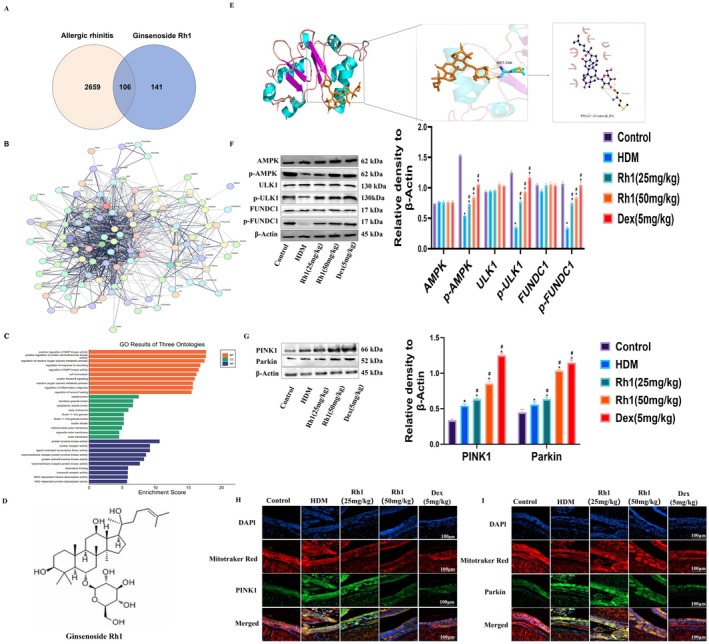
Ginsenoside Rh1, a bioactive compound derived from ginseng, exhibits notable anti-inflammatory and antioxidant effects and has shown promising therapeutic potential in the treatment of allergic diseases. However, its exact role in allergic rhinitis (AR) and the underlying molecular mechanisms remain inadequately understood. This study investigates whether Rh1 alleviates AR through AMPK/ULK1/FUNDC1-mediated mitochondrial autophagy. In this study, human nasal epithelial cells (HNEpCs) were stimulated with house dust mite (HDM) and treated with mitochondrial autophagy inhibitors or siRNA transfection techniques to assess the effects of Rh1. Network pharmacology and molecular docking (MD) were used to explore the interactions between Rh1 and AMPK, ULK1, and FUNDC1. To explore the effects of Rh1, enzyme-linked immunosorbent assay (ELISA) and flow cytometry (FC) were employed to measure IgE levels and various inflammatory mediators. Western blot (WB) analysis was conducted to assess protein expression related to mitochondrial autophagy, inflammation, and apoptosis in nasal tissues and HNEpCs. Immunofluorescence (IF) and transmission electron microscopy (TEM) provided further verification. The experimental data reveal that Rh1 effectively alleviates HDM-induced nasal mucosal epithelial thickening and eosinophil infiltration by modulating mitochondrial autophagy via the AMPK/ULK1/FUNDC1 signaling pathway. Additionally, Rh1 inhibits IL-4 secretion in nasal airway lavage fluid (NALF) and helps restore the Th1/Th2 immune balance. It also reduces mtROS production, inhibits NLRP3 inflammasome activation, and prevents apoptosis, thereby mitigating tissue damage associated with AR. Knockdown of AMPK or treatment with 3-Methyladenine (3-MA) further confirmed Rh1's inducing effect on mitophagy. In summary, Rh1 modulates mitophagy through the AMPK/ULK1/FUNDC1 pathway, reducing inflammatory responses and inhibiting apoptosis, thereby offering significant protection against AR.
人参皂苷Rh1是一种源自人参的生物活性化合物,具有显著的抗炎和抗氧化作用,在过敏性疾病的治疗中显示出有前景的治疗潜力。然而,其在过敏性鼻炎(AR)中的确切作用及潜在分子机制仍未得到充分了解。本研究调查Rh1是否通过AMPK/ULK1/FUNDC1介导的线粒体自噬来减轻AR。在本研究中,用人鼻上皮细胞(HNEpCs)进行屋尘螨(HDM)刺激,并使用线粒体自噬抑制剂或siRNA转染技术进行处理,以评估Rh1的作用。采用网络药理学和分子对接(MD)来探索Rh1与AMPK、ULK1和FUNDC1之间的相互作用。为了探究Rh1的作用,采用酶联免疫吸附测定(ELISA)和流式细胞术(FC)来测量IgE水平和各种炎症介质。进行蛋白质免疫印迹(WB)分析以评估鼻组织和HNEpCs中与线粒体自噬、炎症和凋亡相关的蛋白质表达。免疫荧光(IF)和透射电子显微镜(TEM)提供了进一步的验证。实验数据表明,Rh1通过AMPK/ULK1/FUNDC1信号通路调节线粒体自噬,有效减轻HDM诱导的鼻黏膜上皮增厚和嗜酸性粒细胞浸润。此外,Rh1抑制鼻气道灌洗液(NALF)中IL-4的分泌,并有助于恢复Th1/Th2免疫平衡。它还减少线粒体活性氧(mtROS)的产生,抑制NLRP3炎性小体的激活,并防止细胞凋亡,从而减轻与AR相关的组织损伤。敲低AMPK或用3-甲基腺嘌呤(3-MA)处理进一步证实了Rh1对线粒体自噬的诱导作用。总之,Rh1通过AMPK/ULK1/FUNDC1途径调节线粒体自噬,减少炎症反应并抑制细胞凋亡,从而为AR提供显著的保护作用。