Lundestad Anette, Cetrelli Lena, Angenete Oskar Welander, Augdal Thomas Angell, Tylleskär Karin, Nordal Ellen Berit, Rosendahl Karen, Hoftun Gry Børmark, Hoff Mari, Romundstad Pål Richard, Rygg Marite
Department of Clinical and Molecular Medicine (IKOM), Norwegian University of Science and Technology, Trondheim, Norway
Department of Pediatrics, Trondheim University Hospital St Olav's Hospital, Trondheim, Norway.
RMD Open. 2025 Jun 19;11(2):e005605. doi: 10.1136/rmdopen-2025-005605.
Children with juvenile idiopathic arthritis (JIA) are at risk for impaired bone health. This study evaluates bone mineral density (BMD) and potential risk factors for reduced BMD.
In the NorJIA study, Norwegian children with JIA, and age-matched and sex-matched controls participated in a multicentre cohort study with clinical examinations, questionnaires, imaging and blood tests. BMD was measured using dual-energy X-ray absorptiometry and adjusted for bone age. Standard descriptive statistics and t-tests were used.
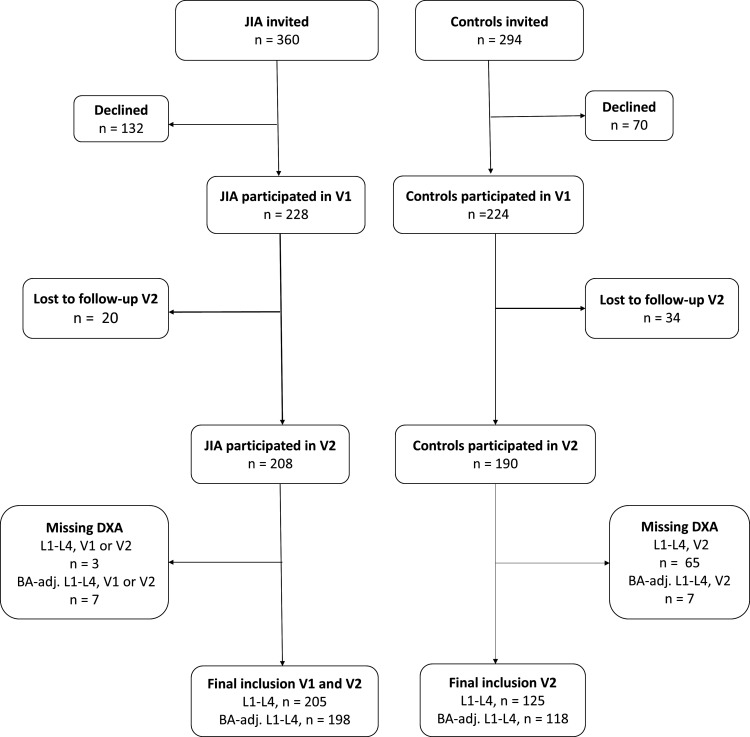
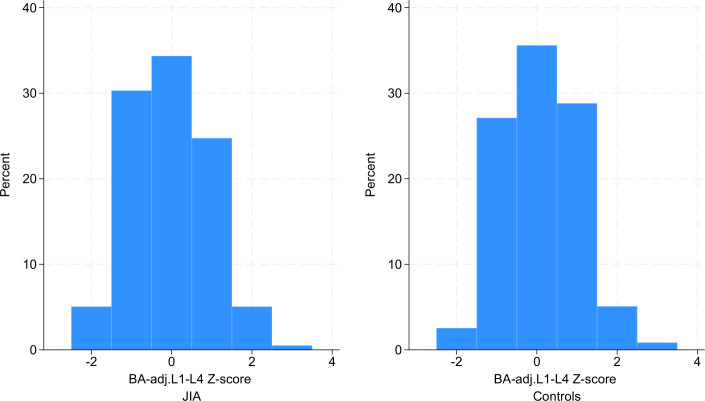
205 children with JIA had BMD measured at two study visits, 2 years apart and 125 controls at the second visit. At visit 2, median age was 14.7 years (IQR 11.5-16.6). Median disease duration was 6.6 (IQR 4.7-10.4) years, 50.7% had used or were currently using biologic disease-modifying antirheumatic drugs and 25.9% had ever used systemic steroids. There were no substantial differences in BMD Z-scores between the JIA group and controls. Mean BMD Z-score L1-L4 in JIA was 0.0 (95% CI -0.1, 0.1) and in controls 0.1 (95% CI -0.1, 0.3). A robust association was seen between physical activity levels and BMD. In children with JIA, the mean BMD Z-score L1-L4 was -0.3 (95% CI -0.6, 0.0) in the low-activity group and 0.2 (95% CI 0.0, 0.4) in the high-activity group, with a similar trend in controls. Children with JIA were as physically active as controls.
BMD Z-scores in JIA were similar to controls and positively associated with physical activity. This underlines the importance of early disease control, steroid-sparing medications and physical activity to optimise bone health.
NCT03904459.
幼年特发性关节炎(JIA)患儿存在骨骼健康受损的风险。本研究评估了骨密度(BMD)以及骨密度降低的潜在风险因素。
在挪威幼年特发性关节炎(NorJIA)研究中,患有JIA的挪威儿童以及年龄和性别匹配的对照组参与了一项多中心队列研究,该研究包括临床检查、问卷调查、影像学检查和血液检测。使用双能X线吸收法测量骨密度,并根据骨龄进行调整。采用标准描述性统计和t检验。
205名患有JIA的儿童在两次研究访视时测量了骨密度,两次访视间隔2年,125名对照组儿童在第二次访视时测量了骨密度。在第二次访视时,中位年龄为14.7岁(四分位间距11.5 - 16.6岁)。中位病程为6.6年(四分位间距4.7 - 10.4年),50.7%的患儿曾使用或正在使用生物改善病情抗风湿药物,25.9%的患儿曾使用过全身用类固醇。JIA组和对照组之间的骨密度Z评分没有显著差异。JIA组L1 - L4椎体的平均骨密度Z评分为0.0(95%置信区间 -0.1, 0.1),对照组为0.1(95%置信区间 -0.1, 0.3)。体力活动水平与骨密度之间存在显著关联。在患有JIA的儿童中,低活动组L1 - L4椎体的平均骨密度Z评分为 -0.3(95%置信区间 -0.6, 0.0),高活动组为0.2(9