
用于增强血管生成和内皮尖端细胞活化的MIL-53(铁)-葡萄糖自组装复合物
MIL-53(Fe)-Glucose self-assembled complex for enhanced angiogenesis and endothelial tip cell activation.
作者信息
Wu Jie, Liu Leyi, Li Runze, Pan Kuangwu, Xu Duoling, Wang Chao, Liu Yuhao, Wang Chao, He Yi, Zhuang Weijie, Li Kechen, Zhao Wei, Yu Dongsheng
机构信息
Hospital of Stomatology, Guanghua School of Stomatology, Sun Yat-sen University, Guangzhou, 510055, China.
Guangdong Provincial Key Laboratory of Stomatology, Sun Yat-sen University, Guangzhou, 510050, China.
出版信息
J Nanobiotechnology. 2025 Jun 19;23(1):454. doi: 10.1186/s12951-025-03483-y.
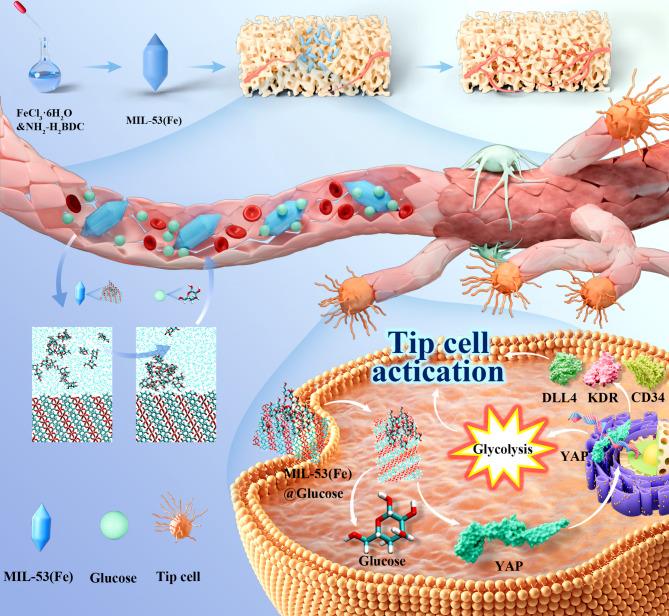
Critical bone defects continue to pose a critical challenge in clinical settings. Facilitating rapid and thorough vascularization during bone regeneration is advantageous for the repair of substantial bone defects. Presently, the application of carriers to deliver pharmacological agents or growth factors to bone deficiency areas is an effective strategy for promoting vascularization within bone tissue, with the selection of appropriate carriers being of paramount importance. Because of its unique breathing characteristics and flexible framework structure, metal-organic framework (MOF) materials MIL-53(Fe), make promising nanocarrier for delivery applications. This work aimed to investigate the role of MIL-53(Fe) in the neovascularization of bone regeneration and the possible molecular mechanisms. The results validated that MIL-53(Fe) has excellent dispersion stability and biocompatibility. Angiogenic sprouting requires the activation of endothelial tip cells. By increasing the glycolytic activity of endothelial cells through self-assembling glucose, the nanocarrier MIL-53(Fe) markedly increased endothelial tip cell activation and boosted angiogenesis, ultimately encouraging bone repair. Through the Hippo/Yes-associated protein (YAP) pathway, the MIL-53(Fe)@Glucose complex was demonstrated to increase glycolytic activity and enhance activation of tip cell phenotype. This study demonstrated that the nanocarrier MIL-53(Fe) serves as an effective strategy for promoting rapid and sufficient angiogenesis during bone regeneration.
严重骨缺损在临床环境中仍然是一个严峻的挑战。在骨再生过程中促进快速而彻底的血管化,有利于修复大面积骨缺损。目前,应用载体将药理剂或生长因子递送至骨缺损区域,是促进骨组织内血管化的一种有效策略,选择合适的载体至关重要。金属有机框架(MOF)材料MIL-53(Fe)因其独特的呼吸特性和灵活的框架结构,成为有前景的递送应用纳米载体。这项工作旨在研究MIL-53(Fe)在骨再生新生血管形成中的作用及可能的分子机制。结果证实MIL-53(Fe)具有优异的分散稳定性和生物相容性。血管生成芽需要激活内皮尖端细胞。通过自组装葡萄糖增加内皮细胞的糖酵解活性,纳米载体MIL-53(Fe)显著增加内皮尖端细胞的激活并促进血管生成,最终促进骨修复。通过Hippo/Yes相关蛋白(YAP)途径,证实MIL-53(Fe)@葡萄糖复合物可增加糖酵解活性并增强尖端细胞表型的激活。本研究表明,纳米载体MIL-53(Fe)是促进骨再生过程中快速且充分血管生成的有效策略。



 Zotero 插件