Luo Xi, El Assal Diana C, Liu Yanjun, Ranjbar Samira, Fleming Ronan M T
School of Medicine, University of Galway, Galway, Ireland.
Division of Science and Math, New York University Abu Dhabi, Abu Dhabi, United Arab Emirates.
Front Comput Neurosci. 2025 Jun 5;19:1594330. doi: 10.3389/fncom.2025.1594330. eCollection 2025.
Emerging evidence suggests that different metabolic characteristics, particularly bioenergetic differences, between the synaptic terminal and soma may contribute to the selective vulnerability of dopaminergic neurons in patients with Parkinson's disease (PD).
To investigate the metabolic differences, we generated four thermodynamically flux-consistent metabolic models representing the synaptic and non-synaptic (somatic) components under both control and PD conditions. Differences in bioenergetic features and metabolite exchanges were analyzed between these models to explore potential mechanisms underlying the selective vulnerability of dopaminergic neurons. Bioenergetic rescue analyses were performed to identify potential therapeutic targets for mitigating observed energy failure and metabolic dysfunction in PD models.
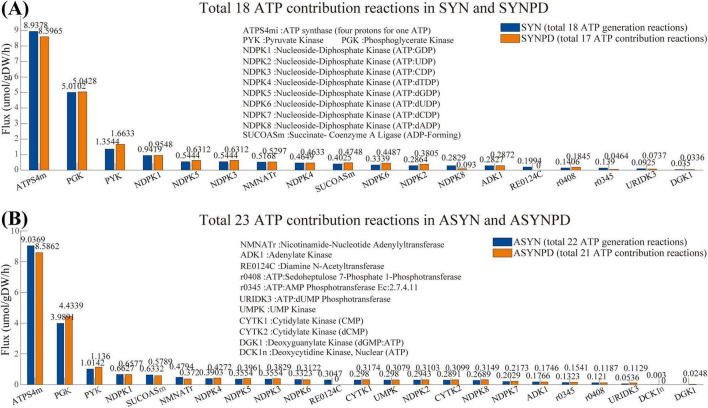
All models predicted that oxidative phosphorylation plays a significant role under lower energy demand, while glycolysis predominates when energy demand exceeds mitochondrial constraints. The synaptic PD model predicted a lower mitochondrial energy contribution and higher sensitivity to Complex I inhibition compared to the non-synaptic PD model. Both PD models predicted reduced uptake of lysine and lactate, indicating coordinated metabolic processes between these components. In contrast, decreased methionine and urea uptake was exclusively predicted in the synaptic PD model, while decreased histidine and glyceric acid uptake was exclusive to the non-synaptic PD model. Furthermore, increased flux of the mitochondrial ornithine transaminase reaction (ORNTArm), which converts oxoglutaric acid and ornithine into glutamate-5-semialdehyde and glutamate, was predicted to rescue bioenergetic failure and improve metabolite exchanges for both the synaptic and non-synaptic PD models.
The predicted differences in ATP contribution between models highlight the bioenergetic differences between these neuronal components, thereby contributing to the selective vulnerability observed in PD. The observed differences in metabolite exchanges reflect distinct metabolic patterns between these neuronal components. Additionally, mitochondrial ornithine transaminase was predicted to be the potential bioenergetic rescue target for both the synaptic and non-synaptic PD models. Further research is needed to validate these dysfunction mechanisms across different components of dopaminergic neurons and to explore targeted therapeutic strategies for PD patients.
新出现的证据表明,突触末端和胞体之间不同的代谢特征,尤其是生物能量差异,可能导致帕金森病(PD)患者多巴胺能神经元的选择性易损性。
为了研究代谢差异,我们生成了四个热力学通量一致的代谢模型,分别代表对照条件和PD条件下的突触和非突触(胞体)成分。分析这些模型之间生物能量特征和代谢物交换的差异,以探索多巴胺能神经元选择性易损性的潜在机制。进行生物能量拯救分析,以确定减轻PD模型中观察到的能量衰竭和代谢功能障碍的潜在治疗靶点。
所有模型都预测,在能量需求较低时氧化磷酸化起重要作用,而当能量需求超过线粒体限制时糖酵解占主导。与非突触PD模型相比,突触PD模型预测线粒体能量贡献较低,对复合体I抑制的敏感性较高。两个PD模型都预测赖氨酸和乳酸摄取减少,表明这些成分之间存在协调的代谢过程。相比之下,仅突触PD模型预测蛋氨酸和尿素摄取减少,而非突触PD模型则特有组氨酸和甘油酸摄取减少。此外,预计将α-酮戊二酸和鸟氨酸转化为谷氨酸-5-半醛和谷氨酸的线粒体鸟氨酸转氨酶反应(ORNTArm)通量增加,可拯救突触和非突触PD模型的生物能量衰竭并改善代谢物交换。
模型之间预测出的ATP贡献差异突出了这些神经元成分之间的生物能量差异,从而导致了PD中观察到的选择性易损性。观察到的代谢物交换差异反映了这些神经元成分之间不同的代谢模式。此外,预计线粒体鸟氨酸转氨酶是突触和非突触PD模型潜在的生物能量拯救靶点。需要进一步研究以验证多巴胺能神经元不同成分中的这些功能障碍机制,并探索针对PD患者的靶向治疗策略。