de Holanda Araújo Sena Alane Macatrão Pires, Bezerra Nogueira Ivan Daniel, Rocha de Sena Kássio Rafael, de Miranda Silva Nogueira Patrícia Angélica
Physical Therapy Postgraduate Program (PPGFIS), Federal University of Rio Grande do Norte (UFRN), Natal, Rio Grande do Norte, Brazil.
Department of Physical Therapy, Federal University of Rio Grande do Norte (UFRN), Natal, Rio Grande do Norte, Brazil.
PLoS One. 2025 Jun 20;20(6):e0325254. doi: 10.1371/journal.pone.0325254. eCollection 2025.
Women undergoing cesarean section frequently report postpartum pain from the surgical procedure, which may be related to functional mobility and cardiorespiratory physiological variables. Transcutaneous electrical nerve stimulation (TENS) and low-level laser therapy (LLLT) photobiomodulation are electrophysical agents used for analgesic purposes in post-cesarean. However, the combined effect of these interventions and their impact on functional performance and cardiorespiratory physiological variables in this population is not known. This study aims to evaluate the effect of TENS combined with LLLT photobiomodulation on pain, functional performance, and behavior of cardiorespiratory variables and compare it with the effects of TENS alone in women during postpartum after cesarean section.
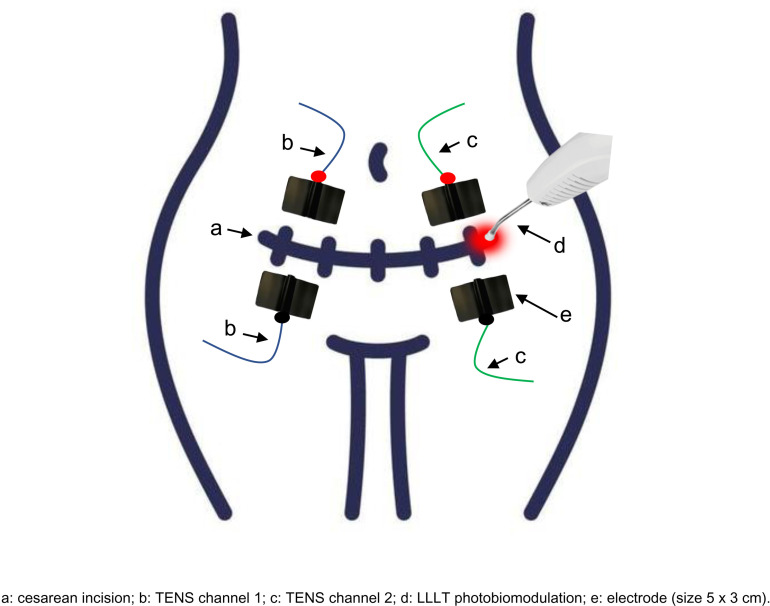
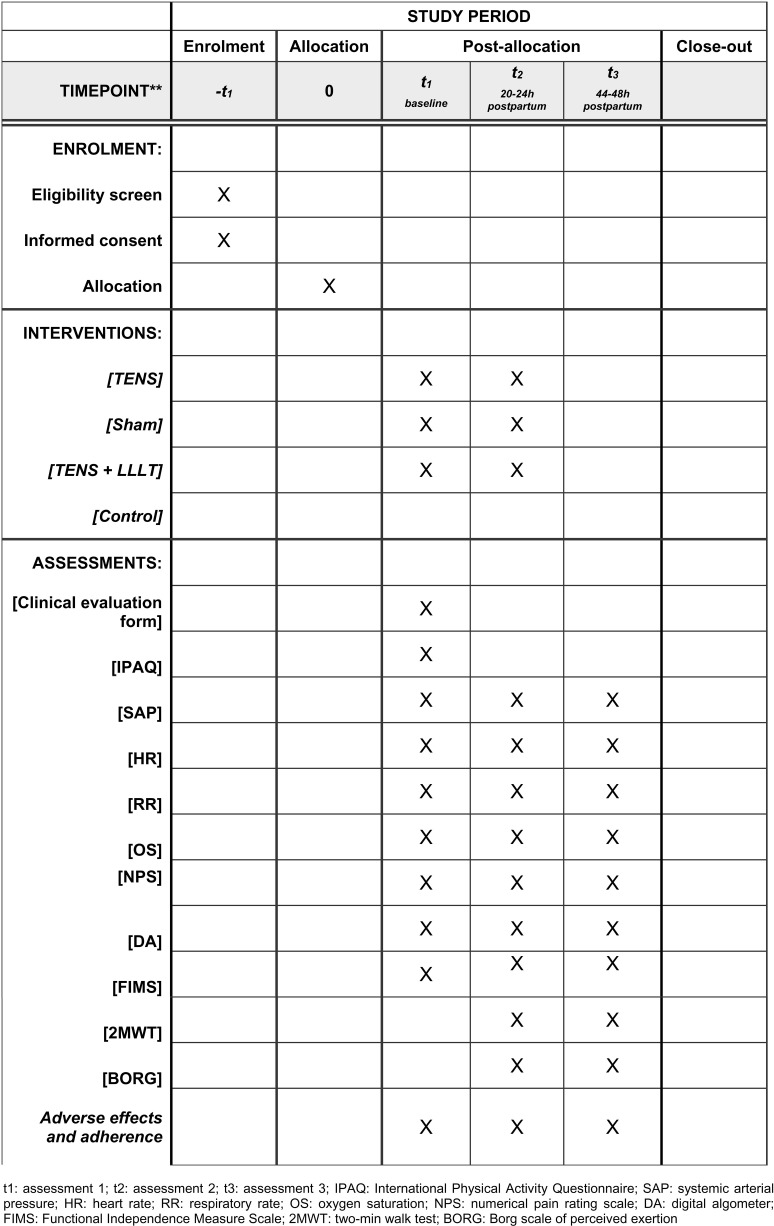
This is a protocol of a randomized clinical trial that will be conducted at Divino Amor Maternity Hospital (Rio Grande do Norte, Brazil). A total of 88 patients undergoing cesarean section will be distributed in four groups: TENS combined with LLLT photobiomodulation, TENS alone, placebo, and control. The patients included in the study will be evaluated at three time-points: assessment 1 (8-12 hours postpartum), assessment 2 (20-24 hours postpartum), and assessment 3 (44-48 hours postpartum). Data will encompass sociodemographic and clinical information, pain assessment, functional performance, and cardiorespiratory physiological variables (systemic arterial pressure, heart and respiratory rates, and oxygen saturation). The combined intervention group will follow the protocol of two sessions with low-intensity TENS (30 min, 100 Hz, and 75 µs), with electrodes above and below the cesarean incision, and LLLT photobiomodulation (660 nm, 2 J per point, and 100 mW), without touching the cesarean incision. The TENS alone group will follow the same low-intensity TENS protocol used in the combined intervention. Interventions (combined and isolated) will be delivered after completion of assessments 1 and 2.
RBR-9pjd2n3.
接受剖宫产的女性经常报告手术带来的产后疼痛,这可能与功能活动能力和心肺生理变量有关。经皮电刺激神经疗法(TENS)和低强度激光疗法(LLLT)光生物调节是用于剖宫产术后镇痛的电物理手段。然而,这些干预措施的联合效果及其对该人群功能表现和心肺生理变量的影响尚不清楚。本研究旨在评估TENS联合LLLT光生物调节对疼痛、功能表现和心肺变量行为的影响,并将其与剖宫产术后女性单独使用TENS的效果进行比较。
这是一项将在巴西北大河州迪维诺阿莫尔妇产医院进行的随机临床试验方案。总共88名接受剖宫产的患者将被分为四组:TENS联合LLLT光生物调节组、单独使用TENS组、安慰剂组和对照组。纳入研究的患者将在三个时间点进行评估:评估1(产后8 - 12小时)、评估2(产后20 - 24小时)和评估3(产后44 - 48小时)。数据将包括社会人口学和临床信息、疼痛评估、功能表现以及心肺生理变量(体循环动脉压、心率和呼吸频率以及血氧饱和度)。联合干预组将遵循两次低强度TENS治疗方案(30分钟,100赫兹,75微秒),电极置于剖宫产切口上下,以及LLLT光生物调节(660纳米,每点2焦耳,100毫瓦),不接触剖宫产切口。单独使用TENS组将遵循联合干预中使用的相同低强度TENS方案。干预措施(联合和单独)将在评估1和2完成后进行。
RBR - 9pjd2n3。