College of Psychology and Sociology, Shenzhen University, Shenzhen, China.
CAS Key Laboratory of Mental Health, Institute of Psychology, Beijing, China; Department of Psychology, University of Chinese Academy of Sciences, Beijing, China.
Neuroimage. 2019 Jul 15;195:396-408. doi: 10.1016/j.neuroimage.2019.03.077. Epub 2019 Apr 1.
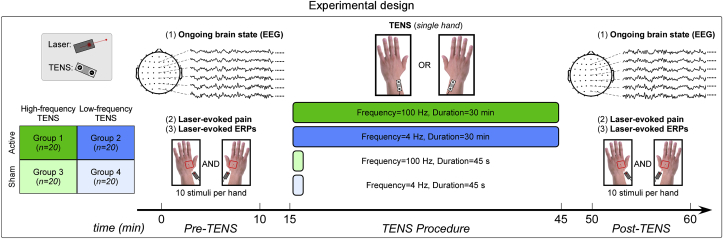
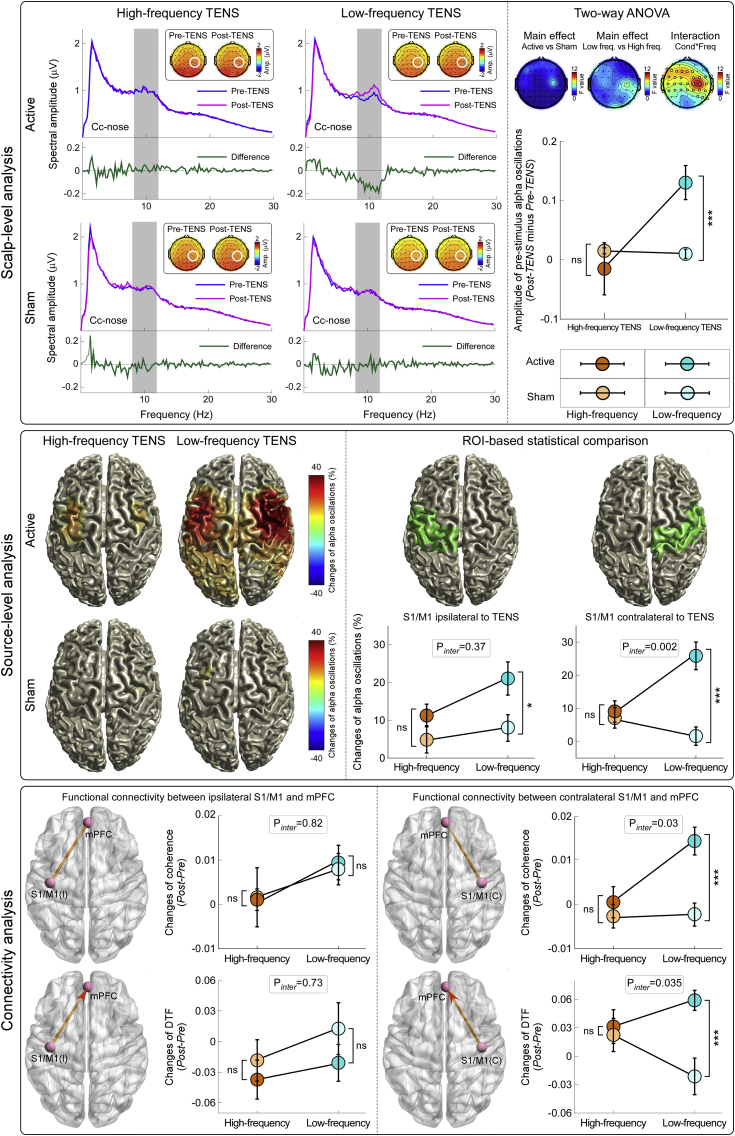
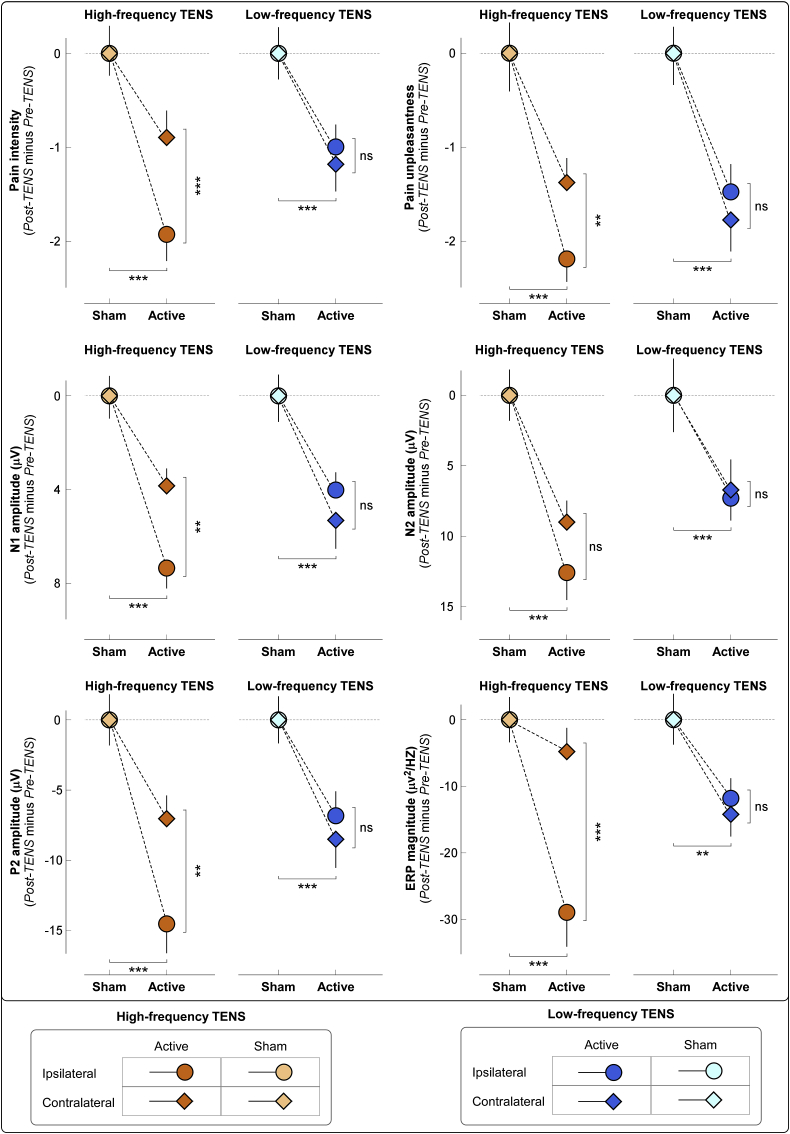
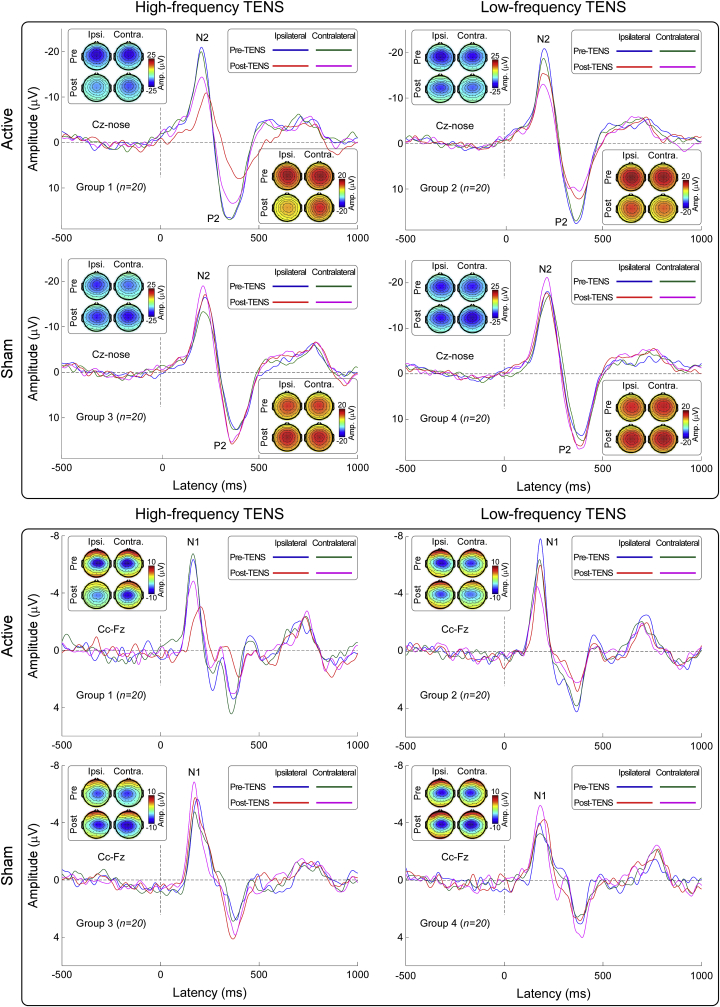
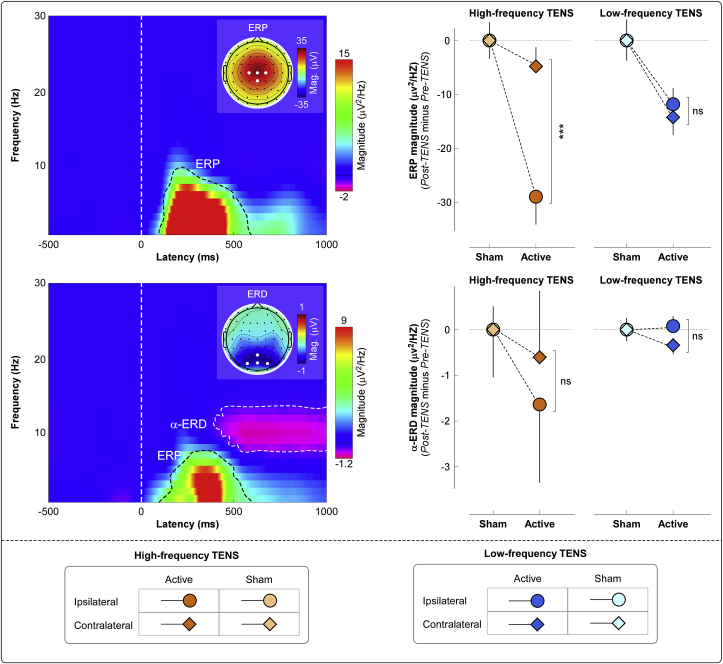
Pain inhibition by additional somatosensory input is the rationale for the widespread use of Transcutaneous Electrical Nerve Stimulation (TENS) to relieve pain. Two main types of TENS produce analgesia in animal models: high-frequency (∼50-100 Hz) and low-intensity 'conventional' TENS, and low-frequency (∼2-4 Hz) and high-intensity 'acupuncture-like' TENS. However, TENS efficacy in human participants is debated, raising the question of whether the analgesic mechanisms identified in animal models are valid in humans. Here, we used a sham-controlled experimental design to clarify the efficacy and the neurobiological effects of 'conventional' and 'acupuncture-like' TENS in 80 human volunteers. To test the analgesic effect of TENS we recorded the perceptual and brain responses elicited by radiant heat laser pulses that activate selectively Aδ and C cutaneous nociceptors. To test whether TENS has a long-lasting effect on brain state we recorded spontaneous electrocortical oscillations. The analgesic effect of 'conventional' TENS was maximal when nociceptive stimuli were delivered homotopically, to the same hand that received the TENS. In contrast, 'acupuncture-like' TENS produced a spatially-diffuse analgesic effect, coupled with long-lasting changes both in the state of the primary sensorimotor cortex (S1/M1) and in the functional connectivity between S1/M1 and the medial prefrontal cortex, a core region in the descending pain inhibitory system. These results demonstrate that 'conventional' and 'acupuncture-like' TENS have different analgesic effects, which are mediated by different neurobiological mechanisms.
额外的躯体感觉输入抑制疼痛,这是经皮神经电刺激(TENS)被广泛用于缓解疼痛的基本原理。两种主要类型的 TENS 在动物模型中产生镇痛作用:高频(50-100 Hz)和低强度“常规”TENS,以及低频(2-4 Hz)和高强度“类似针灸”TENS。然而,TENS 在人类参与者中的疗效存在争议,这引发了一个问题,即动物模型中确定的镇痛机制在人类中是否有效。在这里,我们使用假刺激对照实验设计,在 80 名人类志愿者中阐明了“常规”和“类似针灸”TENS 的疗效和神经生物学效应。为了测试 TENS 的镇痛效果,我们记录了由选择性激活 Aδ和 C 皮肤伤害感受器的辐射热激光脉冲引起的感知和大脑反应。为了测试 TENS 是否对大脑状态有持久影响,我们记录了自发的皮层电振荡。当伤害性刺激在同构部位(即接受 TENS 的手)传递时,“常规”TENS 的镇痛效果最大。相比之下,“类似针灸”TENS 产生了空间弥散的镇痛效应,同时初级感觉运动皮层(S1/M1)的状态以及 S1/M1 与内侧前额叶皮层之间的功能连接发生了持久变化,内侧前额叶皮层是下行疼痛抑制系统的核心区域。这些结果表明,“常规”和“类似针灸”TENS 具有不同的镇痛效果,这些效果是由不同的神经生物学机制介导的。