Fischer Alex Emilio, Hanif Homaira, Stocks Jacob B, Rochelle Aimee E, Dominguez Karen, Armora Langoni Eliana Gabriela, Reyes H Luz McNaughton, Doncel Gustavo F, Muessig Kathryn E
College of Nursing, Florida State University, Tallahassee, FL, United States.
Institute on Digital Health and Innovation, Florida State University, Tallahassee, FL, United States.
JMIR Mhealth Uhealth. 2025 Jun 20;13:e60819. doi: 10.2196/60819.
In 2022, 3100 adolescent girls and young women in sub-Saharan Africa experienced new HIV infections each week. HIV pre-exposure prophylaxis (PrEP) is effective at preventing HIV but has limited uptake and persistence. Mobile health (mHealth) interventions can improve medication adherence; however, their utility to improve PrEP adherence among adolescent girls and young women is not well established.
This scoping review synthesizes evidence supporting mHealth for PrEP among adolescent girls and young women in sub-Saharan Africa and identifies strategies for further evaluation.
We searched PubMed and Google Scholar databases, expert referrals, and reference lists using the following eligibility criteria: (1) original research study or protocol; (2) English language; (3) publication between January 1, 2012, and August 31, 2023; (4) inclusion of adolescent girls and young women; (5) conducted in sub-Saharan Africa; and (6) use of mHealth tools to promote PrEP uptake, adherence, or persistence. Titles and abstracts were screened by 2 independent researchers. Full-text manuscripts were reviewed against all eligibility criteria to determine the final included studies. The characteristics and results of the included studies were abstracted and synthesized by mHealth tool type.
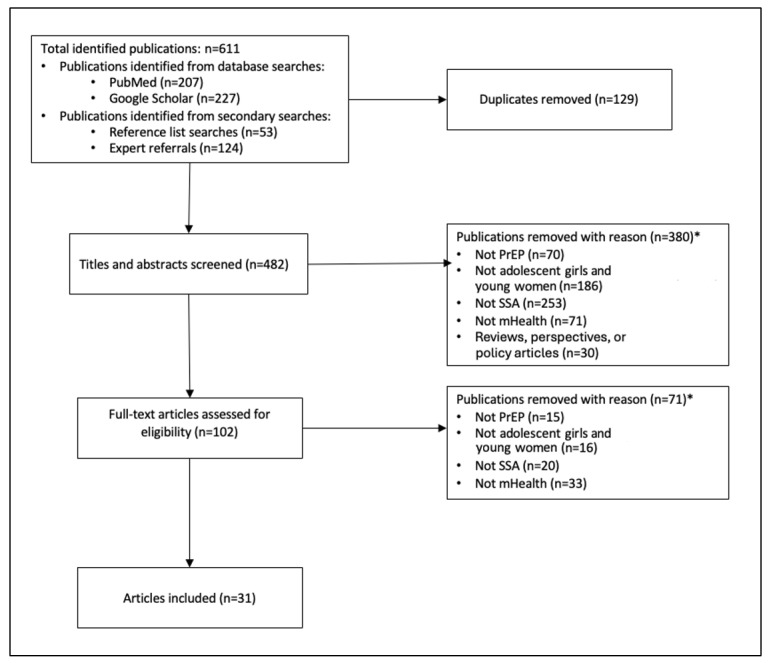
The search identified 482 unique citations. Title and abstract review removed 380 citations primarily for not including adolescent girls and young women or being conducted outside sub-Saharan Africa. The remaining 102 articles underwent full-text review, yielding 31 eligible publications reporting on 21 unique studies. The most common mHealth tool was SMS text message (n=11), followed by app (n=9), telehealth (n=3), website (n=4), and video (n=1). Few publications evaluated effectiveness, and the results were mixed. One study found that SMS text message reminders improved PrEP adherence, and another concluded that SMS text message reminders did not show a significant impact. Two studies found that differentiated service delivery, which included mHealth components, improved PrEP uptake or persistence; however, the findings could not be attributed solely to the mHealth components. Lastly, 1 website was shown to improve PrEP persistence. Several earlier-stage studies focused on values and preferences toward mHealth without reporting the impact on PrEP.
We found few rigorously evaluated mHealth interventions for supporting PrEP among adolescent girls and young women, preventing the ability to draw conclusions on its effectiveness. Studies documented high usability and acceptability but limited assessment of the impact on health outcomes. Secondary uses of mHealth were found for data collection and components of the standard of care. There is substantial room for growth in the innovative use of mHealth to support PrEP among adolescent girls and young women. Consideration of the strengths and limitations of mHealth tools in the local setting, review of past lessons learned, and intentional measurement of mHealth exposure and use could help advance this growing field.
2022年,撒哈拉以南非洲地区每周有3100名青春期女孩和年轻女性感染新发艾滋病毒。艾滋病毒暴露前预防(PrEP)在预防艾滋病毒方面有效,但采用率和持续性有限。移动健康(mHealth)干预措施可以提高药物依从性;然而,其在提高青春期女孩和年轻女性PrEP依从性方面的效用尚未得到充分证实。
本范围综述综合了支持在撒哈拉以南非洲地区青春期女孩和年轻女性中使用移动健康进行PrEP的证据,并确定了进一步评估的策略。
我们使用以下纳入标准搜索了PubMed和谷歌学术数据库、专家推荐及参考文献列表:(1)原创研究或方案;(2)英文;(3)2012年1月1日至2023年8月31日期间发表;(4)纳入青春期女孩和年轻女性;(5)在撒哈拉以南非洲地区开展;(6)使用移动健康工具促进PrEP的采用、依从性或持续性。由2名独立研究人员筛选标题和摘要。根据所有纳入标准对全文进行审查,以确定最终纳入的研究。纳入研究的特征和结果按移动健康工具类型进行提取和综合。
搜索共识别出482条独特引文。标题和摘要审查排除了380条引文,主要原因是未纳入青春期女孩和年轻女性或并非在撒哈拉以南非洲地区开展。其余102篇文章进行了全文审查,产生了31篇符合条件的出版物,报道了21项独特研究。最常见的移动健康工具是短信(n = 11),其次是应用程序(n = 9)、远程医疗(n = 3)、网站(n = 4)和视频(n = 1)。很少有出版物评估有效性,结果不一。一项研究发现短信提醒可提高PrEP依从性,另一项研究则得出短信提醒未显示出显著影响的结论。两项研究发现,包括移动健康组件的差异化服务提供方式可提高PrEP的采用率或持续性;然而,研究结果不能完全归因于移动健康组件。最后,有一个网站被证明可提高PrEP的持续性。几项早期研究关注对移动健康的价值观和偏好,但未报告对PrEP的影响。
我们发现很少有经过严格评估的移动健康干预措施来支持撒哈拉以南非洲地区青春期女孩和年轻女性的PrEP,因此无法就其有效性得出结论。研究记录了较高的可用性和可接受性,但对健康结果影响的评估有限。发现移动健康在数据收集和护理标准组件方面有二次用途。在创新性地利用移动健康支持撒哈拉以南非洲地区青春期女孩和年轻女性的PrEP方面,仍有很大发展空间。考虑移动健康工具在当地环境中的优势和局限性、回顾过去的经验教训以及有意衡量移动健康的接触和使用情况,有助于推动这一不断发展的领域。