Diemer Maire Claire, Ros-Demarize Rosmary, Bradley Catherine C, Kanne Stephen, Kim So Hyun, Parish-Morris Julia, Snyder LeeAnne Green, Wodka Ericka, Carpenter Laura A
Department of Pediatrics, Medical University of South Carolina, Charleston, South Carolina, USA.
Center for Autism and the Developing Brain, Weill Cornell Medical College, New York, NY, USA.
Autism Res. 2025 Aug;18(8):1651-1663. doi: 10.1002/aur.70073. Epub 2025 Jun 23.
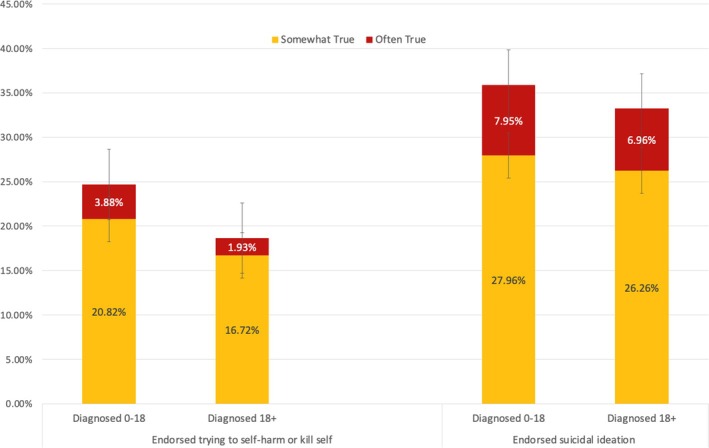
This study investigates the experiences of autistic adult women, a group understudied in autism research due to a predominant focus on early identification/intervention, restrictive research participation criteria, and differing rates of diagnosis by sex. This study characterizes a cohort of autistic adult women (n = 1424) across various dimensions including demographics, relationships, education, employment, income, well-being, and co-occurring psychiatric conditions. It also explores differences among those diagnosed with autism as children versus those diagnosed as adults. The sample was limited to women able to read and provide independent consent to participate. Results indicated that the average age of diagnosis for those diagnosed before age 18 was 9.6 years old, whereas for those diagnosed in adulthood it was 31.8. Over 80% of the sample had completed some college or post-secondary education, with more than a third of those diagnosed as adults having attained a 4-year college degree or higher. More than half were employed, with those diagnosed as adults more likely to be employed full time (31.74%). Additionally, more than half were married or identified a romantic partner. Significant rates of psychiatric comorbidity were reported, with those diagnosed with autism as adults more likely to have co-occurring anxiety (69.87%), depression (61.79%), eating disorders (17.28%), and substance use diagnoses (8.85%) than those diagnosed as children. High rates of suicidal ideation (34%) and self-harm (21%) were endorsed in the full sample. Regression analyses indicated that being diagnosed with autism at a later age was associated with higher internalizing, externalizing, and substance use as well as a lower report of personal strengths, even when accounting for demographic factors. Despite these challenges, our findings highlight that many autistic women have positive outcomes and meet common adult developmental milestones. The authors advocate for the development of more tailored treatment options that address the specific needs of autistic women.
本研究调查了成年自闭症女性的经历,由于自闭症研究主要侧重于早期识别/干预、严格的研究参与标准以及不同的性别诊断率,这一群体在自闭症研究中未得到充分研究。本研究从人口统计学、人际关系、教育、就业、收入、幸福感和共病精神疾病等多个维度对一组成年自闭症女性(n = 1424)进行了特征描述。它还探讨了儿童期被诊断为自闭症的女性与成年期被诊断为自闭症的女性之间的差异。样本仅限于能够阅读并能独立提供参与同意书的女性。结果表明,18岁之前被诊断为自闭症的患者的平均诊断年龄为9.6岁,而成年期被诊断为自闭症的患者的平均诊断年龄为31.8岁。超过80%的样本完成了一些大学或高等教育,超过三分之一的成年期被诊断为自闭症的患者获得了四年制大学学位或更高学历。超过一半的人有工作,成年期被诊断为自闭症的人更有可能全职工作(31.74%)。此外,超过一半的人已婚或有恋爱伴侣。报告显示精神疾病共病率很高,成年期被诊断为自闭症的人比儿童期被诊断为自闭症的人更有可能同时患有焦虑症(69.87%)、抑郁症(61.79%)、饮食失调(17.28%)和物质使用障碍(8.85%)。整个样本中自杀意念(34%)和自我伤害(21%)的发生率很高。回归分析表明,即使考虑到人口统计学因素,成年后被诊断为自闭症与更高的内化、外化和物质使用以及更低的个人优势报告相关。尽管存在这些挑战,我们的研究结果强调,许多自闭症女性有积极结果并达到了常见的成人发展里程碑。作者主张开发更具针对性的治疗方案,以满足自闭症女性的特定需求。