Amendola Alessandra, Gruber Cesare Ernesto Maria, Liuzzi Giuseppina, Rueca Martina, Belladonna Sara, Giancotti Antonella, Girardi Enrico, Maggi Fabrizio
Laboratory of Virology, National Institute for Infectious Diseases Lazzaro Spallanzani, Istituto di Ricovero e Cura a Carattere Scientifico, Rome, Italy (Amendola, Gruber, Rueca, Belladonna, and Maggi).
Maternal-Fetal Infection Prevention Service, National Institute for Infectious Diseases Lazzaro Spallanzani, Istituto di Ricovero e Cura a Carattere Scientifico, Rome, Italy (Liuzzi).
AJOG Glob Rep. 2025 May 18;5(2):100514. doi: 10.1016/j.xagr.2025.100514. eCollection 2025 May.
During 2024, the number of pregnant women who tested positive for parvovirus B19 in central Italy significantly increased. Genome sequence analysis of parvovirus B19 detected in blood samples of pregnant women revealed the co-circulation of 2 distinct clusters belonging to genotype 1, with nucleotide differences in both nonstructural and VP1 and VP2 proteins. The European Centre for Disease Prevention and Control declares a considerable increase in parvovirus B19 infections among children, pregnant women, and blood donors across most European nations from late 2023.
This study aimed to evaluate the positivity rate of parvovirus B19 infections among Italian pregnant women attending the maternal-fetal infection prevention outpatient care facility at the National Institute for Infectious Diseases Lazzaro Spallanzani of Rome for routine evaluation of maternal-fetal infections.
Blood samples from 139 pregnant women were analyzed for parvovirus B19 infection according to the physician's request: parvovirus B19 immunoglobulin M and immunoglobulin G antibodies and/or parvovirus B19 DNA. Among these samples, 8 positive for parvovirus B19 DNA were subjected to target amplicon sequencing and whole-genome reconstruction. For phylogenetic analysis, all parvovirus B19 complete genome sequences were collected, and multisequence alignment was performed to develop the best tree model.
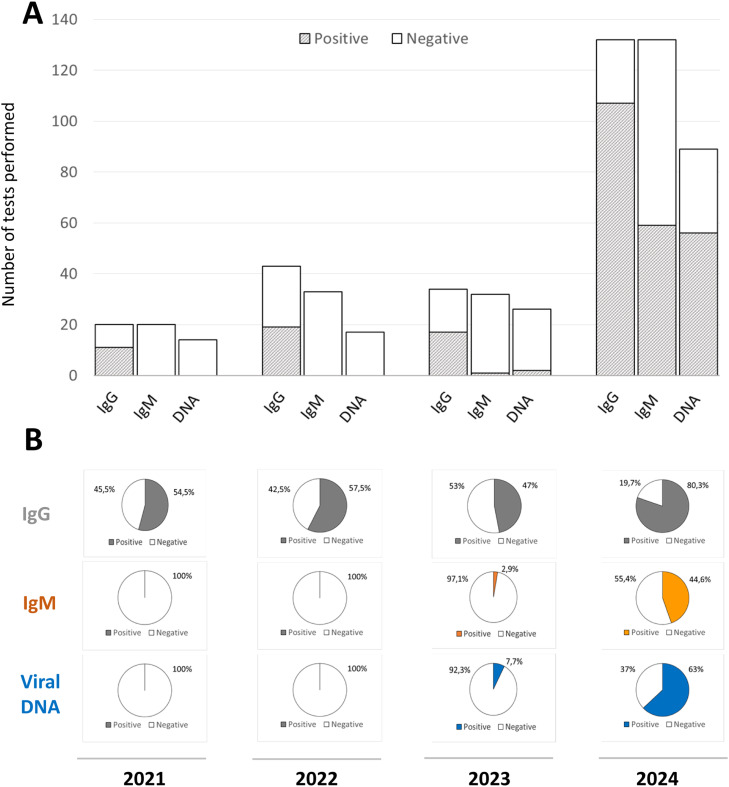
A sharp increase in parvovirus B19 circulation among Italian pregnant women occurred, starting from the end of 2023. During the first 9 months of 2024, requests for diagnosis of parvovirus B19 infection continued to increase significantly, and 46% of the samples analyzed in the first 9 months of the year were positive for parvovirus B19 infection. Phylogenetic analysis showed that all viruses detected belonged to parvovirus B19 genotype 1 and were clustered in 2 separate phylogenetic groups: one similar to the PP818758 genome sequence from France in 2024 and one similar to the KM393165 genome sequence from the United States in 2013. In addition, whole-genome sequence alignment revealed nucleotide mutations that caused amino acid changes, distinguishing the National Institute for Infectious Diseases clusters from similar sequences: the F8L, R54K, and F517S substitutions in the nonstructural gene of the viral genome for cluster 1 and the C298S, E195D, and T456S mutations in the nonstructural, VP1, and VP1 + VP2 genes for cluster 2. Furthermore, the C298S mutation was observed for the first time, as this mutation has never been detected in any other parvovirus B19 genome sequences submitted to international databases.
Since the beginning of 2024, Italy, similar to many European countries, has been experiencing an epidemic of parvovirus B19 infection among pregnant women, with a positivity rate increasing to 46% in the first 9 months of the year. The peak incidence observed in this period seems to be significantly higher than that observed in the same period of the years 2021-2023. Because parvovirus B19 infection can cause up to 20% of asymptomatic infections with serious consequences for the fetus, it is essential to enhance screening and surveillance to stop virus transmission and dissemination, particularly during epidemic periods.
2024年期间,意大利中部检测出细小病毒B19呈阳性的孕妇数量显著增加。对孕妇血液样本中检测出的细小病毒B19进行基因组序列分析,发现属于1型基因型的2个不同簇共同传播,非结构蛋白以及VP1和VP2蛋白均存在核苷酸差异。欧洲疾病预防控制中心宣布,自2023年末起,大多数欧洲国家的儿童、孕妇和献血者中细小病毒B19感染情况大幅增加。
本研究旨在评估在罗马国家传染病研究所拉扎罗·斯帕兰扎尼母婴感染预防门诊接受母婴感染常规评估的意大利孕妇中细小病毒B19感染的阳性率。
根据医生要求,对139名孕妇的血液样本进行细小病毒B19感染分析:检测细小病毒B19免疫球蛋白M和免疫球蛋白G抗体及/或细小病毒B19 DNA。在这些样本中,对8份细小病毒B19 DNA呈阳性的样本进行了目标扩增子测序和全基因组重建。为进行系统发育分析,收集了所有细小病毒B19完整基因组序列,并进行多序列比对以构建最佳树模型。
从2023年末开始,意大利孕妇中细小病毒B19的传播急剧增加。在2024年的前9个月,细小病毒B19感染诊断请求持续显著增加,当年前9个月分析的样本中有46%细小病毒B19感染呈阳性。系统发育分析表明,检测到的所有病毒均属于细小病毒B19基因型1,并聚为2个独立的系统发育组:一组与2024年法国的PP818758基因组序列相似,另一组与2013年美国的KM393165基因组序列相似。此外,全基因组序列比对揭示了导致氨基酸变化的核苷酸突变,使传染病研究所的簇与相似序列有所区别:第1簇病毒基因组非结构基因中的F8L、R54K和F517S替换,以及第2簇非结构基因、VP1基因和VP1 + VP2基因中的C298S、E195D和T456S突变。此外,首次观察到C298S突变,因为在提交至国际数据库的任何其他细小病毒B19基因组序列中均未检测到该突变。
自2024年初以来,与许多欧洲国家一样,意大利孕妇中出现了细小病毒B19感染流行,当年前9个月阳性率升至46%。在此期间观察到的发病率峰值似乎显著高于2021 - 2023年同期。由于细小病毒B19感染可导致高达20%的无症状感染,对胎儿造成严重后果,因此加强筛查和监测以阻止病毒传播和扩散至关重要,尤其是在流行期间。