
中国上海广泛耐药结核病的基因组流行病学分析。
Genomic epidemiology analysis of extremely drug-resistant tuberculosis in Shanghai, China.
作者信息
Lu Xiaoyu, Jiang Yuan, Liu Yanping, Chen Junhong, Lao Yinglin, Li Jing, Zhang Yangyi, Li Nan, Wang Lili, Yu Chenlei, Ye Qi, Wei Wei, Deng Jiale, Shen Xin, Yang Chongguang
机构信息
School of Public Health (Shenzhen), Shenzhen Key Laboratory of Pathogenic Microbes and Biosafety, Shenzhen Campus of Sun Yat-sen University, Sun Yat-sen University, Guangdong, People's Republic of China.
Division of TB and HIV/AIDS Prevention, Shanghai Municipal Center for Disease Control and Prevention, Shanghai, People's Republic of China.
出版信息
Emerg Microbes Infect. 2025 Dec;14(1):2521842. doi: 10.1080/22221751.2025.2521842. Epub 2025 Jul 4.
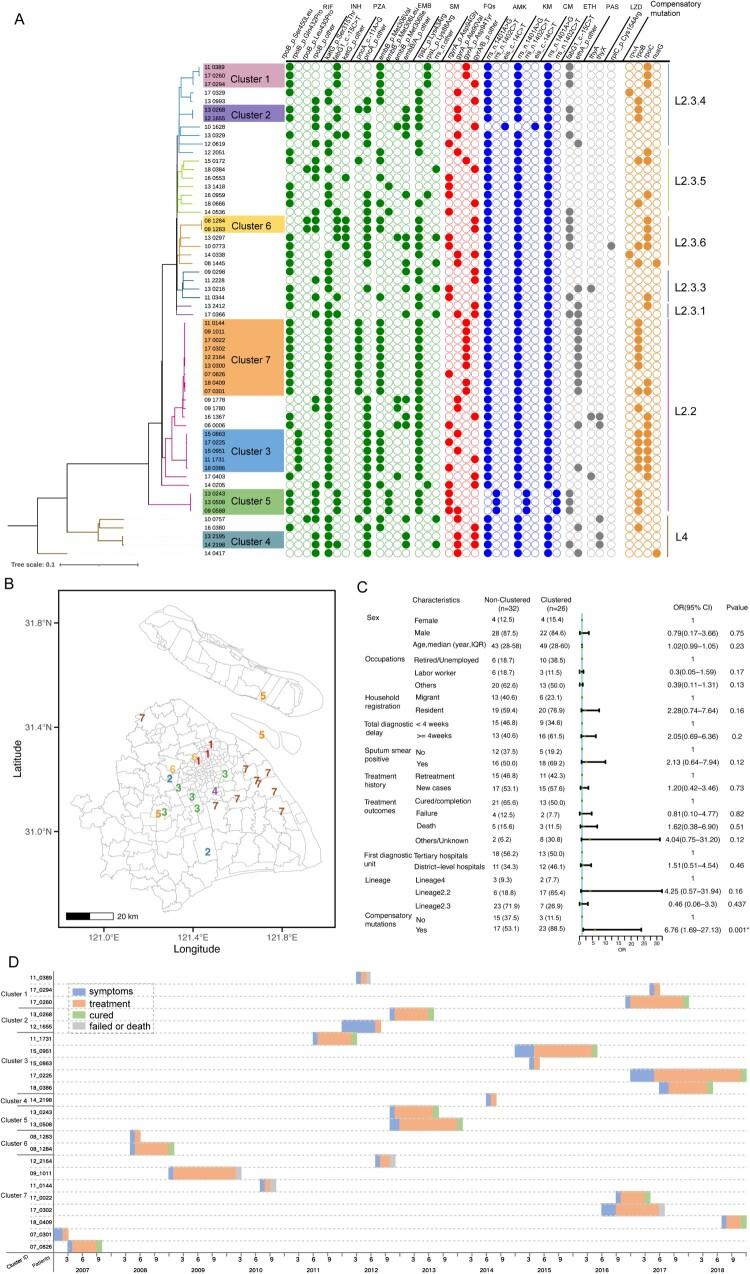
Tuberculosis (TB), particularly extremely drug-resistant TB (EDR-TB), remains a significant public health concern worldwide. Understanding the transmission patterns and epidemiological characteristics of EDR-TB is vital for effective disease control. Between 1 January 2006 and 31 December 2018, we collected clinical strains in Shanghai, with whole-genome sequencing performed on 58 identified clinical EDR-TB strains. We analyzed EDR-related genetic mutations, conducted phylogenetic analyses, and examined bacterial and epidemiological factors that influence their transmission. Among these 58 EDR patients, 43.1% (25/58) were aged 45-64 years, with a median age of 51 years (interquartile range, IQR, 29-59 years). About two-thirds of the EDR-TB patients were residents. We observed a clustering rate of 44.8% (26/58) among EDR strains. Logistic regression analysis indicated a higher risk of recent EDR-TB transmission among the strains with the drug-resistant compensatory mutations. The primary mode of EDR-TB transmission in the study setting was recent, direct person-to-person spread of drug-resistant strains, as evidenced by high clustering rates and the presence of identical resistance mutations among clustered cases.
结核病(TB),尤其是广泛耐药结核病(XDR-TB),仍然是全球重大的公共卫生问题。了解XDR-TB的传播模式和流行病学特征对于有效控制该疾病至关重要。在2006年1月1日至2018年12月31日期间,我们在上海收集了临床菌株,对58株已鉴定的临床XDR-TB菌株进行了全基因组测序。我们分析了与XDR相关的基因突变,进行了系统发育分析,并研究了影响其传播的细菌学和流行病学因素。在这58例XDR患者中,43.1%(25/58)年龄在45-64岁之间,中位年龄为51岁(四分位间距,IQR,29-59岁)。约三分之二的XDR-TB患者为本地居民。我们观察到XDR菌株的聚集率为44.8%(26/58)。逻辑回归分析表明,具有耐药性补偿性突变的菌株近期发生XDR-TB传播的风险更高。研究环境中XDR-TB的主要传播方式是耐药菌株近期在人与人之间的直接传播,高聚集率以及聚集病例中存在相同的耐药突变证明了这一点。
 Zotero 插件