Smith Amy E, Harrison Michelle, McNeil Catriona, Beith Jane, Lim Jennifer
Department of Medical Oncology, Chris O'Brien Lifehouse, 119-143 Missenden Rd, Camperdown 2050, Sydney, NSW, Australia.
Department of Medicine, University of Notre Dame Australia, Sydney, NSW, Australia.
Support Care Cancer. 2025 Jun 23;33(7):615. doi: 10.1007/s00520-025-09664-7.
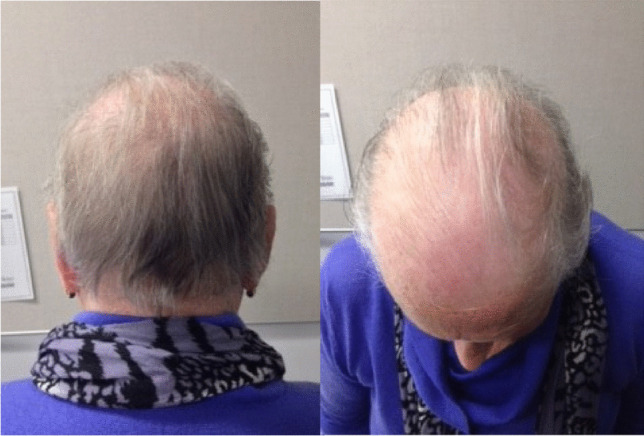
Alopecia is a distressing side-effect of taxane chemotherapy, and evidence suggests that docetaxel leads to chronic alopecia. We measured rates of satisfaction with hair regrowth among women who received adjuvant docetaxel compared with paclitaxel to identify a difference in outcomes.
We identified adult female patients who received paclitaxel or docetaxel chemotherapy for early breast cancer from 2010 to 2015. They were screened to ensure they were alive, without metastatic relapse or a new cancer. Eligible participants were sent an introductory letter, consent, a Dermatology Life Quality Index (DLQI) questionnaire, a Visual Analogue Score (VAS) and the European Organisation for Research and Treatment of Cancer (EORTC) general and breast-specific quality of life. The primary outcomes were the DLQI: a 10-item questionnaire scored on a 0-3 scale (higher scores indicating distress and dissatisfaction) and the VAS (scored out of 4). Secondary outcomes were the global health status, function, symptom score and breast specific outcomes shown by the EORTC QLQ-C30 and EORTC QLQ-BR23.
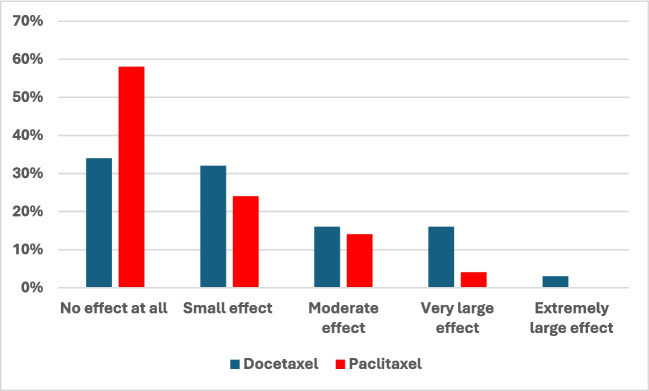
There were 88 responders from 210 letters (response rate 42%); 38 (43%) had docetaxel and 50 (57%) had paclitaxel. They were aged 26-90 (median: 59). There was a significant difference in DLQI scores, with the docetaxel group having a higher median score (docetaxel: 4 vs paclitaxel: 1, p = 0.01). A significantly higher proportion of patients reported no effect of hair loss in the paclitaxel group (p = 0.02). Similarly, there was a significant difference in VAS scores with the docetaxel group having a higher median score (docetaxel: 1 vs. paclitaxel: 0.5, p = 0.002). Secondary outcomes did not reach statistical significance. There was no association with aromatase inhibitor exposure.
Our study shows that adjuvant docetaxel chemotherapy is associated with statistically significant higher rates of dissatisfaction and chronic alopecia than paclitaxel chemotherapy. This supports literature and should be discussed prior to administering docetaxel regimens.
脱发是紫杉烷类化疗令人苦恼的副作用,有证据表明多西他赛会导致慢性脱发。我们比较了接受辅助性多西他赛治疗与紫杉醇治疗的女性患者的头发再生满意度,以确定结果差异。
我们确定了2010年至2015年期间因早期乳腺癌接受紫杉醇或多西他赛化疗的成年女性患者。对她们进行筛查,以确保她们还活着,没有发生转移性复发或新发癌症。符合条件的参与者收到一封介绍信、同意书、一份皮肤病生活质量指数(DLQI)问卷、一份视觉模拟评分(VAS)以及欧洲癌症研究与治疗组织(EORTC)的一般生活质量和乳腺癌特异性生活质量问卷。主要结局指标为DLQI:一份10项问卷,评分范围为0至3分(分数越高表明苦恼和不满程度越高)以及VAS(满分为4分)。次要结局指标为EORTC QLQ-C30和EORTC QLQ-BR23所显示的总体健康状况、功能、症状评分以及乳腺癌特异性结局。
210封信件中有88名回复者(回复率42%);38名(43%)接受了多西他赛治疗,50名(57%)接受了紫杉醇治疗。她们的年龄在26至90岁之间(中位数:59岁)。DLQI评分存在显著差异,多西他赛组的中位数评分更高(多西他赛:4分 vs 紫杉醇:1分,p =)。紫杉醇组中报告脱发无影响的患者比例显著更高(p =)。同样,VAS评分也存在显著差异,多西他赛组的中位数评分更高(多西他赛:1分 vs 紫杉醇:0.5分,p =)。次要结局未达到统计学显著性。与芳香化酶抑制剂暴露无关。
我们的研究表明,辅助性多西他赛化疗与紫杉醇化疗相比,在统计学上导致更高的不满率和慢性脱发率。这支持了相关文献,在给予多西他赛治疗方案之前应进行讨论。