Wei Chih-Fu, Choma Ernani F, Wang Xingyan, Wade Carrie G, Hsiao Ya Luan, Bao Diane, Mukherjee Sudipta K, Christiani David C, Weisskopf Marc G, Liang Liming, Mazumdar Maitreyi
Department of Environmental Health, Harvard T.H. Chan School of Public Health, Boston, Massachusetts, USA.
Department of Environmental and Occupational Medicine, National Taiwan University Hospital Yunlin Branch, Huwei Township, Yunlin County, Taiwan.
Birth Defects Res. 2025 Jun;117(6):e2494. doi: 10.1002/bdr2.2494.
Maternal intake of folic acid prevents most cases of neural tube defects (NTDs), and arsenic exposure may increase NTD risk. In Bangladesh, where arsenic exposures are high, understanding the potential impacts of arsenic reduction and folic acid-based interventions can guide decision-making.
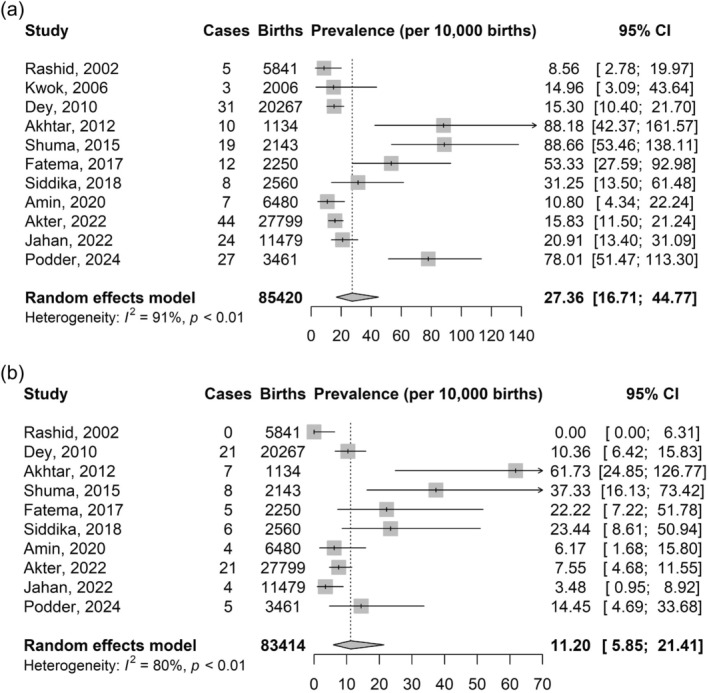
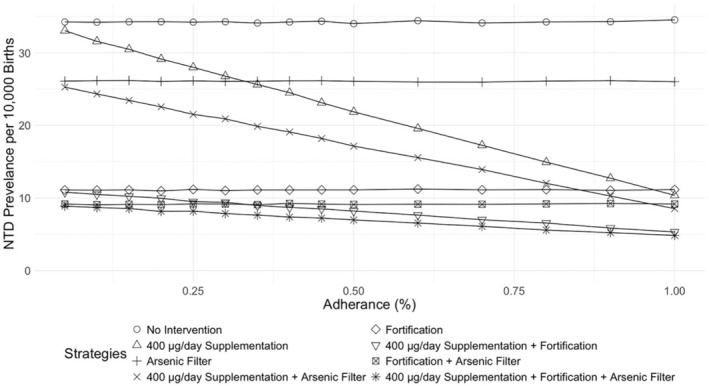
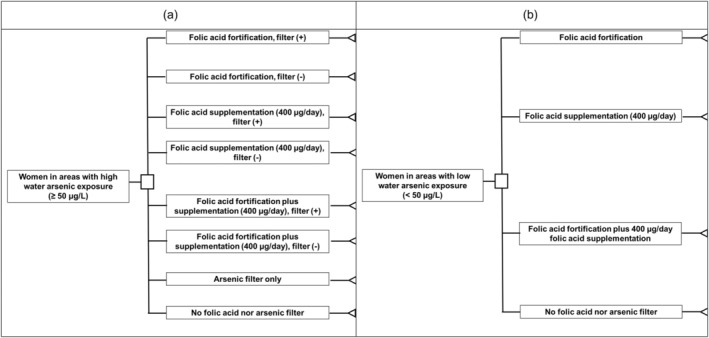
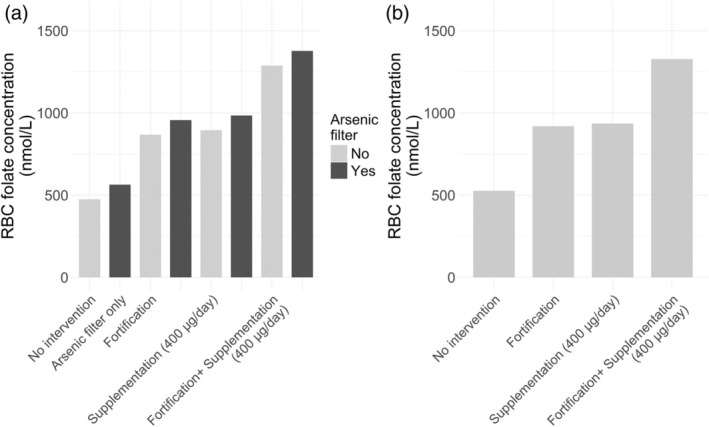
We conducted a systematic review and meta-analysis to estimate the prevalence of NTDs in Bangladesh. We searched PubMed, Embase, Web of Science, Global Health, and Bangladesh Journals Online and extracted data using standardized forms. We used forest plots and random effects models to estimate the prevalence of all NTDs and spina bifida. Decision analysis used assumptions from the literature to compare expected NTD prevalence under strategies incorporating combinations of folic acid supplementation, fortification, and arsenic filters. Sensitivity analyses aimed to quantify the influence of adherence to supplements on estimates.
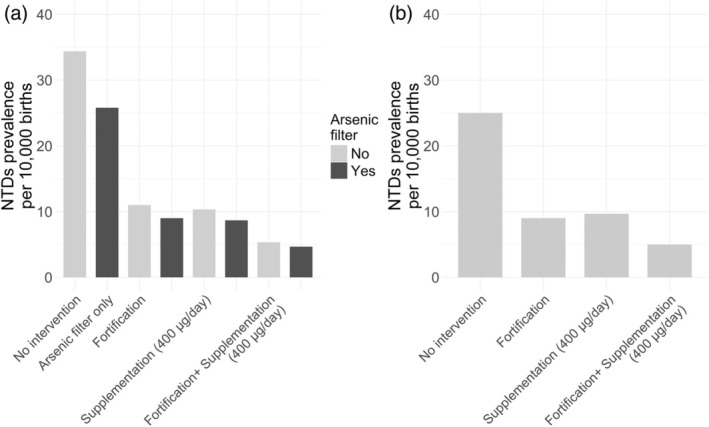
Eleven studies were included. Prevalences of NTD and spina bifida were 27.4 and 11.2 per 10,000 births, respectively; however, when estimated from population red blood cell folate concentrations, NTD prevalence was higher in both high arsenic exposure (drinking water ≥ 50 μg/L) and lower arsenic exposure groups (34.3 and 25.3 per 10,000 births, respectively). Folic acid fortification reduced the prevalence of NTDs to 11.1 and 9.1 per 10,000 births among high exposure and low exposure groups, respectively. Arsenic filters provided little marginal benefit. Benefits of supplements equaled those of fortification when adherence to supplements exceeded 90%.
Bangladesh has high rates of NTDs and high arsenic exposures. Folic acid fortification is projected to be the most effective strategy for NTD prevention.
孕妇摄入叶酸可预防大多数神经管缺陷(NTDs)病例,而接触砷可能会增加神经管缺陷风险。在孟加拉国,砷暴露水平较高,了解降低砷含量和基于叶酸的干预措施的潜在影响可为决策提供指导。
我们进行了一项系统评价和荟萃分析,以估计孟加拉国神经管缺陷的患病率。我们检索了PubMed、Embase、科学网、全球健康和孟加拉国在线期刊,并使用标准化表格提取数据。我们使用森林图和随机效应模型来估计所有神经管缺陷和脊柱裂的患病率。决策分析采用文献中的假设,比较在结合叶酸补充、强化和砷过滤器的策略下预期的神经管缺陷患病率。敏感性分析旨在量化补充剂依从性对估计值的影响。
纳入了11项研究。神经管缺陷和脊柱裂的患病率分别为每10000例出生27.4例和11.2例;然而,根据人群红细胞叶酸浓度估计时,高砷暴露组(饮用水≥50μg/L)和低砷暴露组的神经管缺陷患病率均较高(分别为每10000例出生34.3例和25.3例)。叶酸强化使高暴露组和低暴露组的神经管缺陷患病率分别降至每10000例出生11.1例和9.1例。砷过滤器几乎没有额外益处。当补充剂依从性超过90%时,补充剂的益处与强化相同。
孟加拉国神经管缺陷发生率高且砷暴露水平高。预计叶酸强化是预防神经管缺陷最有效的策略。