Stüwe Malin, Petersen Lars-Erik, Liebeke Manuel
Department for Metabolomics, Institute for Human Nutrition and Food Science, Christian-Albrecht-University Kiel, Kiel, 24118, Germany.
Max Planck Institute for Marine Microbiology, Bremen, 28359, Germany.
Mol Syst Biol. 2025 Aug;21(8):947-951. doi: 10.1038/s44320-025-00129-x. Epub 2025 Jun 24.
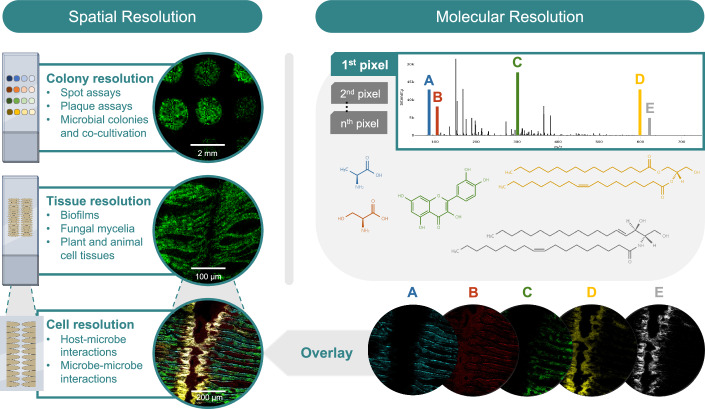
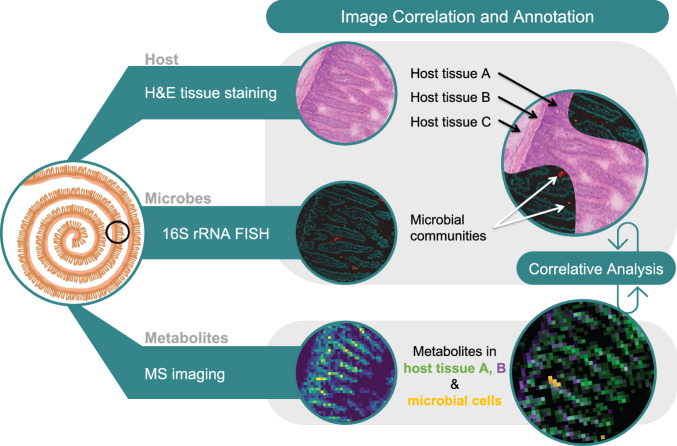
Spatial metabolomics is transforming our understanding of microbial systems by uncovering the localized molecular dynamics within complex microbial communities. By using advanced mass spectrometry imaging techniques, researchers can now visualize metabolites at the micron scale and show how microbes interact, form biofilms, and influence their environments at unprecedented levels of detail. These approaches not only provide molecular insights they also highlight the need of integrating activity measurements and temporal analyses to capture the dynamic nature of microbial assemblages. Incorporating these dimensions in future will enable a deeper understanding of microbial interactions over time, bridging the gap between static snapshots and the evolving processes that drive microbial ecosystems. This commentary explores important aspects in microbial spatial metabolomics, underscores the need for activity and time-resolved studies, and advocates for a deeper exploration of microbial systems to advance chemical ecological concepts, host–microbe interactions, and metabolic mechanisms in microbial communities.
空间代谢组学正在改变我们对微生物系统的理解,它揭示了复杂微生物群落中的局部分子动态。通过使用先进的质谱成像技术,研究人员现在能够在微米尺度上可视化代谢物,并以前所未有的详细程度展示微生物如何相互作用、形成生物膜以及影响其环境。这些方法不仅提供了分子层面的见解,还凸显了整合活性测量和时间分析以捕捉微生物群落动态本质的必要性。未来将这些维度纳入研究,将能够更深入地理解微生物随时间的相互作用,弥合静态快照与驱动微生物生态系统的演变过程之间的差距。本评论探讨了微生物空间代谢组学的重要方面,强调了活性和时间分辨研究的必要性,并主张更深入地探索微生物系统,以推进化学生态学概念、宿主 - 微生物相互作用以及微生物群落中的代谢机制。