Farzan Jessica J, Guart Jiddu, De la Cruz Ku Gabriel, Kulkarni Nichita, Huselid Rachel, Desai Anshumi, Franco Camila, Mroueh Vanessa, Mroueh Jessica, Ziegler Gonzalo
University of Massachusetts Medical School, Worcester, MA 01655, USA.
Universidad Cientifica del Sur, Lima 15067, Peru.
Ecancermedicalscience. 2025 May 13;19:1905. doi: 10.3332/ecancer.2025.1905. eCollection 2025.
Malignant melanoma presents with diverse clinical and histological manifestations that vary per population. Lymph node status, assessed through sentinel lymph node biopsy, is a widely accepted standard of care and a key prognostic indicator. This study aims to identify clinical outcomes, clinicopathologic factors, recurrence patterns, metastatic spread patterns and risk factors associated with lymph node-negative melanoma in our Latino/Hispanic patient population.
We included patients diagnosed with lymph node-negative melanoma at the Instituto Nacional de Enfermedades Neoplásicas, Lima, Peru, from 2010 to 2019. Cox regression analysis was used to assess prognostic factors.
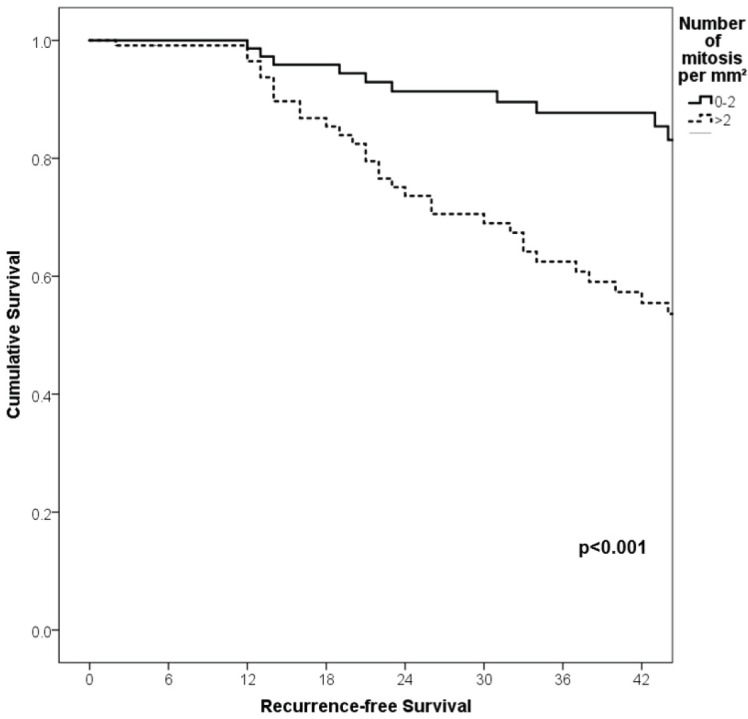
The study included 249 patients with lymph node-negative melanoma, with a median follow-up time of 25 months. Recurrence was observed in 27% of patients, with a mean age of 65 years compared to 60 years in the non-recurrent group. With a median follow-up of 35 months, the 3-year recurrence-free survival (RFS) rates and overall survival (OS) were 75% and 94%, respectively. The 3-year OS rate was 97% and 88% for non-recurrent and recurrent patients, respectively ( = 0.002). The predictors of RFS were Breslow index (hazard ratio (HR) = 1.098, 95%CI: 1.051-1.146, < 0.001) and number of mitoses per mm (HR = 2.105, 95%CI: 1.150-3.852, = 0.016). Age was the only predictor for lymph node recurrence (HR = 1.053, 95%CI: 1.010-1.098, = 0.016), and Breslow index for distant metastasis (HR = 1.126, 95%CI:1.059-1.196, < 0.001). Breslow index was the only prognostic factor for OS (HR = 1.090, 95%CI:1.034-1.150, = 0.001).
The Latino/Hispanic population has unique characteristics and prognostic factors for oncologic outcomes. Increased Breslow depth and number of mitoses per mm were significant predictors of recurrence in lymph node-negative melanoma. There is a need for personalised risk assessment and management strategies in this population in terms of surveillance and adjuvant therapies. Further molecular and genetic predictors and markers of recurrence need to be investigated.
恶性黑色素瘤具有多样的临床和组织学表现,因人群而异。通过前哨淋巴结活检评估的淋巴结状态是广泛接受的治疗标准和关键的预后指标。本研究旨在确定在我们的拉丁裔/西班牙裔患者群体中,与淋巴结阴性黑色素瘤相关的临床结局、临床病理因素、复发模式、转移扩散模式和危险因素。
我们纳入了2010年至2019年在秘鲁利马国家肿瘤研究所被诊断为淋巴结阴性黑色素瘤的患者。采用Cox回归分析评估预后因素。
该研究纳入了249例淋巴结阴性黑色素瘤患者,中位随访时间为25个月。27%的患者出现复发,复发患者的平均年龄为65岁,而非复发组为60岁。中位随访35个月时,3年无复发生存率(RFS)和总生存率(OS)分别为75%和94%。非复发和复发患者的3年OS率分别为97%和88%(P = 0.002)。RFS的预测因素为Breslow指数(风险比(HR)= 1.098,95%置信区间:1.051 - 1.146,P < 0.001)和每毫米有丝分裂数(HR = 2.105,95%置信区间:1.150 - 3.852,P = 0.016)。年龄是淋巴结复发的唯一预测因素(HR = 1.053,95%置信区间:1.010 - 1.098,P = 0.016),Breslow指数是远处转移的预测因素(HR = 1.126,95%置信区间:1.059 - 1.196,P < 0.001)。Breslow指数是OS的唯一预后因素(HR = 1.090,95%置信区间:1.034 - 1.150,P = 0.001)。
拉丁裔/西班牙裔人群在肿瘤学结局方面具有独特的特征和预后因素。Breslow深度增加和每毫米有丝分裂数是淋巴结阴性黑色素瘤复发的重要预测因素。在该人群的监测和辅助治疗方面,需要个性化的风险评估和管理策略。需要进一步研究复发的分子和遗传预测因素及标志物。