Hasan Sana S, John David, Rudnicki Martina, AlZaim Ibrahim, Eberhard Daniel, Moll Iris, Taylor Jacqueline, Klein Christian, von Heesen Maximilian, Conradi Lena-Christin, Adams Ralf H, Lammert Eckhard, Kalucka Joanna, Ruhrberg Christiana, Dimmeler Stefanie, Fischer Andreas
Department of Clinical Chemistry, University Medical Center Göttingen, Göttingen, Germany.
Institute of Cardiovascular Regeneration, Goethe University, Frankfurt, Germany.
Nat Commun. 2025 Jun 25;16(1):5392. doi: 10.1038/s41467-025-60910-2.
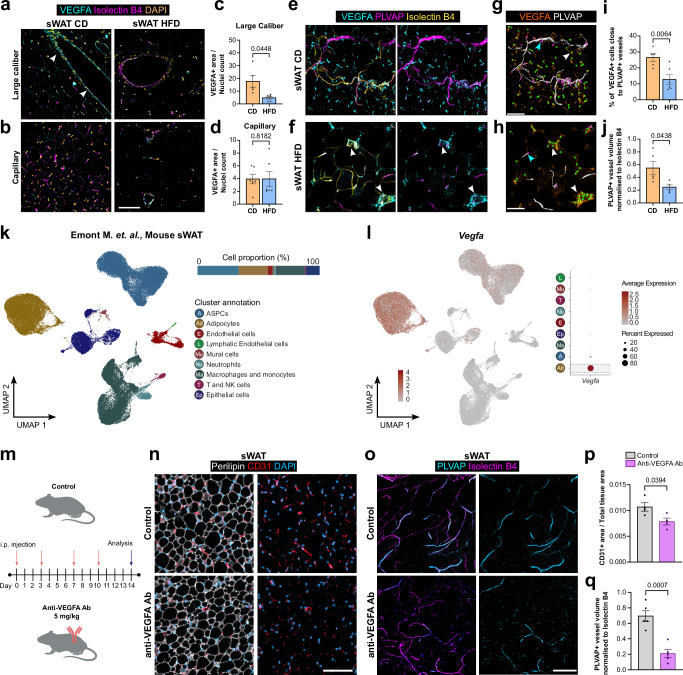
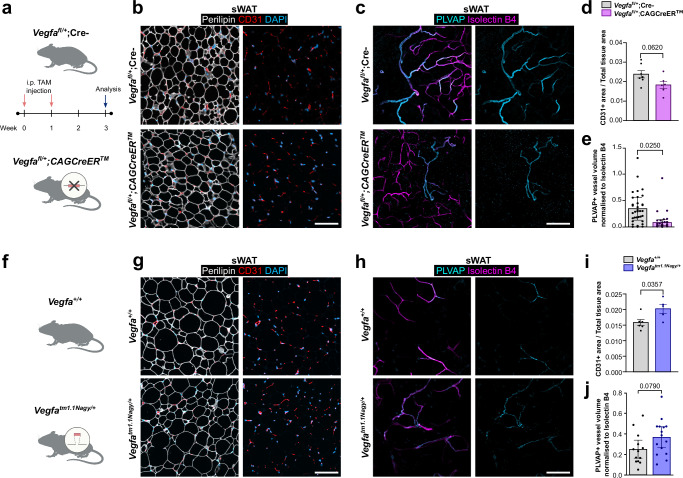
Obesity-driven pathological expansion of white adipose tissue (WAT) is a key driver of endothelial dysfunction. However, early vascular alterations associated with over-nutrition also serve to exacerbate WAT dysfunction. Here, we conduct a single-cell transcriptomic analysis of WAT endothelium to delineate endothelial heterogeneity and elucidate vascular alterations and its consequence in a male murine model of obesity. We demarcate depot-specific differences in subcutaneous (sWAT) and visceral WAT (vWAT) endothelium through in sillico analysis and further corroboration of our findings. Moreover, we identify a sWAT-specific fenestrated endothelial cell (EC) subtype, which declines in obese conditions. Utilizing systemic anti-VEGFA blockade and genetic Vegfa manipulation, we demonstrate that VEGFA is necessary for maintaining fenestration in sWAT. Additionally, we detect this fenestrated EC subtype in male human WAT, which undergoes reduction in individuals with obesity. Collectively, this atlas serves as a valuable tool for future studies to decipher the functional significance of different WAT EC subtypes.
肥胖驱动的白色脂肪组织(WAT)病理性扩张是内皮功能障碍的关键驱动因素。然而,与营养过剩相关的早期血管改变也会加剧WAT功能障碍。在此,我们对WAT内皮进行单细胞转录组分析,以描绘内皮细胞的异质性,并阐明肥胖雄性小鼠模型中的血管改变及其后果。我们通过计算机分析以及对研究结果的进一步验证,划定了皮下(sWAT)和内脏WAT(vWAT)内皮中特定部位的差异。此外,我们鉴定出一种sWAT特异性的有孔内皮细胞(EC)亚型,该亚型在肥胖状态下会减少。利用全身性抗VEGFA阻断和基因Vegfa操纵,我们证明VEGFA对于维持sWAT中的窗孔形成是必需的。此外,我们在男性人类WAT中检测到这种有孔EC亚型,肥胖个体中该亚型会减少。总体而言,这一图谱是未来研究解读不同WAT EC亚型功能意义的宝贵工具。