Liu Ao, Huang Mengting, Xi Yuwen, Deng Xiaoling, Xu Keshu
Department of Gastroenterology, Union Hospital, Tongji Medical College, Huazhong University of Science and Technology, 1277 Jiefang Avenue, Wuhan 430022, China.
Department of Radiology, Union Hospital, Tongji Medical College, Huazhong University of Science and Technology, 1277 Jiefang Avenue, Wuhan 430022, China.
Biomedicines. 2025 Jun 10;13(6):1422. doi: 10.3390/biomedicines13061422.
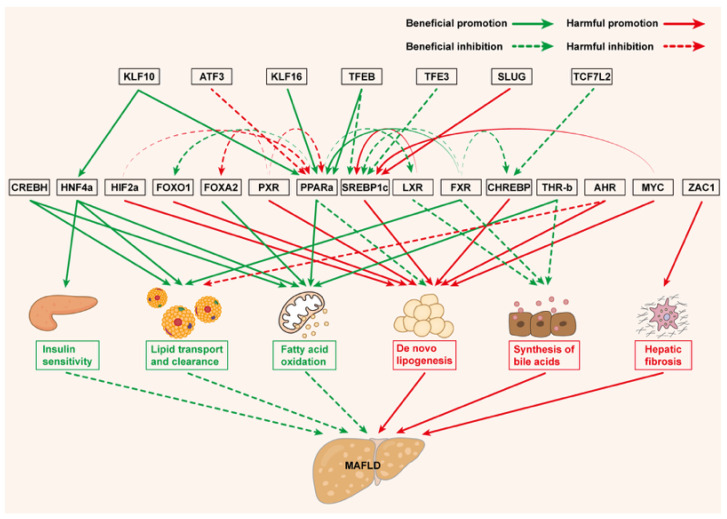
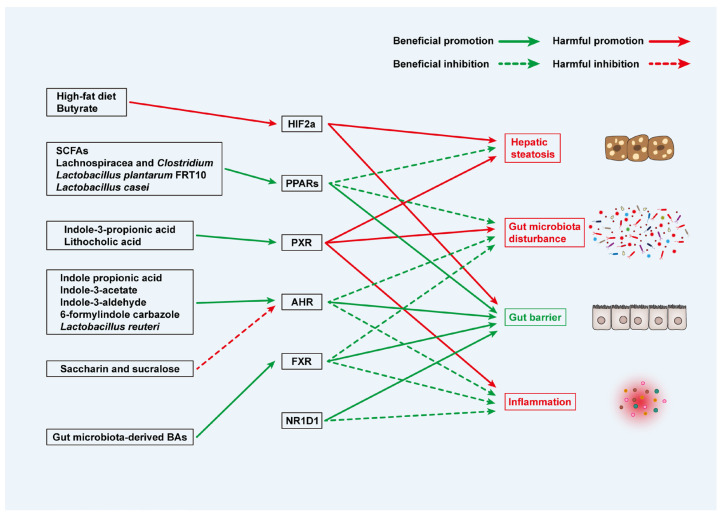
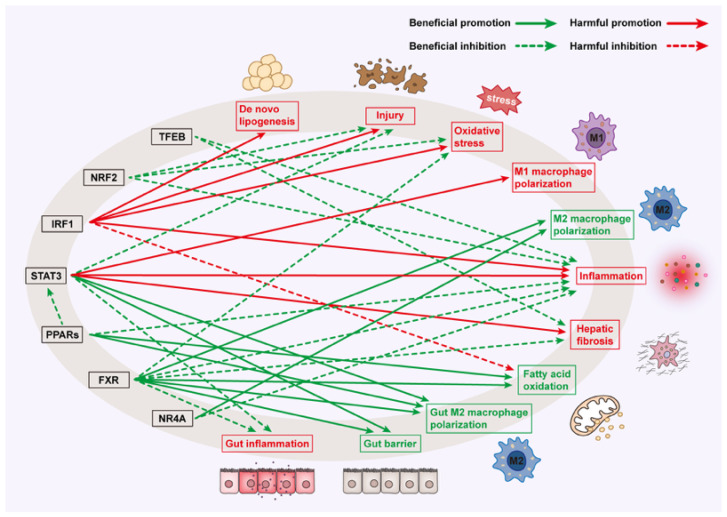
Metabolic dysfunction-associated fatty liver disease (MAFLD) represents a global health burden, however, therapeutic advancements remain hindered by incomplete insights on mechanisms and suboptimal clinical interventions. This review focused on the transcription factors (TFs) associated with the gut-liver axis, emphasizing their roles as molecular interpreters of systemic crosstalk in MAFLD. We delineate how TF networks integrate metabolic, immune, and gut microbial signals to manage hepatic steatosis, inflammation, and fibrosis. For instance, metabolic TFs such as peroxisome proliferator-activated receptor α (PPARα) and farnesoid X receptor (FXR) are responsible for regulating lipid oxidation and bile acid homeostasis, while immune-related TFs like signal transducer and activator of transcription 3 (STAT3) modulate inflammatory cascades involving immune cells. Emerging evidence highlights microbiota-responsive TFs, like hypoxia-inducible factor 2α (HIF2α) and aryl hydrocarbon receptor (AHR), linking microbial metabolite signaling to hepatic metabolic reprogramming. Critically, TF-centric therapeutic strategies, including selective TF-agonists, small molecules targeted to degrade TF, and microbiota modulation, hold considerable promise for treating MAFLD. By synthesizing these insights, this review underscores the necessity to dissect TF-mediated interorgan communication and proposes a roadmap for translating mechanism discoveries into precision therapies. Future research should prioritize the use of multi-omics approaches to map TF interactions and validate their clinical relevance to MAFLD.
代谢功能障碍相关脂肪性肝病(MAFLD)是一项全球性的健康负担,然而,由于对其机制的认识不全面以及临床干预措施欠佳,治疗进展仍然受到阻碍。本综述聚焦于与肠-肝轴相关的转录因子(TFs),强调它们在MAFLD中作为系统性相互作用分子解读器的作用。我们阐述了TF网络如何整合代谢、免疫和肠道微生物信号以管理肝脏脂肪变性、炎症和纤维化。例如,过氧化物酶体增殖物激活受体α(PPARα)和法尼醇X受体(FXR)等代谢TF负责调节脂质氧化和胆汁酸稳态,而信号转导和转录激活因子3(STAT3)等免疫相关TF则调节涉及免疫细胞的炎症级联反应。新出现的证据突出了微生物群反应性TF,如缺氧诱导因子2α(HIF2α)和芳烃受体(AHR),它们将微生物代谢物信号与肝脏代谢重编程联系起来。至关重要的是,以TF为中心的治疗策略,包括选择性TF激动剂、靶向降解TF的小分子以及微生物群调节,在治疗MAFLD方面具有很大的前景。通过综合这些见解,本综述强调了解析TF介导的器官间通信的必要性,并提出了将机制发现转化为精准治疗的路线图。未来的研究应优先使用多组学方法来绘制TF相互作用图谱,并验证它们与MAFLD的临床相关性。