Dumina Maria V, Zhdanov Dmitry D, Veselovsky Alexander V, Pokrovskaya Marina V, Aleksandrova Svetlana S, Minyaev Mikhail E, Varfolomeeva Larisa A, Matyuta Ilya O, Boyko Konstantin M, Zhgun Alexander A
Federal Research Center "Fundamentals of Biotechnology" of the Russian Academy of Sciences, Moscow 117312, Russia.
Institute of Biomedical Chemistry, Moscow 119121, Russia.
Int J Mol Sci. 2025 Jun 6;26(12):5437. doi: 10.3390/ijms26125437.
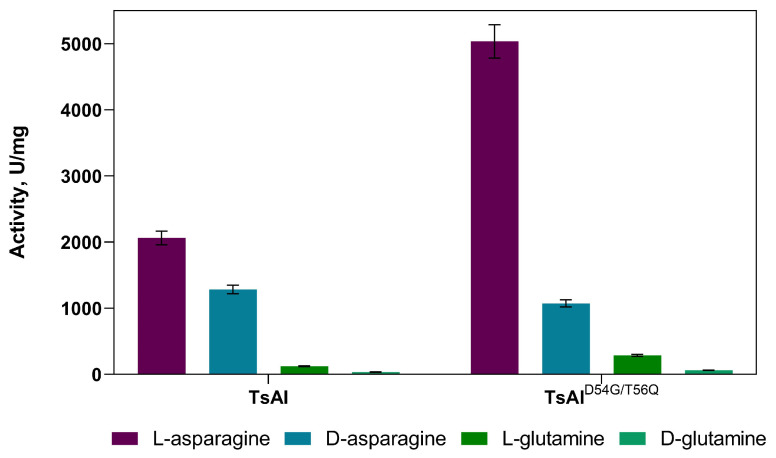
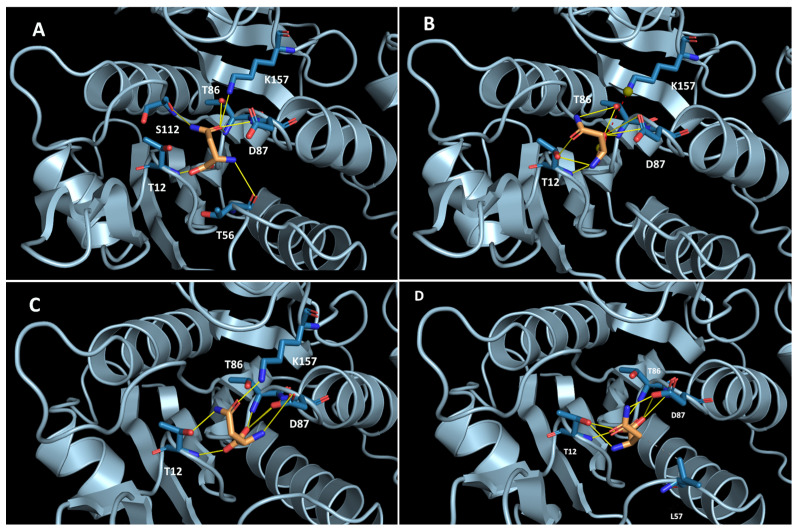
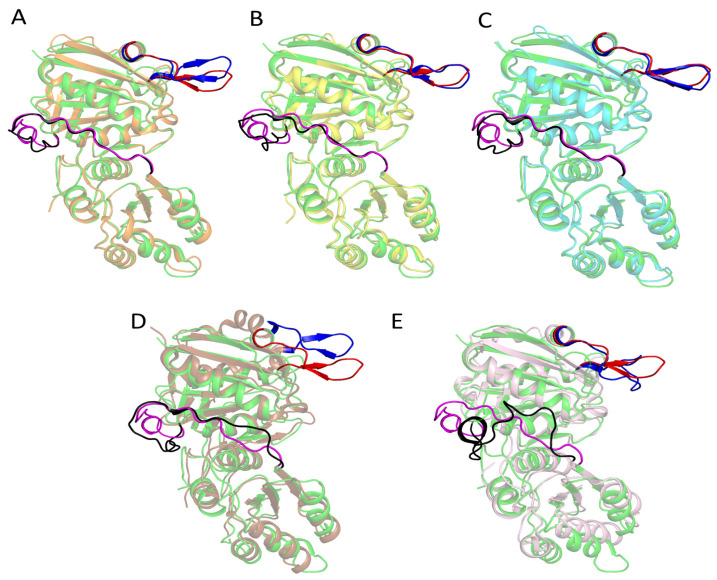
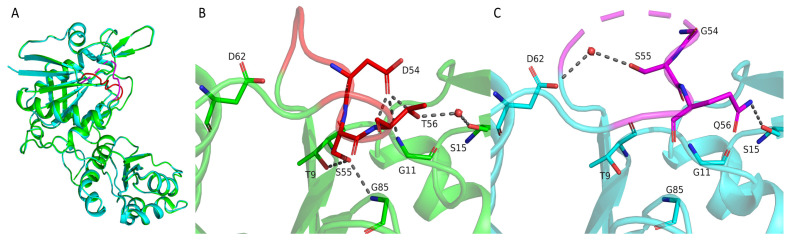
L-asparaginase (L-ASNase) is a key industrial enzyme significant for cancer therapy and the food industry for reducing dietary acrylamide. The hyperthermophilic L-ASNase from (TsAI) was previously shown to exhibit high activity and thermostability and is promising for biotechnology. To gain insights into structure-functional relationships of TsAI, determination of the substrate specificity, kinetic parameters, structural characterization, and molecular docking were performed. TsAI characteristics were compared with the TsAI mutant, which exhibited increased activity after a double mutation in the substrate-binding region. TsAI and TsAI were found to display high activity towards D-asparagine-62% and 21% of L-asparaginase activity, respectively-and low L-glutaminase coactivity of ~5%. Restoring the mesophilic-like triad GSQ in the mutant resulted in a two-fold increase in activity towards L-asparagine compared with TsAI. Crystal structures of TsAI forms solved at 1.9 Å resolution revealed that double mesophilic-like mutation increased the flexibility of the loop M51-L57, located in close proximity to the active site. Structural superposition and mutational analysis indicate that mobility of this loop is essential for the activity of thermo-ASNases. Molecular docking, without taking into account the temperature factor, showed that, in contrast to L-asparagine interaction, D-asparagine orientation in the TsAI and TsAI active sites is similar and not optimal for catalysis. Under real conditions, high temperatures can induce structural changes that reduce L-ASNase discrimination towards D-asparagine. Overall, the obtained structural and biochemical data provide a basis for a more detailed understanding of thermo-ASNase functioning and possibilities to engineer improved variants for future biotechnological application.
L-天冬酰胺酶(L-ASNase)是一种关键的工业酶,对癌症治疗和食品工业中减少膳食丙烯酰胺具有重要意义。来自嗜热栖热放线菌(TsAI)的嗜热L-天冬酰胺酶先前已显示出高活性和热稳定性,在生物技术领域具有广阔前景。为深入了解TsAI的结构-功能关系,进行了底物特异性测定、动力学参数测定、结构表征和分子对接。将TsAI的特性与TsAI突变体进行了比较,该突变体在底物结合区域发生双突变后活性增强。发现TsAI和TsAI对D-天冬酰胺均具有较高活性,分别为L-天冬酰胺酶活性的62%和21%,而L-谷氨酰胺酶的共活性较低,约为5%。与TsAI相比,突变体中恢复类似嗜温菌的三联体GSQ后,对L-天冬酰胺的活性提高了两倍。以1.9 Å分辨率解析的TsAI形式的晶体结构表明,类似嗜温菌的双突变增加了位于活性位点附近的M51-L57环的灵活性。结构叠加和突变分析表明,该环的流动性对热稳定天冬酰胺酶的活性至关重要。不考虑温度因素的分子对接显示,与L-天冬酰胺相互作用不同,TsAI和TsAI活性位点中D-天冬酰胺的取向相似,且对催化作用并非最佳。在实际条件下,高温可诱导结构变化,降低L-天冬酰胺酶对D-天冬酰胺的区分能力。总体而言,所获得的结构和生化数据为更详细地理解热稳定天冬酰胺酶的功能以及为未来生物技术应用设计改良变体提供了基础。