Zhang Yixi, Fan Boming, Gao Yanqing, Yang Jie, Zhang Weizhen, Su Shichen, Li Linxi, Li Huili, Luo Zhaorong, Tang Guangli, Wang Chenxi, Zhang Xueting, Liu Hehua, Gan Jianhua
State Key Laboratory of Genetics and Development of Complex Phenotypes, Collaborative Innovation Center of Genetics and Development, Shanghai Sci-Tech Inno Center for Infection & Immunity, Department of Biochemistry and Biophysics, School of Life Sciences, Fudan University, Shanghai 200438, PR China.
Nucleic Acids Res. 2025 Jun 20;53(12). doi: 10.1093/nar/gkaf562.
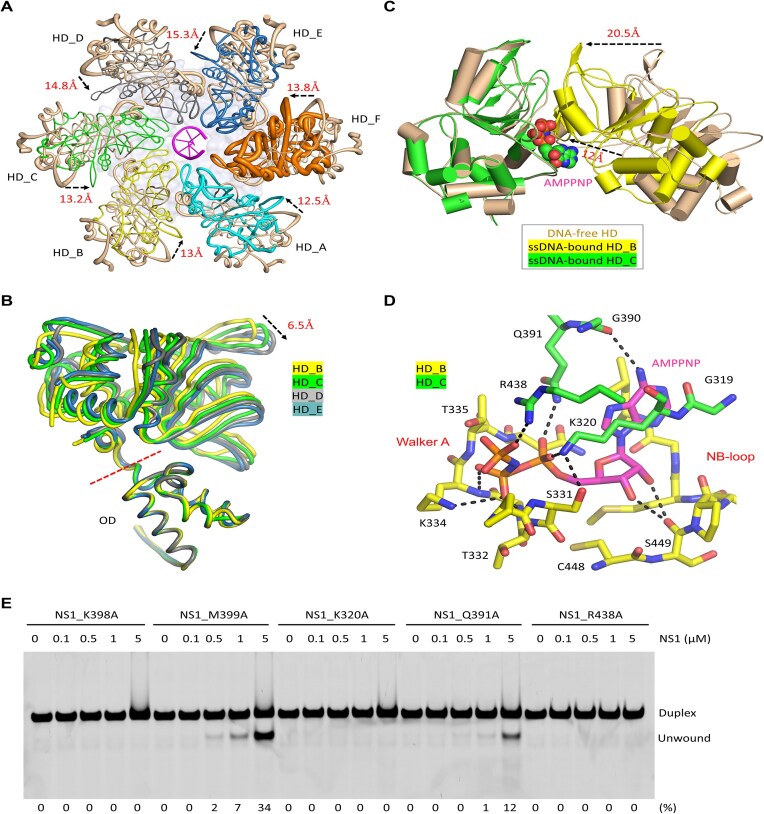
Parvovirus B19 (B19V) is a ubiquitous virus that can infect the majority of human population and cause erythema infectiosum, acute arthropathy, and many other diseases. The main replication protein NS1 plays a critical role in cell cycle arrest, transactivation of viral and host genes, and replication and package of B19V genome. Both DNA nicking and unwinding activities are required for the in vivo function of NS1, but the underlying basis is poorly understood. Here, we report extensive structural and biochemical studies of NS1, showing that NS1 can unwind various types of DNA substrates. The cryo-electron microscopy (cryo-EM) structures reveal the detailed mechanisms for ATP binding and hydrolysis, and DNA binding and unwinding by NS1. In addition to the SF3 HD domain, the C-terminal region is also required for double-stranded DNA (dsDNA) nicking by NS1. Unexpectedly, instead of enhancing, the dsDNA nicking activity of NS1 is negatively regulated by its DNA unwinding ability, suggesting that they likely function in different stages. This study advances our understanding of the structure and function of NS1 and other parvoviral replication proteins, such as the Rep proteins of adeno-associated virus.
细小病毒B19(B19V)是一种普遍存在的病毒,可感染大多数人群并引起传染性红斑、急性关节炎和许多其他疾病。主要复制蛋白NS1在细胞周期停滞、病毒和宿主基因的反式激活以及B19V基因组的复制和包装中起关键作用。DNA切口和解旋活性都是NS1体内功能所必需的,但其潜在机制尚不清楚。在这里,我们报告了对NS1的广泛结构和生化研究,表明NS1可以解开各种类型的DNA底物。冷冻电子显微镜(cryo-EM)结构揭示了NS1结合和水解ATP以及结合和解开DNA的详细机制。除了SF3 HD结构域外,NS1切割双链DNA(dsDNA)还需要C末端区域。出乎意料的是,NS1的dsDNA切口活性不是增强而是受到其DNA解旋能力的负调控,这表明它们可能在不同阶段发挥作用。这项研究增进了我们对NS1和其他细小病毒复制蛋白(如腺相关病毒的Rep蛋白)的结构和功能的理解。