González Sánchez Salud, García Fernández Jorge, Cascales-Campos Pedro Antonio, Gonzalez Gil Alida, Manzanedo Israel, Pereira Perez Fernando, Díaz Gómez Daniel, González-de Pedro Carlos, Asensio Diaz Enrique, Pacheco Sanchez David, Prada-Villaverde Aranzazu, Jaén Torrejimeno Isabel, Lacueva Javier, Caravaca-Garcia Iban, Torres-Melero Juan, Sanchez-García Susana, Díaz Reques Eduardo, Ramírez Plaza César, Gutiérrez-Calvo Alberto, González Bayón Luis, Morales-Soriano Rafael, López-Mozos Fernando, Bjelic Lana, Galindo Álvarez Julio, Marcello Fernandez Manuel Emilio, Turienzo Santos Estrella, Titos García Alberto, Álvarez Seoane Rosa, Artiles Armas Manuel, Garaulet Emilio Terol, Villarejo Campos Pedro, Boldó Roda Enrique, Rihuete Caro Cristina, García Fadrique Alfonso, Arjona-Sánchez Álvaro
Unit of Surgical Oncology, Reina Sofia University Hospital, Cordoba, Spain.
GE09 Research in Peritoneal and Retroperitoneal Oncologic Surgery Group, Maimonides Biomedical Research Institute of Cordoba, Reina Sofía University Hospital, University of Cordoba, Córdoba, Spain.
JAMA Netw Open. 2025 Jun 2;8(6):e2517676. doi: 10.1001/jamanetworkopen.2025.17676.
Ovarian cancer, often diagnosed at advanced stages, presents significant challenges in treatment and survival. Evaluation of different hyperthermic intraperitoneal chemotherapy (HIPEC) regimens could provide crucial insights to improve patient outcomes.
To evaluate whether HIPEC with paclitaxel (HIPEC-paclitaxel) is associated with similar oncological outcomes as HIPEC with cisplatin (HIPEC-cisplatin) in patients with advanced ovarian cancer undergoing interval cytoreductive surgery (iCRS).
DESIGN, SETTING, AND PARTICIPANTS: This multicenter retrospective cohort study included patients with advanced ovarian cancer who received iCRS and HIPEC. Patients with primary or secondary surgical procedures or nonovarian cancers were excluded. Data came from the National Registry of Peritoneal Carcinomatosis, which includes 27 Spanish specialized peritoneal oncology centers. Cases were included from January 2012 to December 2022. The study used propensity score matching to balance the groups and ensure comparability.
HIPEC-cisplatin and HIPEC-paclitaxel, administered during iCRS. The HIPEC regimen was selected based on the standard clinical protocol for advanced ovarian cancer.
The primary end points were overall survival (OS) and disease-free survival (DFS). The secondary end point was the rate of complications in each group. These outcomes were predefined prior to data collection.
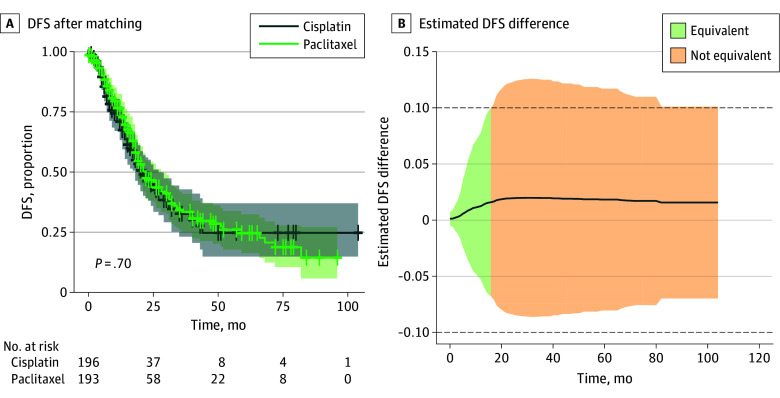
A total of 846 patients (mean [SD] age, 59.04 [11.01] years) were included (325 [38.4%] in HIPEC-cisplatin group; 521 [61.6%] in HIPEC-paclitaxel group), and 199 patients in each group were propensity score matched. Among these 398 matched patients, the HIPEC-paclitaxel group had similar DFS and OS compared with the HIPEC-cisplatin group. Additionally, similar morbidity was observed. Equivalence in OS and DFS was observed during the initial 20 and 15 months of follow-up, respectively, with an equivalence margin of 0.1 respectively.
In this cohort study of patients with advanced ovarian cancer, HIPEC-paclitaxel was associated with comparable oncologic outcomes as HIPEC-cisplatin, suggesting that it could be a viable alternative. These findings support its use, especially in patients in whom cisplatin could be contraindicated. Further studies may help refine treatment protocols and improve patient-specific outcomes.
卵巢癌通常在晚期被诊断出来,在治疗和生存方面面临重大挑战。评估不同的热灌注化疗(HIPEC)方案可为改善患者预后提供关键见解。
评估在接受间歇性肿瘤细胞减灭术(iCRS)的晚期卵巢癌患者中,紫杉醇热灌注化疗(HIPEC-紫杉醇)与顺铂热灌注化疗(HIPEC-顺铂)的肿瘤学结局是否相似。
设计、地点和参与者:这项多中心回顾性队列研究纳入了接受iCRS和HIPEC的晚期卵巢癌患者。排除接受初次或二次手术或患有非卵巢癌的患者。数据来自腹膜癌国家登记处,该登记处包括27个西班牙专业腹膜肿瘤学中心。病例纳入时间为2012年1月至2022年12月。该研究使用倾向评分匹配来平衡各组并确保可比性。
在iCRS期间给予HIPEC-顺铂和HIPEC-紫杉醇。HIPEC方案根据晚期卵巢癌的标准临床方案选择。
主要终点是总生存期(OS)和无病生存期(DFS)。次要终点是每组的并发症发生率。这些结局在数据收集之前预先确定。
共纳入846例患者(平均[标准差]年龄,59.04[11.01]岁)(HIPEC-顺铂组325例[38.4%];HIPEC-紫杉醇组521例[61.6%]),每组199例患者进行倾向评分匹配。在这398例匹配患者中,HIPEC-紫杉醇组与HIPEC-顺铂组的DFS和OS相似。此外,观察到相似的发病率。在随访的最初分别为20个月和15个月期间观察到OS和DFS的等效性,等效边际分别为0.1。
在这项针对晚期卵巢癌患者的队列研究中,HIPEC-紫杉醇与HIPEC-顺铂的肿瘤学结局相当,表明它可能是一种可行的替代方案。这些发现支持其应用,特别是在顺铂可能禁忌的患者中。进一步的研究可能有助于完善治疗方案并改善针对患者的结局。