Kiptinness Catherine, Naik Paulami, Kareithi Tabitha, Thuo Nicholas, Okello Phelix, Culquichicon Carlos, Rafferty Maeve, Abdulrashid Samira, Jomo Edwin, Nyamasyo Nicky, Wood Tony, Mendonca Rouella, Malen Rachel C, Dettinger Julia C, Pintye Jillian, Mwangi June, Stergachis Andy, Onentia Jonah, Curran Kelly, Mugambi Melissa Latigo, Were Daniel, Ngure Kenneth, Sharma Monisha, Ortblad Katrina F
Center for Clinical Research, Kenya Medical Research Institute, Nairobi, Kenya.
Department of Global Health, University of Washington, Seattle, Washington, USA.
J Int AIDS Soc. 2025 Jun;28 Suppl 1(Suppl 1):e26468. doi: 10.1002/jia2.26468.
The expansion of telecommunication networks and smartphones in many African countries could be leveraged to deliver HIV prevention products directly to consumers. In collaboration with a private e-commerce platform and online pharmacy in Kenya, MYDAWA, we piloted a new model of HIV pre- and post-exposure prophylaxis (PrEP/PEP) delivery.
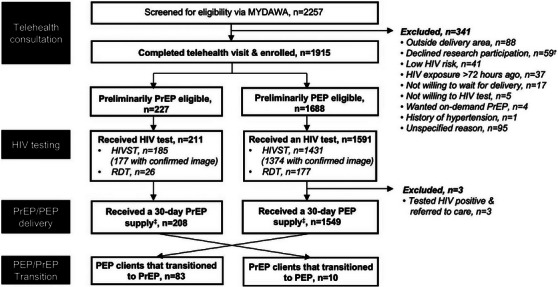
In the ePrEP Kenya pilot (NCT05377138), individuals living in Nairobi and Mombasa Counties could complete a free telehealth visit with a remote clinician to assess eligibility for online PrEP/PEP (i.e. ≥18 years; no medical contraindications). Eligible individuals could order HIV testing services-courier delivered to clients' choice location-for a fee of 250 KES (∼$2 USD) for self-testing or 150 KES (∼$1 USD) for provider-administered rapid diagnostic testing. Following confirmation of clients' HIV-negative status (via an uploaded test result image), free PrEP/PEP drugs from government supply were courier delivered with or separately from HIV testing services. Clients paid a delivery fee ≤149 KES (∼$1 USD) per courier visit.
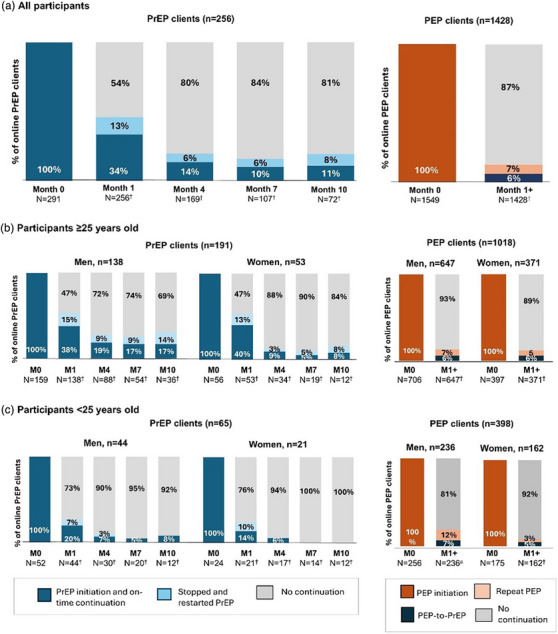
From October 2022 to December 2023, we screened 2257 individuals and enrolled 1915. Most PrEP/PEP clients were men (63%, 1428/1915), ≥25 years (72%, 1631/1915) and never married (80%, 1796/1915); few had ever used PrEP (3%, 48/1915) or PEP (14%, 263/1915). At enrolment, 227 (12%) were preliminarily eligible for PrEP and 1688 (88%) for PEP. Among PrEP-eligible clients, 89% (203/227) completed HIV testing and 92% (208/227) received PrEP; among PEP-eligible clients, 92% (1551/1688) completed HIV testing and 92% (1549/1688) received PEP. Most PrEP/PEP clients completed HIV testing within 6 hours of their telehealth visit (53%, 927/1757) and had drugs delivered with testing services (88%, 1546/1757). Among PrEP clients eligible for follow-up, 47% (120/256) continued PrEP and 4% (10/256) initiated PEP following PrEP discontinuation. Among PEP clients eligible for follow-up, 7% (99/1428) repeated PEP use and 6% (83/1428) transitioned from PEP to PrEP.).
Online PrEP/PEP delivery could expand access to prevention services by reaching individuals not engaged in existing delivery platforms. The uptake of online PEP was five times greater than PrEP, underscoring an unmet demand for PEP and highlighting the potential for online pharmacies to deliver time-sensitive PEP services.
在许多非洲国家,电信网络和智能手机的普及可用于直接向消费者提供艾滋病毒预防产品。我们与肯尼亚的一家私人电子商务平台和在线药房MYDAWA合作,试点了一种新的艾滋病毒暴露前和暴露后预防(PrEP/PEP)交付模式。
在肯尼亚电子PrEP试点项目(NCT05377138)中,居住在内罗毕和蒙巴萨县的个人可以与远程临床医生进行免费远程医疗问诊,以评估在线PrEP/PEP的资格(即≥18岁;无医学禁忌证)。符合条件的个人可以订购艾滋病毒检测服务——由快递送到客户选择的地点——自我检测费用为250肯尼亚先令(约2美元),由医护人员进行快速诊断检测费用为150肯尼亚先令(约1美元)。在确认客户艾滋病毒阴性状态(通过上传检测结果图像)后,政府供应的免费PrEP/PEP药物会与艾滋病毒检测服务一起或分开由快递送达。客户每次快递上门需支付≤149肯尼亚先令(约1美元)的送货费。
从2022年10月到2023年12月,我们筛查了2257人,招募了1915人。大多数PrEP/PEP客户为男性(63%,1428/1915),≥25岁(72%,1631/1915)且未婚(80%,1796/1915);很少有人曾使用过PrEP(3%,48/1915)或PEP(14%,263/1915)。在入组时,227人(12%)初步符合PrEP资格,1688人(88%)符合PEP资格。在符合PrEP资格的客户中,89%(203/227)完成了艾滋病毒检测,92%(208/227)接受PrEP;在符合PEP资格的客户中,92%(1551/1688)完成了艾滋病毒检测,92%(1549/1688)接受PEP。大多数PrEP/PEP客户在远程医疗问诊后6小时内完成艾滋病毒检测(53%,927/1757),且药物与检测服务一起送达(88%,1546/1757)。在符合随访条件的PrEP客户中,47%(120/256)继续使用PrEP,4%(10/256)在停用PrEP后开始使用PEP。在符合随访条件的PEP客户中,7%(99/1428)重复使用PEP,6%(83/1428)从PEP转为PrEP。
在线PrEP/PEP交付可以通过覆盖未参与现有交付平台的个人来扩大预防服务的可及性。在线PEP的接受度比PrEP高五倍,这突出了对PEP的未满足需求,并凸显了在线药房提供时效性强的PEP服务的潜力。