Singh Pushpendra, Khare Ruchi, Sharma Kuldeep, Bhargava Anudita, Negi Sanjay Singh
Department of Microbiology, All India Institute of Medical Sciences, Raipur 492099, Chhattīsgarh, India.
World J Virol. 2025 Jun 25;14(2):100001. doi: 10.5501/wjv.v14.i2.100001.
The evolutionary mutational changes of severe acute respiratory syndrome coronavirus 2 (SARS-CoV-2) since its emergence in Chhattisgarh, India in 2020 have warranted the need for the characterization of every lineage/sublineage that has evolved until February 2024.
To unravel the evolutionary pathway of SARS-CoV-2 in Chhattisgarh from 2020 to February 2024.
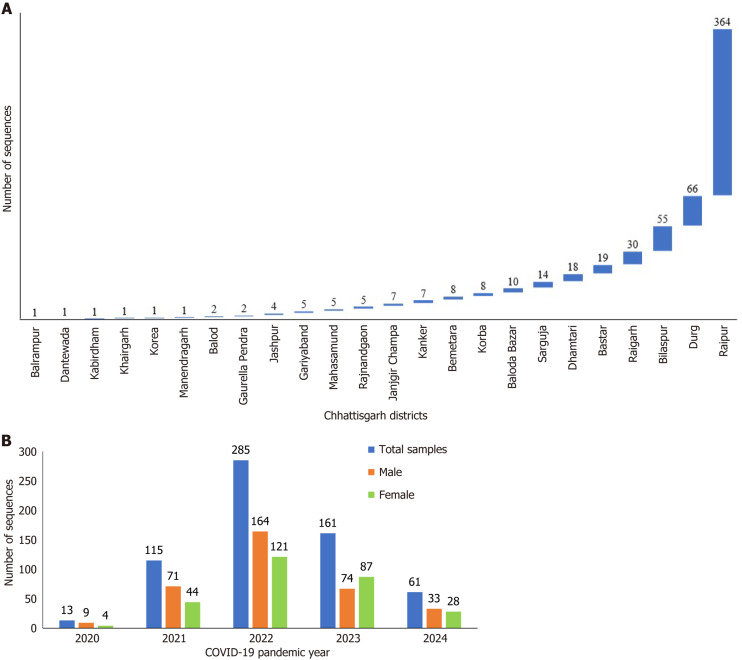
A total of 635 coronavirus disease 2019 cases obtained between 2020 and February 2024 were investigated by whole genome sequencing.
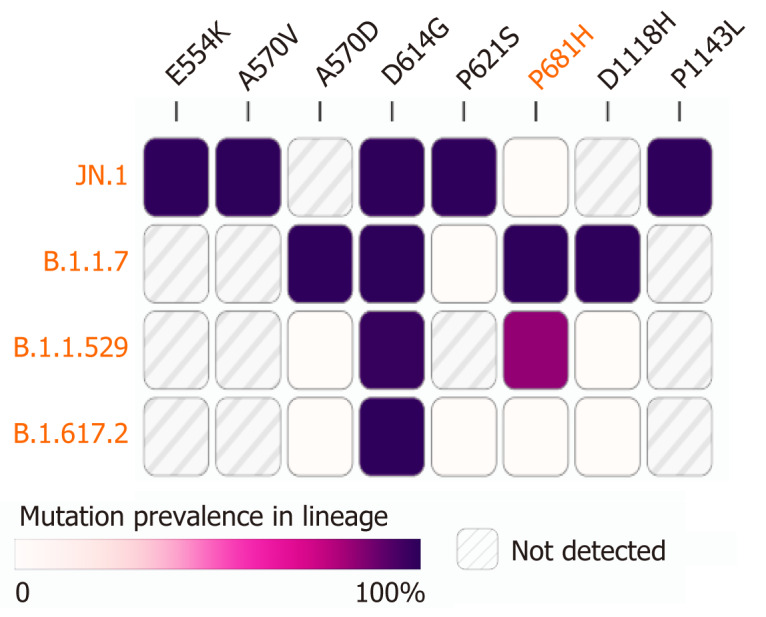
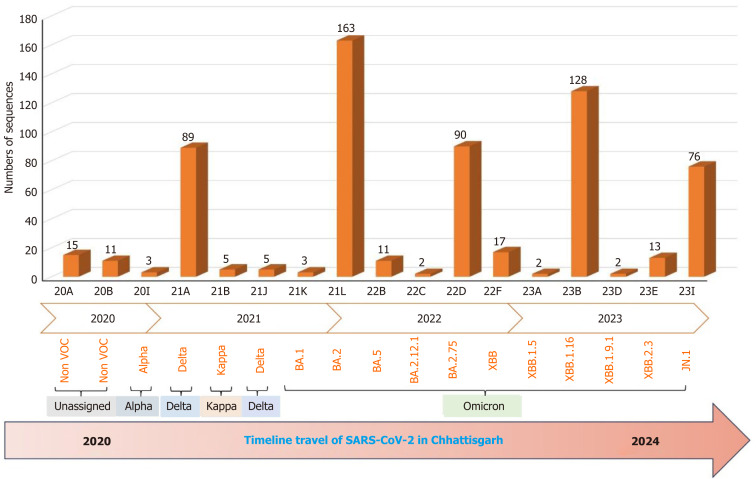
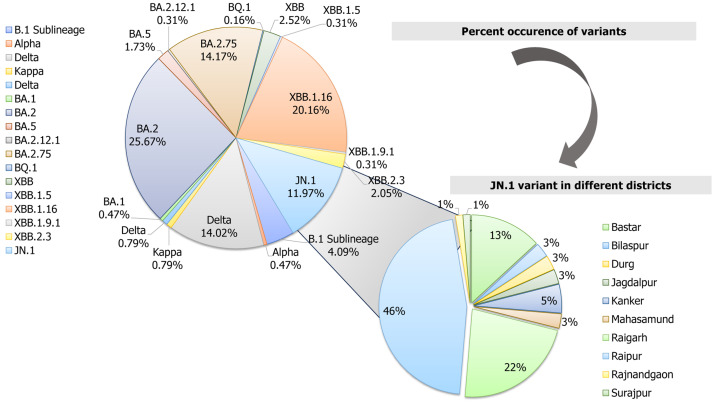
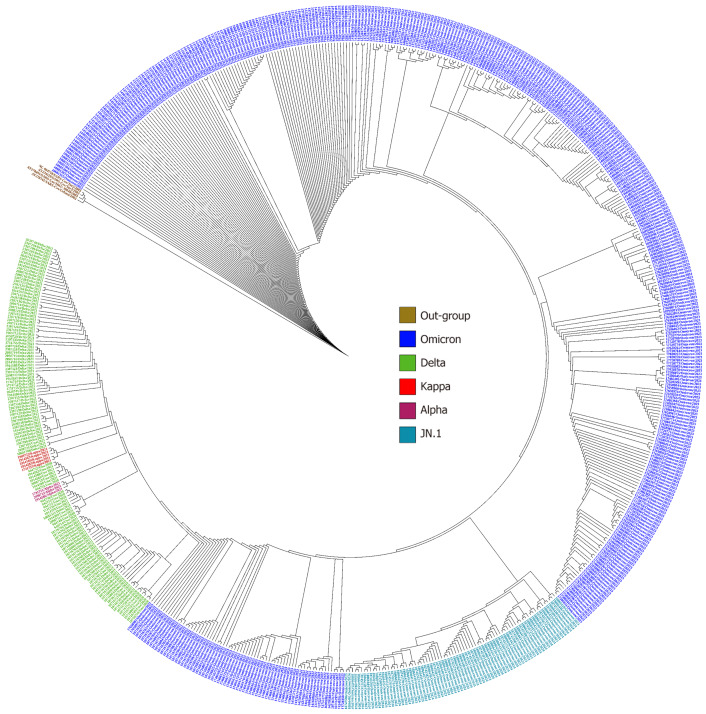
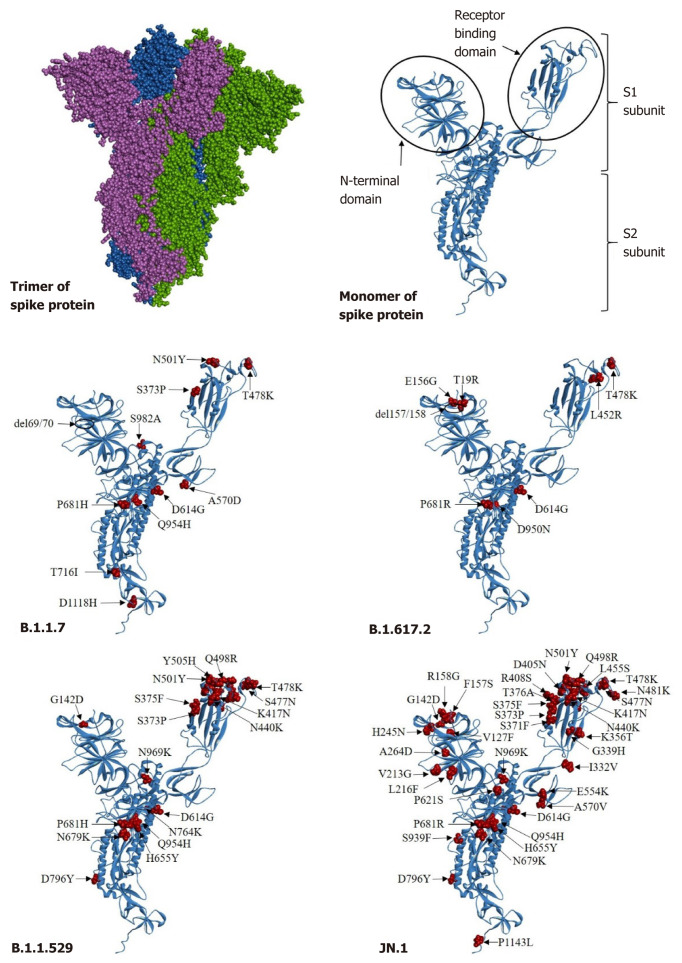
Whole genome sequencing analysis identified the evolution of SARS-CoV-2 into seventeen lineages from 2020 to 2024. SARS-CoV-2 initially emerged in Chhattisgarh in its Alpha (B.1.1.7) variant in 2020. Thereafter, it continuously underwent periodical mutational changes in the spike gene to further differentiate into various lineages/sublineages, viz., Kappa, Delta, BA.1, and BA.2 in 2021; the Omicron lineage (BA.5, BA.2.12.1, BA.2.75, BQ.1, and XBB) in 2022; the new Omicron lineage (XBB.1.5, XBB.1.16, XBB.1.9.1, and XBB.2.3) in 2023; and finally to JN.1 in January and February 2024. The predominant lineages over these 4 years were BA.1.1.7 (Alpha) in 2020, B.1.617.2 (Delta) in the period between 2021 and mid-2022, B.1.1.529 (Omicron) in late 2022 to 2023, and Omicron-JN.1 in early 2024. The presently circulating JN.1 lineage was observed harboring exclusive predominant mutations of E4554K, A570V, P621A, and P1143 L with 99% prevalence.
SARS-CoV-2 from 2020 to 2024 has evolved into 17 lineages/sublineages in Chhattisgarh. The presently circulating JN.1 harbored 40 mutations, especially E554K, A570V, P621S, and P1143 L, capacitating the virus with features of host cell entry, stability, replication, rapid transmissibility, and crucial immune evasion. Therefore, earlier immunity from either vaccination or prior infection may not protect against the current lineage and increases the possibility of future outbreaks. Thus, the periodical genomic surveillance of SARS-CoV-2 is essential for the genomic blueprint of the circulating virus, which may help in updating the vaccine strain and various basic research for developing appropriate therapeutics and diagnostics.
自2020年严重急性呼吸综合征冠状病毒2(SARS-CoV-2)在印度恰蒂斯加尔邦出现以来,其进化突变变化使得有必要对截至2024年2月进化出的每个谱系/亚谱系进行特征描述。
揭示2020年至2024年2月期间恰蒂斯加尔邦SARS-CoV-2的进化途径。
通过全基因组测序对2020年至2024年2月期间获得的635例2019冠状病毒病病例进行调查。
全基因组测序分析确定了2020年至2024年期间SARS-CoV-2进化为17个谱系。SARS-CoV-2于2020年最初在恰蒂斯加尔邦以其阿尔法(B.1.1.7)变体出现。此后,它在刺突基因中不断经历周期性突变变化,进一步分化为各种谱系/亚谱系,即2021年的卡帕、德尔塔、BA.1和BA.2;2022年的奥密克戎谱系(BA.5、BA.2.12.1、BA.2.75、BQ.1和XBB);2023年的新奥密克戎谱系(XBB.1.5、XBB.1.16、XBB.1.9.1和XBB.2.3);最后在2024年1月和2月进化为JN.1。这4年中的主要谱系分别是2020年的BA.1.1.7(阿尔法)、2021年至2022年年中期间的B.1.617.2(德尔塔)、2022年末至2023年的B.1.1.529(奥密克戎)以及2024年初的奥密克戎-JN.1。观察到当前流行的JN.1谱系具有E4554K、A570V、P621A和P1143L的独家主要突变,流行率为99%。
2020年至2024年期间,恰蒂斯加尔邦的SARS-CoV-2已进化为17个谱系/亚谱系。当前流行的JN.1有40个突变,特别是E554K、A570V、P621S和P1143L,使病毒具有宿主细胞进入、稳定性、复制、快速传播和关键免疫逃逸的特征。因此,先前通过疫苗接种或既往感染获得的免疫力可能无法抵御当前谱系,增加了未来爆发的可能性。因此,对SARS-CoV-2进行定期基因组监测对于了解流行病毒的基因组蓝图至关重要,这可能有助于更新疫苗株以及开展各种基础研究以开发合适的治疗方法和诊断方法。