Huang Liang-Chin, Paek Hunki, Lee Kyeryoung, Calay Ediz, Pillai Deepak, Ofoegbu Nneka, Lin Bin, Xu Hua, Wang Xiaoyan
IMO Health, Rosemont, IL, 60018, USA.
Department of Biomedical Informatics and Data Science, Yale School of Medicine, New Haven, CT, 06510, USA.
Res Sq. 2025 Jun 16:rs.3.rs-6728958. doi: 10.21203/rs.3.rs-6728958/v1.
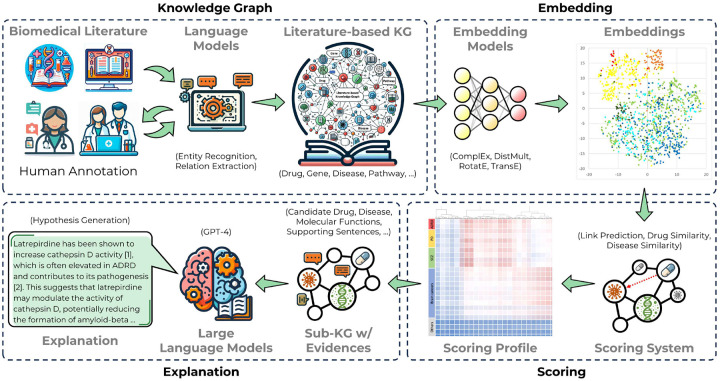
Drug repurposing offers a time-efficient and cost-effective approach for therapeutic development by finding new uses for existing drugs. Additionally, achieving explainability in drug repurposing remains a challenge due to the lack of transparency in decision-making processes, hindering researchers' understanding and trust in the generated insights. To address these issues, we present DrugReX, a system integrating a literature-based knowledge graph, embedding, scoring system, and explanation modules using large language models (LLMs). We validated DrugReX on 15 established drug repurposing cases, achieving significantly high scores. As a real-world use case, we applied DrugReX to identify candidate drugs for Alzheimer's disease and related dementias (ADRD) and thoroughly evaluated the pipeline. The system identified 25 promising candidates, with nine clustering with FDA-approved ADRD drugs and 10 linked to ongoing clinical trials. For explainability, an LLM was employed to generate explanations supported by evidence from the literature-based knowledge graph. Domain expert evaluation revealed that DrugReX-produced explanations were superior in quality and clarity than using an LLM alone, enhancing the explainability of repurposing predictions. This study represents the first integration of LLMs to provide explainable insights into drug repurposing, bridging computation precision with explainability, and thus, ultimately enabling more transparent and reliable decision-making in therapeutic development.
药物再利用通过为现有药物寻找新用途,为治疗开发提供了一种省时且具成本效益的方法。此外,由于决策过程缺乏透明度,在药物再利用中实现可解释性仍然是一项挑战,这阻碍了研究人员对所产生见解的理解和信任。为了解决这些问题,我们提出了DrugReX系统,该系统集成了基于文献的知识图谱、嵌入、评分系统以及使用大语言模型(LLMs)的解释模块。我们在15个已确立的药物再利用案例上对DrugReX进行了验证,取得了显著的高分。作为一个实际应用案例,我们将DrugReX应用于识别阿尔茨海默病及相关痴呆症(ADRD)的候选药物,并对整个流程进行了全面评估。该系统识别出了25个有前景的候选药物,其中9个与FDA批准的ADRD药物聚类,10个与正在进行的临床试验相关。为了实现可解释性,我们使用了一个大语言模型来生成基于文献知识图谱证据支持的解释。领域专家评估表明,DrugReX生成的解释在质量和清晰度上优于单独使用大语言模型,增强了再利用预测的可解释性。这项研究首次将大语言模型集成起来,为药物再利用提供可解释的见解,弥合了计算精度与可解释性之间的差距,从而最终在治疗开发中实现更透明、可靠的决策。