Pent Gabriel J, Swecker William S, Tracy Benjamin F
Shenandoah Valley Agricultural Research and Extension Center, Virginia Polytechnic Institute and State University, Raphine, VA 24472, USA.
Veterinary Teaching Hospital, Virginia-Maryland College of Veterinary Medicine, Virginia Polytechnic Institute and State University, Blacksburg, VA 24061, USA.
Transl Anim Sci. 2025 Jun 7;9:txaf075. doi: 10.1093/tas/txaf075. eCollection 2025.
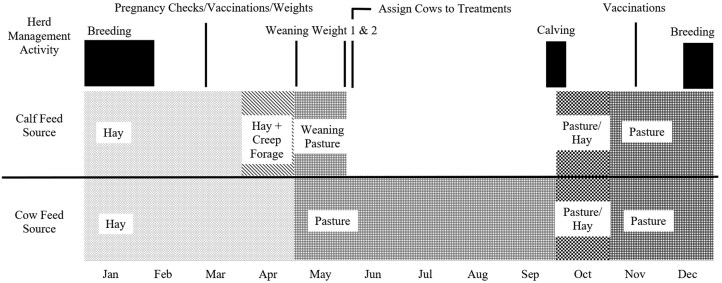
Providing calves with access to high-quality forage through creep grazing prior to weaning may help improve calf productivity. In this study of fall-calving herds, the productivity of a rotationally stocked forage system with 10% of the pasture area rotated between winter forages for creep grazing and summer forages (CRP) was compared to the productivity of rotationally (ROT) and continuously (CON) stocked, perennial forage systems. Calves in CRP were provided access to the creep forage 6 to 26 d before weaning and through a 2-wk weaning process. Creep forage nutritive value declined over sampling period. Cows in CON had lower (P = 0.02) hay requirements than cows in CRP. Cow body condition score (BCS) prior to the creep grazing period was greater for CON cows than cows in other systems (P ≤ 0.001). Spring calf body weight (BW) was lowest in ROT compared to calf BW in the other systems (P ≤ 0.008). Calf BW following a 2-wk weaning process was greater (P ≤ 0.002) for CON and CRP calves (246 ± 4 kg) than for ROT calves (226 ± 5 kg), with no difference in calf BW at weaning (P = 1.0) between CON and CRP. Calf average daily gain (ADG; 0.92 ± 0.04 kg day) from spring pregnancy checks through weaning did not differ between treatments (P ≥ 0.41). While creep grazing systems with cool-season annual forages increased fall-born calf weaning weights compared to rotationally stocked, perennial forage systems, the creep grazing systems required greater hay inputs without weaning weight improvements compared to continuously stocked, perennial forage systems.
在断奶前通过犊牛补饲让犊牛获取优质牧草,可能有助于提高犊牛的生产性能。在这项针对秋季产犊牛群的研究中,将一个轮牧牧草系统(10%的牧场面积在冬季用于犊牛补饲的牧草和夏季牧草(CRP)之间轮换)的生产性能,与轮牧(ROT)和连续放牧(CON)的多年生牧草系统的生产性能进行了比较。CRP组的犊牛在断奶前6至26天以及为期2周的断奶过程中可以获取补饲牧草。在采样期间,补饲牧草的营养价值下降。CON组的母牛比CRP组的母牛干草需求量更低(P = 0.02)。在补饲放牧期之前,CON组母牛的体况评分(BCS)高于其他系统中的母牛(P≤0.001)。与其他系统中的犊牛体重相比,ROT组春季犊牛体重最低(P≤0.008)。经过2周断奶过程后,CON组和CRP组犊牛的体重(246±4千克)高于ROT组犊牛(226±5千克)(P≤0.002),CON组和CRP组犊牛断奶时的体重没有差异(P = 1.0)。从春季妊娠检查到断奶期间,各处理组犊牛的平均日增重(ADG;0.92±0.04千克/天)没有差异(P≥0.41)。虽然与轮牧的多年生牧草系统相比,使用冷季一年生牧草的补饲放牧系统增加了秋季出生犊牛的断奶体重,但与连续放牧的多年生牧草系统相比,补饲放牧系统需要更多的干草投入,且断奶体重没有提高。