Chisompola David, Nzobokela John, Moono Roy, Chinyante Elijah, Chipipa Allen, Chapuswike Nancy, Chakopo Moses, Mukuma Nswana, Chakulya Martin
Pathology Laboratory Department, Arthur Davison Children's Hospital, Ndola, Zambia.
Pathology Laboratory Department, Ndola Teaching Hospital, Ndola, Zambia.
BMC Infect Dis. 2025 Jul 1;25(1):879. doi: 10.1186/s12879-025-11259-w.
Cholera remains a significant public health challenge in Zambia, particularly in the Copperbelt Province, where antibiotic-resistant Vibrio cholerae strains are increasingly threatening treatment efficacy. This study aimed to determine the prevalence of cholera and the antibiotic resistance patterns of V. cholerae isolates at three tertiary hospitals in the region.
A retrospective cross-sectional study was conducted across three major referral hospitals in the Copperbelt Province (Arthur Davison Children's Hospital, Kitwe Teaching Hospital, and Ndola Teaching Hospital) during the cholera outbreak from January to April 2024. Clinical samples from suspected cholera cases were analysed, and antimicrobial susceptibility testing was performed following Clinical Laboratory Standards Institute guidelines and the European committee on antimicrobial susceptibility testing methodology for Vibrio cholerae. To isolate Vibrio cholerae, alkaline peptone water and thiosulfate-citrate-bile salt-sucrose agar were utilized. The isolates were identified based on colony morphology, Gram staining, biochemical testing, and serotyping. Antimicrobial susceptibility testing was conducted by using the Kirby-Bauer disk diffusion method. Descriptive statistics were employed to assess the prevalence of Vibrio cholerae, and chi-square tests were applied with p-values of < 0.05 indicating statistical significance.
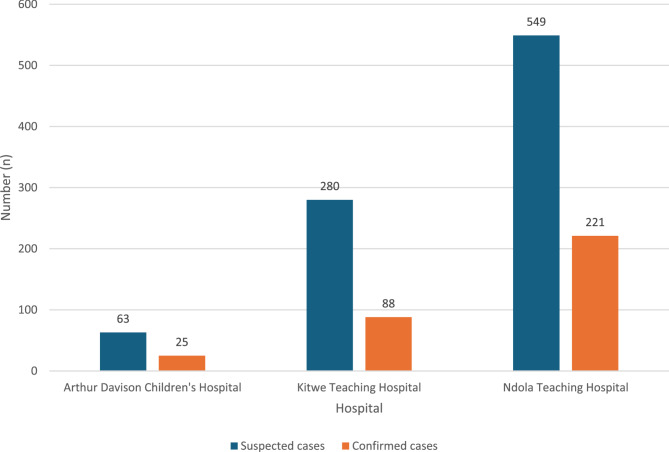
Of the 892 suspected cases, 334 (37.4%) were confirmed as V. cholerae through culture. The highest number of V. cholerae confirmed cases was recorded at Ndola Teaching Hospital 221 (24.8%), followed by Kitwe Teaching Hospital 88 (9.9%), while Arthur Davison Children's Hospital 25 (2.8%) reported the lowest. High antimicrobial resistance was observed trimethoprim/sulfamethoxazole 69 (74.2%), ampicillin 75 (54.3%), and imipenem 22 (46.8%). In contrast, erythromycin 25 (100%), gentamicin 6 (85.7%) and ciprofloxacin 118 (76.6%) remained highly effective. The overall prevalence of multidrug resistance (MDR) in Vibrio cholerae was 3.7%. Among these, resistance to four or more antibiotics was observed in 3 (1.2%), followed by resistance to the combination of Ciprofloxacin, Ceftazidime, and Tetracycline in 2 (0.8%). All other MDR patterns were detected in a single isolate each (0.4%).
The high prevalence of antibiotic-resistant Vibrio cholerae in the Copperbelt Province underscores the urgent need for enhanced antimicrobial stewardship and robust surveillance systems to inform effective cholera control strategies. Sustainable public health impact can be achieved through targeted immunization campaigns in endemic areas combined with strengthened water, sanitation, and hygiene (WASH) interventions, including improved access to clean water, adequate sanitation infrastructure, hygiene promotion, and supportive policies, which are essential for reducing transmission and preventing future outbreaks in vulnerable populations. However, because the number of antibiotics used in antimicrobial susceptibility testing across isolates varies, these results should be interpreted cautiously. Such differences may affect the comparability and overall interpretation of resistance patterns.

霍乱仍是赞比亚一项重大的公共卫生挑战,尤其是在铜带省,耐抗生素的霍乱弧菌菌株对治疗效果的威胁日益增大。本研究旨在确定该地区三家三级医院中霍乱的流行情况以及霍乱弧菌分离株的抗生素耐药模式。
2024年1月至4月霍乱疫情期间,在铜带省的三家主要转诊医院(亚瑟·戴维森儿童医院、基特韦教学医院和恩多拉教学医院)开展了一项回顾性横断面研究。对疑似霍乱病例的临床样本进行分析,并按照临床实验室标准协会指南以及欧洲抗菌药物敏感性测试委员会针对霍乱弧菌的方法进行抗菌药物敏感性测试。为分离霍乱弧菌,使用了碱性蛋白胨水和硫代硫酸盐-柠檬酸盐-胆盐-蔗糖琼脂。根据菌落形态、革兰氏染色、生化测试和血清分型对分离株进行鉴定。采用 Kirby-Bauer 纸片扩散法进行抗菌药物敏感性测试。运用描述性统计评估霍乱弧菌的流行情况,并应用卡方检验,p值<0.05表示具有统计学意义。
在892例疑似病例中,334例(37.4%)通过培养确诊为霍乱弧菌。恩多拉教学医院确诊的霍乱弧菌病例数最多,为221例(24.8%),其次是基特韦教学医院88例(9.9%),而亚瑟·戴维森儿童医院25例(2.8%)报告的病例数最少。观察到对多种抗菌药物的高耐药性,甲氧苄啶/磺胺甲恶唑69例(74.2%)、氨苄西林75例(54.3%)和亚胺培南22例(46.8%)。相比之下,红霉素25例(100%)、庆大霉素6例(85.7%)和环丙沙星118例(76.6%)仍然高度有效。霍乱弧菌多重耐药(MDR)的总体患病率为3.7%。其中,观察到对四种或更多种抗生素耐药的有3例(1.2%),其次是对环丙沙星、头孢他啶和四环素组合耐药的有2例(0.8%)。所有其他MDR模式在每个分离株中各检测到1例(0.4%)。
铜带省耐抗生素霍乱弧菌的高患病率凸显了迫切需要加强抗菌药物管理和健全监测系统,以制定有效的霍乱控制策略。通过在流行地区开展有针对性的免疫接种运动,结合加强水、环境卫生和个人卫生(WASH)干预措施,包括改善清洁水供应、完善卫生基础设施、促进个人卫生以及制定支持性政策,对于减少传播和预防弱势群体未来爆发霍乱至关重要,从而可实现可持续的公共卫生影响。然而,由于各分离株抗菌药物敏感性测试中使用的抗生素数量不同,这些结果应谨慎解读。此类差异可能会影响耐药模式的可比性和整体解读。