Lin Chih-Hsueh, Chou Che-Yi, Li Tsai-Chung, Liu Chiu-Shong, Lin Wen-Yuan, Li Chia-Ing, Yang Chuan-Wei, Lin Cheng-Chieh
School of Medicine, College of Medicine, China Medical University, Taichung, Taiwan, Republic of China.
Department of Family Medicine, China Medical University Hospital, Taichung, Taiwan, Republic of China.
Clin Interv Aging. 2025 Jun 27;20:903-909. doi: 10.2147/CIA.S518738. eCollection 2025.
Elderly with frailty are more at risk of cardiovascular disease and all-cause mortality than the general population. Albuminuria is a risk factor for atherosclerosis, a major cause of frailty. We investigated the association between frailty and albuminuria in community-dwelling elderly.
This was a cross-sectional study for analyzing 1347 participants aged at least 65 years in the north district of Taichung, Taiwan. We defined the frailty phenotype as at least three characteristics: weight loss, exhaustion, weakness, slow walking speed, and decreased physical activity. We collected random urine and measured all participants' albumin/creatinine ratio (ACR). We analyzed the association between frailty and ACR using logistic regression with adjustments for confoundings.
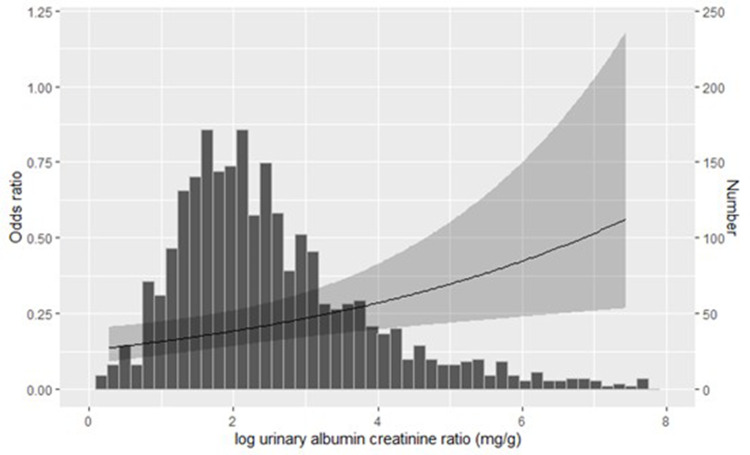
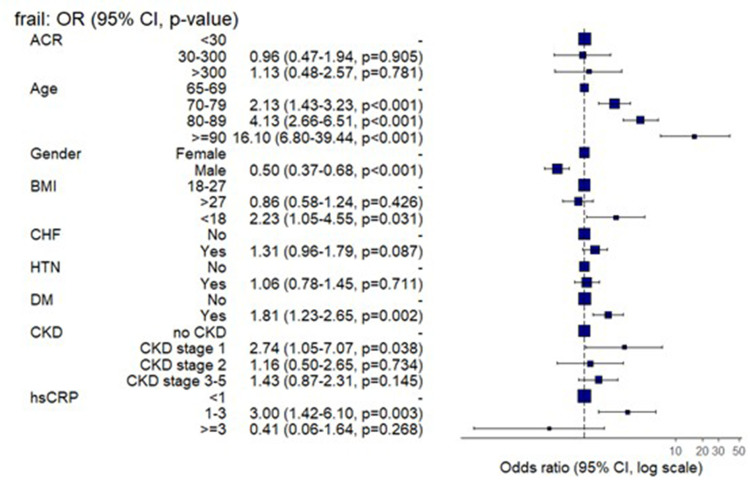
The average age of 1347 participants was 76 ± 7 years, and 649 (48.2%) were male. Two hundred and forty-two (18.7) participants were robust, 853 (63.3%) participants were pre-frail, and 242 (18%) were frail. One thousand sixty-four (79%) participants had an ACR < 30 mg/g; the highest ACR was 2825 mg/g. The odds ratio of ACR was 1.12 (95% confidence interval 1.05-1.25, p = 0.001) with adjustments for age, body mass index, estimated glomerular filtration rate, diabetes, liver function, and cholesterol.
Frailty is associated with urinary albuminuria in community-dwelling elderly, and this association is independent of traditional and non-traditional cardiovascular risk factors.
与一般人群相比,体弱的老年人患心血管疾病和全因死亡率的风险更高。蛋白尿是动脉粥样硬化的一个风险因素,而动脉粥样硬化是体弱的一个主要原因。我们调查了社区居住老年人中体弱与蛋白尿之间的关联。
这是一项横断面研究,分析了台湾台中市北区1347名年龄至少65岁的参与者。我们将体弱表型定义为至少具备以下三个特征:体重减轻、疲惫、虚弱、步速缓慢和身体活动减少。我们收集了随机尿液样本,并测量了所有参与者的白蛋白/肌酐比值(ACR)。我们使用逻辑回归分析了体弱与ACR之间的关联,并对混杂因素进行了调整。
1347名参与者的平均年龄为76±7岁,其中649名(48.2%)为男性。242名(18.7%)参与者身体健壮,853名(63.3%)参与者为虚弱前期,242名(18%)参与者体弱。1064名(79%)参与者的ACR<30mg/g;最高ACR为2825mg/g。在对年龄、体重指数、估计肾小球滤过率、糖尿病、肝功能和胆固醇进行调整后,ACR的比值比为1.12(95%置信区间1.05-1.25,p=0.001)。
社区居住老年人中的体弱与尿蛋白有关,且这种关联独立于传统和非传统的心血管风险因素。