
靶向大麻素受体1以拮抗促纤维化肺泡巨噬细胞可减轻肺纤维化。
Targeting cannabinoid receptor 1 for antagonism in pro-fibrotic alveolar macrophages mitigates pulmonary fibrosis.
作者信息
Basu Abhishek, Arif Muhammad, Wolf Kaelin M, Behee Madeline, Johnson Natalie, Pommerolle Lenny, Pineda Ricardo H, Sembrat John, Zawatsky Charles N, Dvorácskó Szabolcs, Coffey Nathan J, Park Joshua K, Karagoz Seray B, Godlewski Grzegorz, Jourdan Tony, Harvey-White Judith, Königshoff Melanie, Iyer Malliga R, Cinar Resat
机构信息
Section on Fibrotic Disorders and.
Laboratory of Cardiovascular Physiology and Tissue Injury, National Institute on Alcohol Abuse and Alcoholism, NIH, Rockville, Maryland, USA.
出版信息
JCI Insight. 2025 Jul 3;10(15). doi: 10.1172/jci.insight.187967. eCollection 2025 Aug 8.
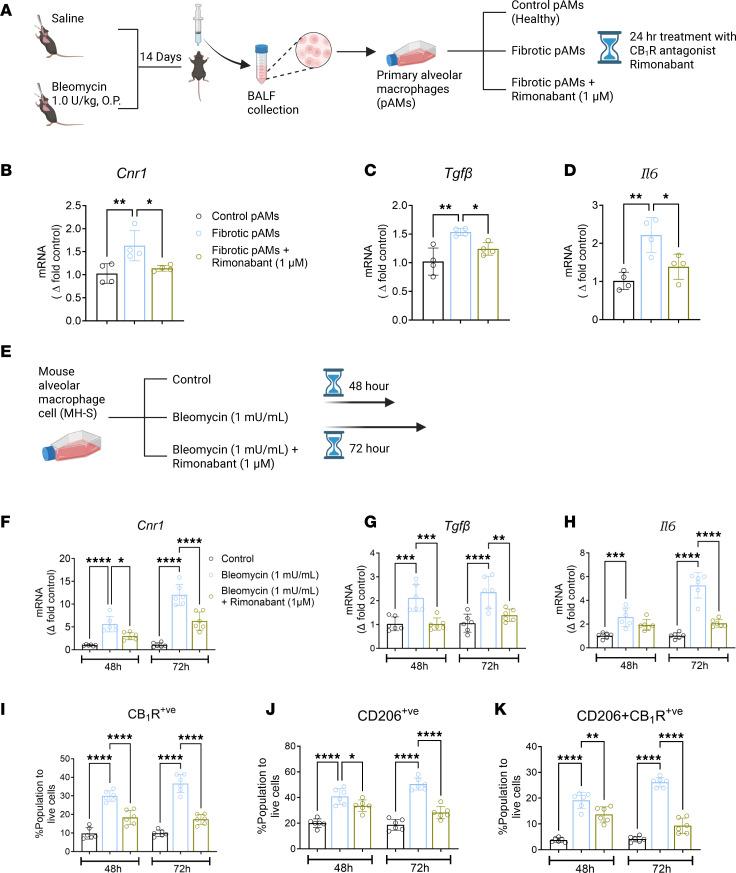
Pulmonary fibrosis (PF) is a life-threatening disease that requires effective and well-tolerated therapeutic modalities. Previously, the distinct pathogenic roles of cannabinoid receptor 1 (CB1R) and inducible nitric oxide synthase (iNOS) in the lungs and their joint therapeutic targeting were highlighted in PF. However, the cell-specific role of CB1R in PF has not been explored. Here, we demonstrate that CB1R in alveolar macrophages (AMs) mediates the release of anandamide into the alveoli, which promotes PF by inducing pro-fibrotic macrophages that are accessible to locally delivered antifibrotic therapy. A multitargeted therapy may improve therapeutic efficacy in PF. Pulmonary delivery of 0.5 mg/kg/d MRI-1867 (zevaquenabant), a peripherally acting hybrid CB1R/iNOS inhibitor, was as effective as systemic delivery of 10 mg/kg/d and also matched the efficacy of nintedanib in mitigating bleomycin-induced PF. A systems pharmacology approach revealed that zevaquenabant and nintedanib treatments reversed pathologic changes in both distinct and shared PF-related pathways, which are conserved in human and mouse. Moreover, zevaquenabant treatment also attenuated fibrosis and pro-fibrotic mediators in human precision-cut lung slices. These findings establish CB1R-expressing AMs as a therapeutic target and support local delivery of dual CB1R/iNOS inhibitor zevaquenabant by inhalation as an effective, well-tolerated, and safe strategy for PF.
肺纤维化(PF)是一种危及生命的疾病,需要有效且耐受性良好的治疗方式。此前,大麻素受体1(CB1R)和诱导型一氧化氮合酶(iNOS)在肺部的不同致病作用及其联合治疗靶点在PF中得到了突出强调。然而,CB1R在PF中的细胞特异性作用尚未得到探索。在此,我们证明肺泡巨噬细胞(AM)中的CB1R介导花生四烯乙醇胺释放到肺泡中,通过诱导可接受局部递送抗纤维化治疗的促纤维化巨噬细胞来促进PF。多靶点治疗可能会提高PF的治疗效果。以0.5 mg/kg/d的剂量经肺部递送MRI-1867(泽伐喹班),一种外周作用的CB1R/iNOS混合抑制剂,其效果与以10 mg/kg/d的剂量全身递送相当,并且在减轻博来霉素诱导的PF方面与尼达尼布的疗效相当。一种系统药理学方法表明,泽伐喹班和尼达尼布治疗可逆转人类和小鼠中不同且共同的PF相关途径中的病理变化。此外,泽伐喹班治疗还可减轻人精密切割肺切片中的纤维化和促纤维化介质。这些发现将表达CB1R的AM确立为治疗靶点,并支持通过吸入局部递送双重CB1R/iNOS抑制剂泽伐喹班作为一种有效、耐受性良好且安全的PF治疗策略。




 Zotero 插件