
将不相容的串联光生物催化整合到人工细胞中可实现天然细胞的代谢调控。
Integrating incompatible tandem photobiocatalysis in artificial cells enables metabolic modulation of natural cells.
作者信息
Wang Zhicheng, Chali Sharafudheen Pottanam, Doan-Nguyen Thao P, Kim Seunghyeon, Mailänder Volker, Jiang Shuai, Landfester Katharina
机构信息
Max Planck Institute for Polymer Research, Ackermannweg 10, 55128 Mainz, Germany.
Dermatology Department, University Medicine Mainz, Langenbeckstr. 1, 55131 Mainz, Germany.
出版信息
Sci Adv. 2025 Jul 4;11(27):eadu4828. doi: 10.1126/sciadv.adu4828.
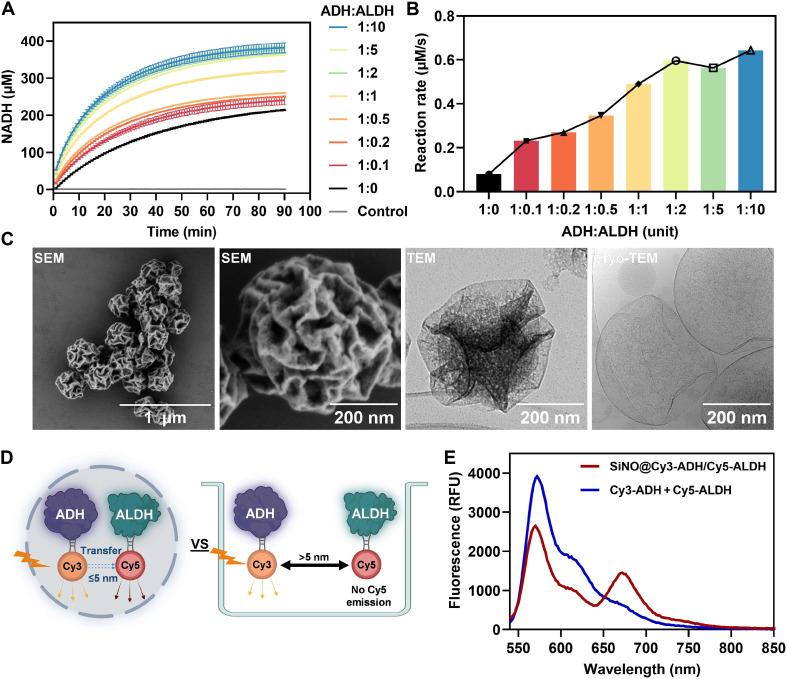
Sustaining biological reactions in artificial cells is crucial for their practical integration into living systems, which relies on continuous cofactor supply. Although photocatalysis enables cofactor regeneration in synthetic biological systems, the generated reactive oxygen can deactivate enzymes. Here, we engineer photobiocatalytic artificial cells that modulate hepatocyte metabolism through alleviating alcohol-induced oxidative stress. These artificial cells feature nano-organelles that segregate incompatible modules: one for photocatalytic cofactor regeneration and another for biocatalytic alcohol metabolism. This spatial separation ensures sustainable cofactor provision and protects enzymes from oxidative damage. Co-compartmentalization of alcohol dehydrogenase and aldehyde dehydrogenase within a single nano-organelle enhances cascade reaction efficiency while inhibiting intermediate leakage. When cocultured with hepatocytes, these artificial cells demonstrate excellent biocompatibility and efficiently mitigate oxidative stress from alcohol metabolism. This work advances artificial cells from proof of concept to practical application in living systems. The successful connection of photocatalysis and enzymatic reactions broadens the range of strategies available for chemical synthesis, synthetic biology, and biomedical applications.
在人工细胞中维持生物反应对于将其实际整合到生命系统中至关重要,这依赖于连续的辅因子供应。尽管光催化能够在合成生物系统中实现辅因子再生,但产生的活性氧会使酶失活。在此,我们构建了光生物催化人工细胞,通过减轻酒精诱导的氧化应激来调节肝细胞代谢。这些人工细胞具有纳米细胞器,可分隔不相容的模块:一个用于光催化辅因子再生,另一个用于生物催化酒精代谢。这种空间分离确保了辅因子的可持续供应,并保护酶免受氧化损伤。将乙醇脱氢酶和乙醛脱氢酶共分隔在单个纳米细胞器中可提高级联反应效率,同时抑制中间产物泄漏。当与肝细胞共培养时,这些人工细胞表现出优异的生物相容性,并有效减轻酒精代谢产生的氧化应激。这项工作将人工细胞从概念验证推进到生命系统中的实际应用。光催化与酶促反应的成功结合拓宽了化学合成、合成生物学和生物医学应用可用策略的范围。




 Zotero 插件