van Essen Rens R T, Kaur Jatinder, Li Tongda, Mann Ross C, Sawbridge Tim I
Department of Energy, Environment and Climate Action, Agriculture Victoria, AgriBio, Centre for AgriBioscience, Melbourne, VIC, Australia.
School of Applied Systems Biology, La Trobe University, Melbourne, VIC, Australia.
Front Microbiol. 2025 Jun 25;16:1621463. doi: 10.3389/fmicb.2025.1621463. eCollection 2025.
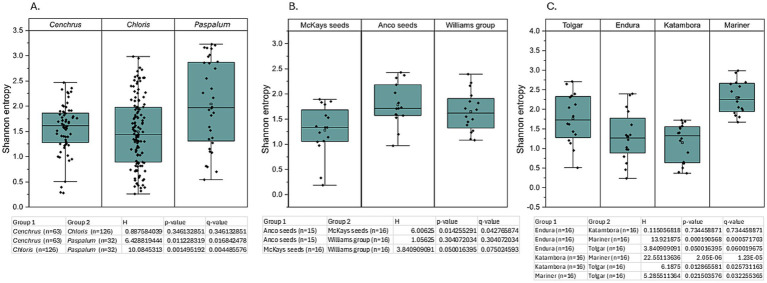
A rapidly changing climate has resulted in increasing challenges for farmers. This has led to an increase in demand for beneficial microbes to help fight these challenges faced by farmers, improving crop production under harsh conditions. Increasing temperatures caused by the changing climate will also affect the dairy industry in temperate climates around the world. This has resulted in an increasing importance of warm-season pasture grasses to fill the feed gaps left by the affected temperate grasses. In this study, we assessed the microbial communities present in commercially available warm-season pasture grass seeds. We utilised amplicon metagenomics to profile and compare the bacterial and fungal communities of seeds from three different genera of warm-season pasture grasses. Microbial isolations have also been performed to assess the culturability of the seed microbiome. Significant differences in drivers of bacterial and fungal communities within warm-season pasture grass seeds were observed. In addition, most of the bacteria present in high abundance were found to be culturable, while a relatively lower percentage of abundant fungi were culturable. Analysis of the bacterial communities showed considerable variation between different distributors, possibly driven by differing seed processing methods. This variation indicates that the bacterial communities could be manipulated by providing different bacteria to the seed to promote plant growth under different conditions. In contrast, the fungal communities were more strongly driven by the genetics of the respective host genera. This suggests that differences in fungal strain levels could be exploited for modification of fungal microbiome effects.
气候变化迅速给农民带来了越来越多的挑战。这导致对有益微生物的需求增加,以帮助应对农民面临的这些挑战,从而在恶劣条件下提高作物产量。气候变化导致的气温上升也将影响全球温带气候地区的乳制品行业。这使得暖季牧草的重要性日益增加,以填补受影响的温带牧草留下的饲料缺口。在本研究中,我们评估了市售暖季牧草种子中存在的微生物群落。我们利用扩增子宏基因组学对三种不同属的暖季牧草种子的细菌和真菌群落进行了分析和比较。还进行了微生物分离,以评估种子微生物组的可培养性。观察到暖季牧草种子内细菌和真菌群落的驱动因素存在显著差异。此外,发现大多数高丰度存在的细菌是可培养的,而丰度较高的真菌中可培养的比例相对较低。对细菌群落的分析表明,不同经销商之间存在相当大的差异,这可能是由不同的种子加工方法驱动的。这种差异表明,可以通过向种子提供不同的细菌来操纵细菌群落,以促进不同条件下的植物生长。相比之下,真菌群落受各自宿主属的遗传学影响更大。这表明可以利用真菌菌株水平的差异来改变真菌微生物组的作用。