Yao Qinfan, Chen Yitong, Zhang Xinyi, Wang Lefeng, Li Jingyi, Lv Junhao, Chen Jianghua, Chen Dajin
Kidney Disease Center, the First Affiliated Hospital, College of Medicine, Zhejiang University, Qingchun Road 79, Hangzhou, 310003, China.
Key Laboratory of Kidney Disease Prevention and Control Technology, Zhejiang Province, Hangzhou, 310003, China.
J Transl Med. 2025 Jul 10;23(1):771. doi: 10.1186/s12967-025-06817-4.
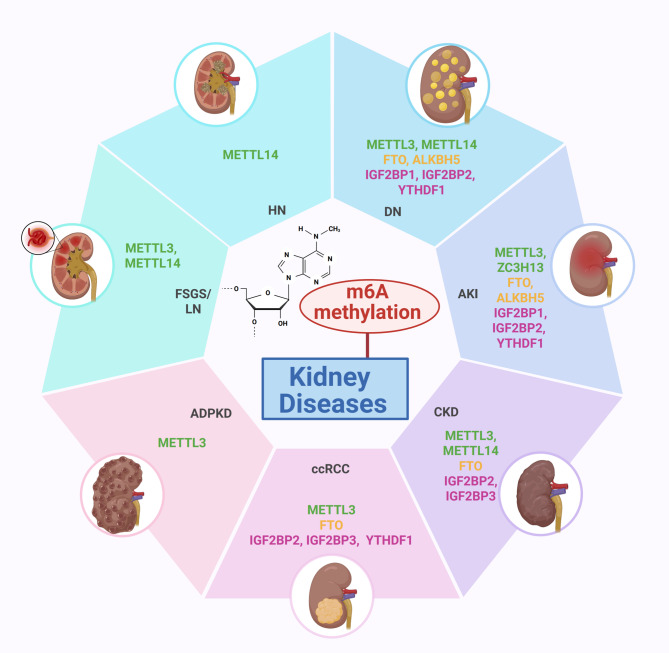
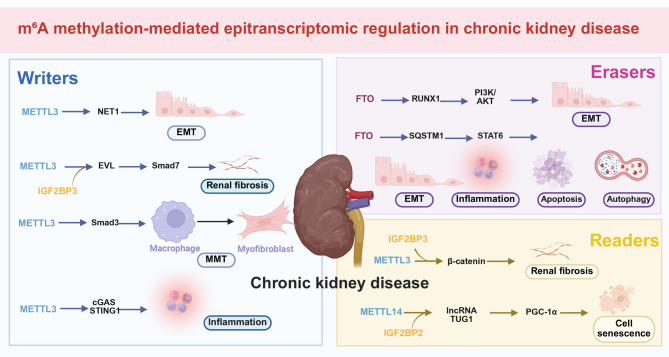
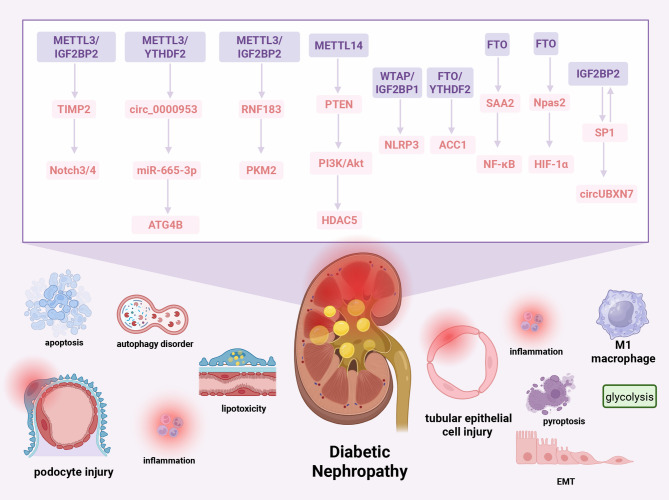
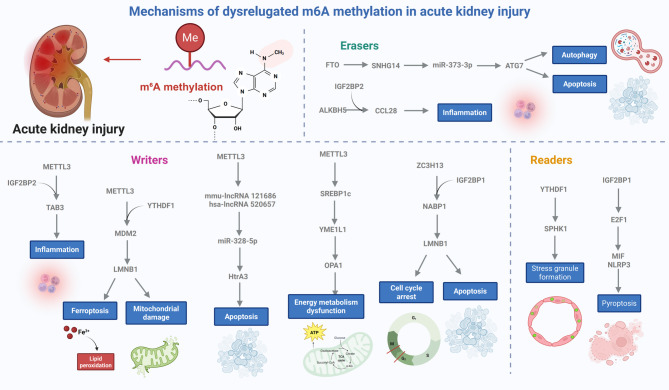
N-methyladenosine (mA), the most abundant internal modification in eukaryotic messenger RNA (mRNA) and long noncoding RNA (lncRNA), is dynamically modulated by methyltransferases ("writers"), demethylases ("erasers"), and binding proteins ("readers"). As a central epitranscriptomic regulator, mA governs RNA stability, splicing, translation, and degradation, thereby orchestrating a wide range of physiological and pathological pathways. Accumulating evidence has underscored its pivotal involvement in the pathogenesis of kidney disorders. This review delineates the regulatory landscape of mA methylation across various kidney diseases, with emphasis on diabetic nephropathy (DN), acute kidney injury (AKI), chronic kidney disease (CKD), focal segmental glomerulosclerosis (FSGS), lupus nephritis (LN), hyperuricemic nephropathy (HN), autosomal dominant polycystic kidney disease (ADPKD), and clear cell renal cell carcinoma (ccRCC). Disease-specific alterations in mA levels and the expression patterns of core regulators, including METTL3, METTL14, FTO, ALKBH5, YTH domain proteins, and IGF2BPs, are systematically summarized. By elucidating their roles in inflammation, fibrosis, apoptosis, and metabolic imbalance, this review highlights the translational potential of mA-centric interventions and offers novel insights into epitranscriptomic regulation within renal pathophysiology.
N6-甲基腺苷(mA)是真核生物信使核糖核酸(mRNA)和长链非编码核糖核酸(lncRNA)中最丰富的内部修饰,其受到甲基转移酶(“书写者”)、去甲基化酶(“擦除者”)和结合蛋白(“阅读者”)的动态调控。作为一种核心的表观转录组调控因子,mA控制着RNA的稳定性、剪接、翻译和降解,从而协调广泛的生理和病理途径。越来越多的证据强调了其在肾脏疾病发病机制中的关键作用。本综述阐述了各种肾脏疾病中mA甲基化的调控情况,重点关注糖尿病肾病(DN)、急性肾损伤(AKI)、慢性肾脏病(CKD)、局灶节段性肾小球硬化症(FSGS)、狼疮性肾炎(LN)、高尿酸血症肾病(HN)、常染色体显性多囊肾病(ADPKD)和透明细胞肾细胞癌(ccRCC)。系统总结了mA水平以及包括METTL3、METTL14、FTO、ALKBH5、YTH结构域蛋白和IGF2BPs在内的核心调控因子表达模式的疾病特异性改变。通过阐明它们在炎症、纤维化、细胞凋亡和代谢失衡中的作用,本综述突出了以mA为中心的干预措施在转化医学方面的潜力,并为肾脏病理生理学中的表观转录组调控提供了新的见解。