Li Xueke, Luo Simin, Jiang Yifang, Ma Qiong, You Fengming, Kuang Qixuan, Fu Xi, Zheng Chuan
Traditional Chinese Medicine (TCM) Regulating Metabolic Diseases Key Laboratory of Sichuan Province, Hospital of Chengdu University of Traditional Chinese Medicine, Chengdu, Sichuan, China.
Oncology Teaching and Research Department, Chengdu University of Traditional Chinese Medicine, Chengdu, Sichuan, China.
Front Immunol. 2025 Jun 26;16:1563922. doi: 10.3389/fimmu.2025.1563922. eCollection 2025.
() has been identified as a causative factor in the progression of colon cancer. This study aims to integrate bulk RNA-seq with single-cell RNA-seq (scRNA-seq) to elucidate the molecular mechanisms by which facilitates colon cancer progression.
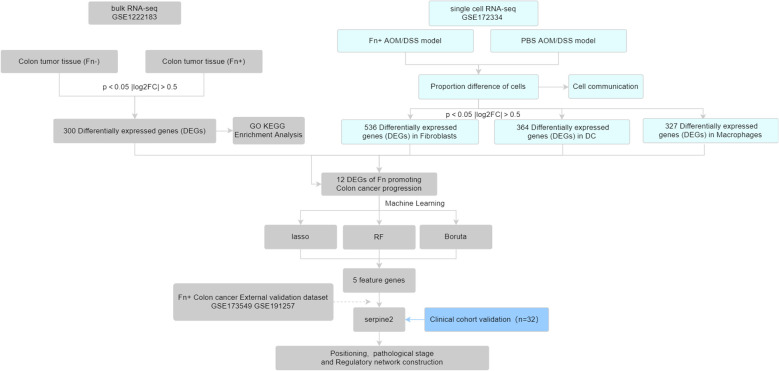
The scRNA-seq data from tumor tissues of intervention were analyzed to screen cells with significant proportion changes. Differentially expressed genes of cells with different proportions were extracted and intersected with those identified in the bulk RNA-seq analysis. Three machine learning algorithms were employed to identify characteristic genes. Clinical tissue samples and external datasets, along with co-culture experiments, were utilized to validate these findings.
Following intervention, there was an observed increase in the fibroblast iso-cellular ratio and interaction levels. Utilizing machine learning algorithms, we identified five key genes. The differential expression of Serpine2 was validated using clinical samples and external datasets. Furthermore, patients with metastatic colon cancer exhibited significantly higher Serpine2 expression compared to those without metastasis. was found to significantly enhance the expression of Serpine2 in fibroblasts and to promote the proliferation and migration capabilities of tumor cells.
This study elucidates the role of in promoting colon cancer progression through the enhancement of fibro-macrophage-epithelial cell interactions. Furthermore, Serpine2 has been identified as a potential molecular marker associated with -mediated colon cancer progression and metastasis. These findings contribute novel insights that may inform the development of therapeutic strategies for colon cancer.
()已被确定为结肠癌进展的一个致病因素。本研究旨在整合批量RNA测序与单细胞RNA测序(scRNA-seq),以阐明()促进结肠癌进展的分子机制。
分析来自()干预的肿瘤组织的scRNA-seq数据,以筛选具有显著比例变化的细胞。提取不同比例细胞的差异表达基因,并与批量RNA-seq分析中鉴定的基因进行交集分析。采用三种机器学习算法来识别特征基因。利用临床组织样本和外部数据集以及()共培养实验来验证这些发现。
在()干预后,观察到成纤维细胞异细胞比例和相互作用水平增加。利用机器学习算法,我们鉴定出五个关键基因。使用临床样本和外部数据集验证了Serpine2的差异表达。此外,与无转移的患者相比,转移性结肠癌患者的Serpine2表达显著更高。()被发现可显著增强成纤维细胞中Serpine2的表达,并促进肿瘤细胞的增殖和迁移能力。
本研究阐明了()通过增强成纤维细胞-巨噬细胞-上皮细胞相互作用在促进结肠癌进展中的作用。此外,Serpine2已被确定为与()介导的结肠癌进展和转移相关的潜在分子标志物。这些发现提供了新的见解,可能为结肠癌治疗策略的开发提供信息。