Chen Yuting, Lu Weitao, Liao Ruilian, Zhang Ximin, Chen Wang, Wang Jing, Feng Huancun
Department of Pharmacy, Guangzhou Red Cross Hospital of Jinan University, Guangzhou, Guangdong, China.
School of Pharmaceutical sciences, Southern Medical University, Guangzhou, Guangdong, China.
PLoS One. 2025 Jul 11;20(7):e0327842. doi: 10.1371/journal.pone.0327842. eCollection 2025.
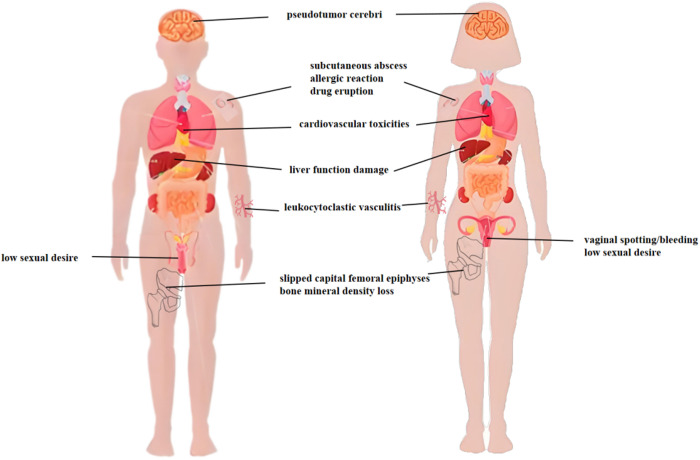
Long-acting Gonadotropin-releasing hormone analogs(GnRHa), including leuprolide, goserelin, histrelin, buserelin, triptorelin, have been widely used for a variety of diseases including prostate cancer, breast cancer, endometriosis, uterine leiomyomas, and central precocious puberty (CPP). However, their real-world safety profile differences have not been adequately compared.
We aimed to investigate the adverse event (AE) profile differences of long-acting GnRHa reported by the US Food and Drug Administration Adverse Event Reporting System (FAERS).
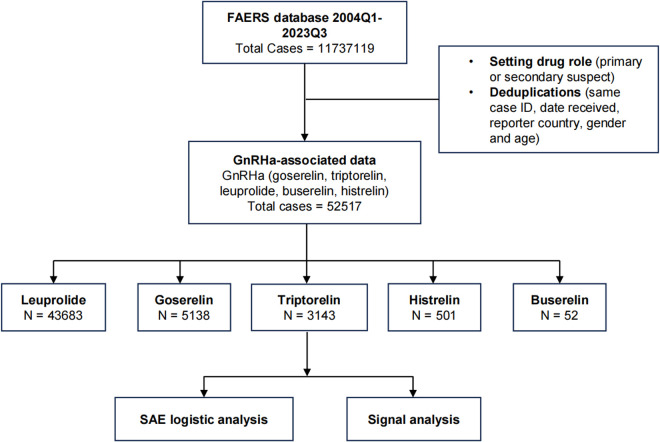
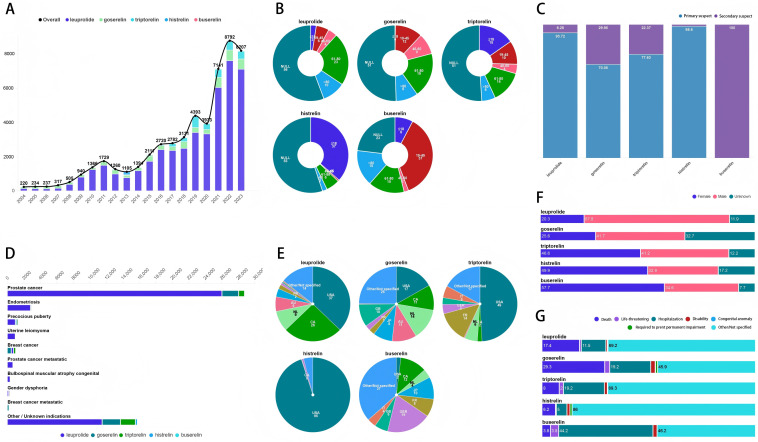
All indications were searched long-acting GnRHa, as primary suspect drugs, from FAERS data (January 2004 to September 2023). We performed disproportionality analyses by reporting odds ratios (ROR) and conducted univariate and multivariate logistical regression analyses to determine the odds ratio (OR) of serious AEs associated with long-acting GnRHa under different exposure factors.
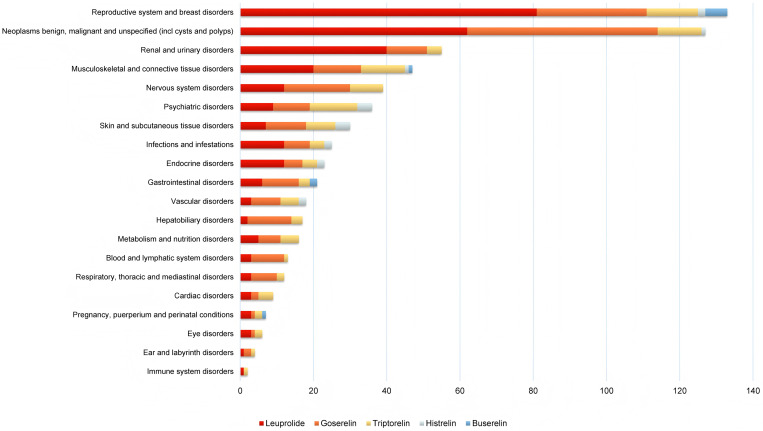
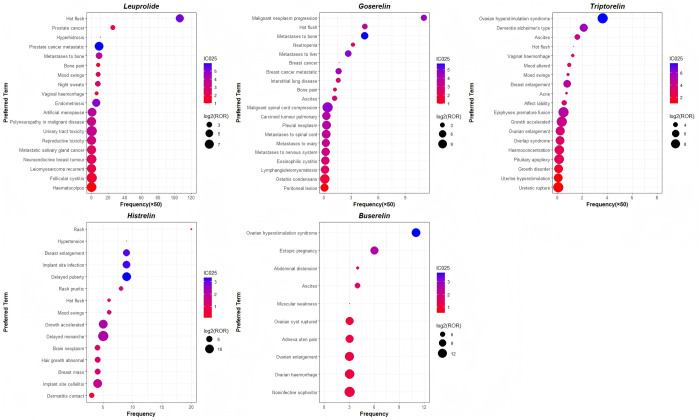
Reproductive system and breast disorders accounted for the greatest proportion of adverse events among the five long-acting GnRHa formulations analyzed. Both buserelin and histrelin showed distinct adverse effect profiles, with buserelin demonstrating a higher incidence of gastrointestinal disorders and histrelin showing a greater propensity for psychiatric disorders. Logistic regression analysis revealed these five medications carried an elevated risk of significant medical events, and this risk was notably lower in pediatric patients (<18 years) compared to adult populations (≥18 years).
Significant disparities exist between the adverse event profiles of long-acting GnRHa. The identification of high-risk factors and the enhancement of AEs monitoring are crucial during clinical application.
长效促性腺激素释放激素类似物(GnRHa),包括亮丙瑞林、戈舍瑞林、组氨瑞林、布舍瑞林、曲普瑞林,已广泛用于多种疾病,包括前列腺癌、乳腺癌、子宫内膜异位症、子宫肌瘤和中枢性性早熟(CPP)。然而,它们在现实世界中的安全性差异尚未得到充分比较。
我们旨在调查美国食品药品监督管理局不良事件报告系统(FAERS)报告的长效GnRHa的不良事件(AE)差异。
从FAERS数据(2004年1月至2023年9月)中搜索所有将长效GnRHa作为主要可疑药物的适应症。我们通过报告比值比(ROR)进行不成比例分析,并进行单变量和多变量逻辑回归分析,以确定在不同暴露因素下与长效GnRHa相关的严重AE的比值比(OR)。
在所分析的五种长效GnRHa制剂中,生殖系统和乳腺疾病占不良事件的比例最大。布舍瑞林和组氨瑞林均表现出独特的不良反应谱,布舍瑞林胃肠道疾病发生率较高,组氨瑞林精神疾病倾向较大。逻辑回归分析显示,这五种药物发生重大医疗事件的风险升高,与成人(≥18岁)相比,儿科患者(<18岁)的这种风险明显较低。
长效GnRHa的不良事件谱存在显著差异。在临床应用中识别高危因素并加强AE监测至关重要。