Jemelen Emilien, Orchard Francisco, Madie William, Valentin Bernard, Belin Josine, Laas Enora, Jeannerod Guillaume, Mares Pierre, Katsahian Sandrine, Guilloux Agathe
French Institute for Research in Computer Science and Automation (INRIA), Paris, France.
Data Science Department, Epiconcept, Paris, France.
Sci Rep. 2025 Jul 11;15(1):25096. doi: 10.1038/s41598-025-10115-w.
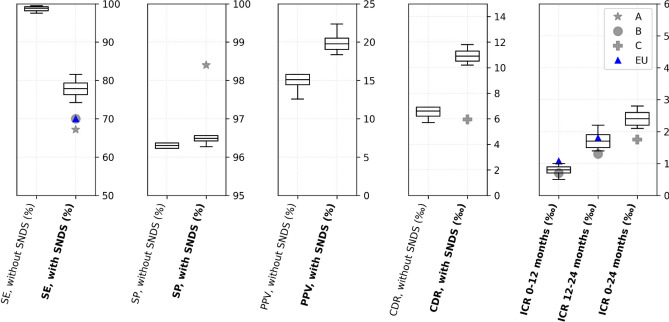
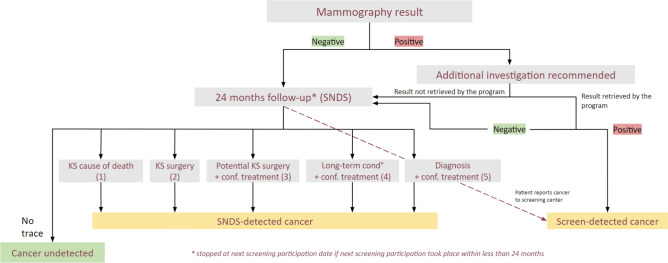
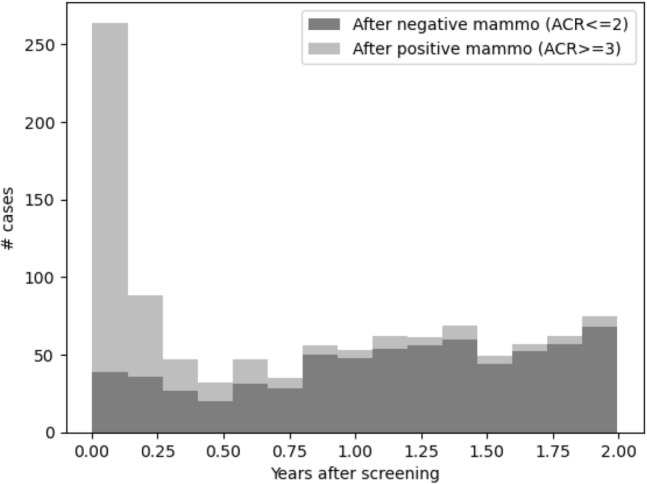
The French Breast Cancer Screening Program (DOCS) was created to detect early Breast Cancer (BC). Key performance indicators for digital mammography include sensitivity (SE), positive predictive value (PPV), interval cancer rate (ICR) and cancer detection rate (CDR). Calculating these metrics requires a linkage between screening data and BC registries; however, registries are scarce in France and often inaccessible for research. We therefore used medico-administrative data as an alternative. We linked regional screening data to the French National Health Data System (SNDS) between 2011 and 2020. Women were followed for 24 months post-screening. Screen-detected cancers and those identified with the SNDS were included. Performance metrics were calculated based on these linked datasets. A total of 252,786 screening exams were analyzed, covering 29,661-33,447 screenings annually, with a mean age of 61 years. SE was 77.9% (95% CI 76.3-79.3), indicating that approximately four in five cancers were detected through mammography. PPV was 19.8% (95% CI 19-20.5), meaning that one in five women with a positive screening test were confirmed with cancer within 24 months. CDR was 10.9 per 1000 exams (95% CI 10.5-11.3), equating to one detected case per 100 screenings. ICR was 2.4 per 1000 exams (95% CI 2.2-2.6), meaning that more than two interval cancers were detected per 1000 screenings. This identification approach using medico-administrative data offers a reproducible alternative for regions where cancer registries are unavailable. A future study applying this methodology in a registry-covered region could further validate the effectiveness of linking screenings to SNDS data for systematic cancer identification.
法国乳腺癌筛查项目(DOCS)旨在检测早期乳腺癌(BC)。数字乳腺摄影的关键性能指标包括敏感度(SE)、阳性预测值(PPV)、间期癌发病率(ICR)和癌症检测率(CDR)。计算这些指标需要将筛查数据与乳腺癌登记处相联系;然而,法国的登记处很少,且研究人员通常无法获取。因此,我们使用医疗行政数据作为替代。我们将2011年至2020年期间的区域筛查数据与法国国家卫生数据系统(SNDS)相联系。对女性进行了筛查后24个月的随访。纳入了筛查发现的癌症以及通过SNDS识别出的癌症。基于这些关联数据集计算性能指标。共分析了252,786次筛查检查,每年覆盖29,661 - 33,447次筛查,平均年龄为61岁。敏感度为77.9%(95%置信区间76.3 - 79.3),表明约五分之四的癌症是通过乳腺摄影检测出来的。阳性预测值为19.8%(95%置信区间19 - 20.5),意味着筛查结果呈阳性的女性中,五分之一在24个月内被确诊患有癌症。癌症检测率为每1000次检查10.9例(95%置信区间10.5 - 11.3),相当于每100次筛查发现1例。间期癌发病率为每1000次检查2.4例(95%置信区间2.2 - 2.6),意味着每1000次筛查发现超过2例间期癌。这种使用医疗行政数据的识别方法为没有癌症登记处的地区提供了一种可重复的替代方法。未来在有登记处覆盖的地区应用这种方法的研究可以进一步验证将筛查与SNDS数据相联系以进行系统性癌症识别的有效性。