Agarwal Veenoo, Spalding Lisa, Martin Hilary, Darcey Ellie, Stone Jennifer, Redfern Andrew
Fiona Stanley Hospital, Murdoch, WA 6150, Australia.
School of Medicine, The University of Western Australia, Crawley, WA 6009, Australia.
Cancers (Basel). 2025 Jul 1;17(13):2214. doi: 10.3390/cancers17132214.
An inverse association between high mammographic breast density (MBD) and pathologic complete response (pCR) following neoadjuvant chemotherapy (NAC) for early breast cancer (EBC) has been reported. However, the relationship of MBD to relapse-free (RFS) and breast cancer-specific survival (BCSS) is unexplored. This study aims to validate the relationship between MBD and NAC pCR in EBC and to assess correlations with RFS and BCSS.
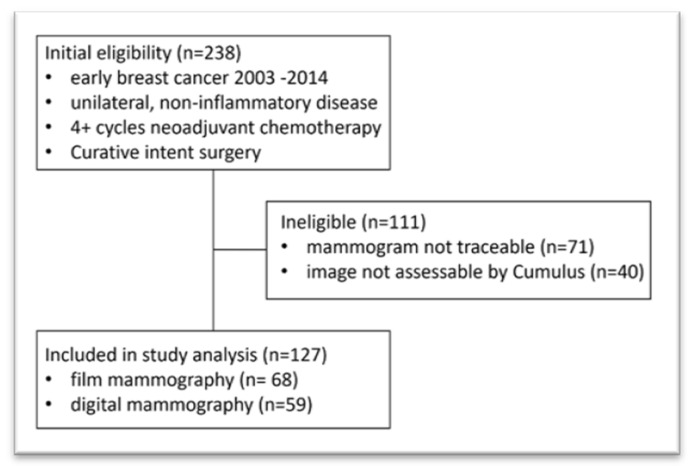
MATERIALS & METHODS: MBD was measured on contralateral mammograms in 127 women before NAC using Cumulus software. The percent dense area was correlated with patient and tumour characteristics, pCR, RFS and BCSS.
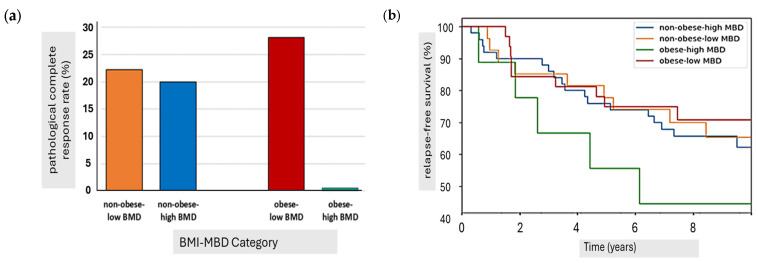
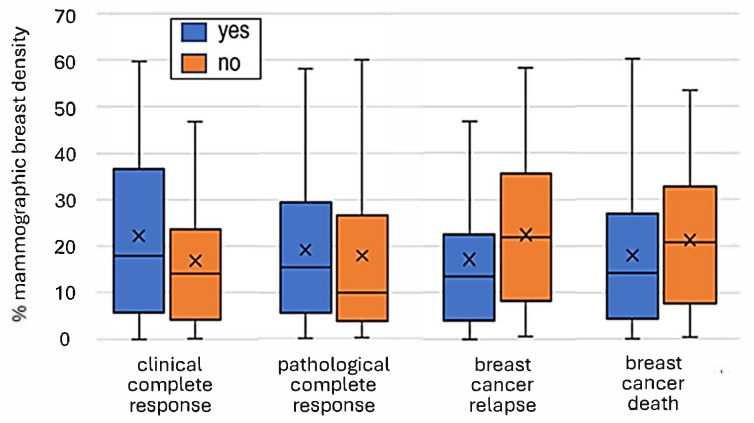
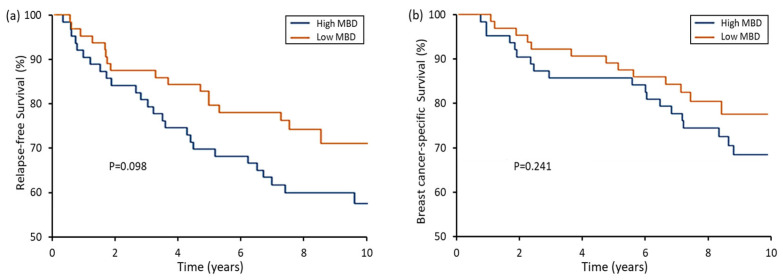
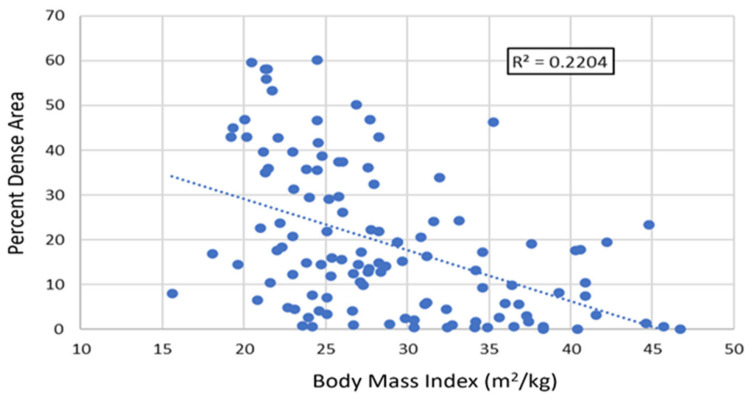
Mean MBD was higher in relapsing patients ( = 0.041) but did not vary by pCR or BC-deaths. As a dichotomous variable, no difference was seen between high and low MBD cohorts for pCR (17.5 vs. 25.0%, = 0.15), BC relapse (38 vs. 30%, = 0.15) or BC death (32 vs. 25%, = 0.20). A planned analysis by body mass index (BMI) demonstrated high MBD associated with lower pCR (0% vs. 28.1%, = 0.036) and trends for higher relapse (56% vs. 28%, = 0.063) and BC deaths (56 vs. 28%, ( = 0.071)) in obese patients. No relationship was observed in non-obese patients.
Obesity and high MBD may interact to cause chemoresistance. Further research in these patients is warranted.
已有报道称,早期乳腺癌(EBC)新辅助化疗(NAC)后,乳腺钼靶高密度(MBD)与病理完全缓解(pCR)呈负相关。然而,MBD与无复发生存期(RFS)及乳腺癌特异性生存期(BCSS)之间的关系尚未得到探讨。本研究旨在验证EBC中MBD与NAC pCR之间的关系,并评估其与RFS和BCSS的相关性。
使用Cumulus软件在127名女性患者NAC前的对侧乳房钼靶片上测量MBD。致密面积百分比与患者及肿瘤特征、pCR、RFS和BCSS相关。
复发患者的平均MBD较高(=0.041),但在pCR或乳腺癌死亡方面无差异。作为二分变量,高MBD组和低MBD组在pCR(17.5%对25.0%,=0.15)、乳腺癌复发(38%对30%,=0.15)或乳腺癌死亡(32%对25%,=0.20)方面均无差异。按体重指数(BMI)进行的计划分析显示,肥胖患者中高MBD与较低的pCR(0%对28.1%,=0.036)相关,且有复发率升高(56%对28%,=0.063)和乳腺癌死亡率升高(56%对28%,(=0.071))的趋势。在非肥胖患者中未观察到相关性。
肥胖和高MBD可能相互作用导致化疗耐药。有必要对这些患者进行进一步研究。